Showing posts with label Senate Judiciary Commitee. Show all posts

Friday, October 19, 2007

Mulkasey Compares U.S. Torture To Nazis

Attorney General nominee Michael Mukasey’s confirmation hearings got underway this morning, and Senate Judiciary Committee Chairman Pat Leahy (D-Vt.) explored Mukasey’s position on administration torture policies. His response was surprising.

Not only did Michael Mukasey repudiate the so-called 2002 “torture memo” signed by Office of Legal Counsel chief Jay Bybee — which appears to have survived in spirit, if not in letter — but he compared U.S. torture to the Holocaust. […]

The Bybee memo is “worse than a sin, it’s a mistake,” Mukasey said. He referenced the photographs taken by U.S. troops who liberated the Nazi concentration camps in 1945 to document the “barbarism” the U.S. opposed. “They didn’t do that so that we could then duplicate it ourselves.” Beyond legal restrictions barring torture clearly, torture is “antithetical to everything this country stands for.”

Greg Sargent had the same reaction I did — weren’t Republicans apoplectic when Sen. Dick Durbin (D-Ill.) said something similar two years ago?

One suspects the ensuing firestorm to Mukasey’s remarks will be a little less intense (which is to say, non-existent).


(In accordance with Title 17 U.S.C. Section 107, this material is distributed without profit to those who have expressed a prior interest in receiving the included information for research and educational purposes. I.U. has no affiliation whatsoever with the originator of this article nor is I.U endorsed or sponsored by the originator.)


The Nazis, Fascists and Communists were political parties before they became enemies of liberty and mass murderers.
Tuesday, August 14, 2007

Democrats to Continue Investigations


This might make me feel better if I had any hope at all that anything is going to come out of any of this. I'm not so sure anymore.

Investigations reveal one horror after another and still nothing happens. We go along as if we had never heard anything about Abu Ghraib, secret renditions, illegal wire-tapping, illegal wars, outing CIA NOCs, rigged elections, etc., etc.

Is anyone ever going to be held accountable for anything?

I am beginning to doubt it.


Democrats Continue to Seek Testimony From Rove

___

By Paul Kane
washingtonpost.com Staff Writer
Tuesday, August 14, 2007; A07


Congressional Democrats said yesterday that they will continue to demand the testimony of senior White House adviser Karl Rove about a range of sensitive policy matters even after he leaves the West Wing at the end of the month.

"Karl Rove's resignation will not stop our inquiry into the firings of the U.S. attorneys. He has every bit as much of a legal obligation to reveal the truth once he steps down as he does today," said Sen. Charles E. Schumer (D-N.Y.), who has helped lead the Senate Judiciary Committee's inquiry into the dismissals.

Rove's retirement announcement came 11 days after he refused to testify before the Judiciary Committee. While his actions figure in two other investigations on Capitol Hill, the Senate panel is the only committee that has subpoenaed Rove.

Aides to Judiciary Committee Chairman Patrick J. Leahy (D-Vt.) said he is considering whether to assert that a White House claim of immunity is not valid, which could lead to a committee vote next month holding Rove in contempt of Congress.

White House counsel Fred F. Fielding wrote in an Aug. 1 letter to Leahy that President Bush asserted that Rove, "as an immediate presidential adviser," was immune from testifying on any of his official activities. Fielding has offered to allow Rove and other current and former West Wing staff members to be interviewed behind closed doors, but not under oath.

Legal experts were divided on whether Rove's resignation heightens the likelihood of his testimony. Stanley Brand, former House general counsel, said the president's privilege claim will extend beyond Rove's days as a White House adviser. "He's too close to the king. This is the guy who's the king's alter ego," Brand said.

But Charles Tiefer, a constitutional scholar at the University of Baltimore, said some former White House staff members have testified in past confrontations, even though they claimed immunity while serving in the West Wing. Tiefer pointed to Oliver L. North, who declined to testify while still on President Reagan's National Security Council in 1986 but appeared in nationally televised hearings in 1987, after he had left the White House.

A rationale often used by White House staff for refusing to testify is that it interferes with an official's ability to advise the president, Tiefer said. "He can no longer say that an appearance would compromise his ongoing White House duties. It becomes more and more untenable for him to refuse to show up."


(In accordance with Title 17 U.S.C. Section 107, this material is distributed without profit to those who have expressed a prior interest in receiving the included information for research and educational purposes. I.U. has no affiliation whatsoever with the originator of this article nor is I.U endorsed or sponsored by the originator.)

The Nazis, Fascists and Communists were political parties before they became enemies of liberty and mass murderers.

Saturday, August 4, 2007

The Most Corrupt-To-The-Core Addminstration Ever

Bush Aide Addresses Missing RNC E-Mails

At Senate Hearing, Jennings Is Silent on U.S. Attorneys' Firings; Rove Is Absent

By Paul Kane
washingtonpost.com Staff Writer
Friday, August 3, 2007; A02

A young White House political aide was grilled inconclusively by the Senate Judiciary Committee yesterday about the firings of U.S. attorneys after Karl Rove, the president's senior political adviser, failed to show up at the committee's hearing in response to a subpoena.

J. Scott Jennings, 29, the deputy political director for the White House, refused to address the firings but tried to explain how thousands -- or possibly millions -- of White House e-mails to and from the political office were transmitted only through communications accounts controlled by the Republican National Committee.

That use of the RNC accounts put some of the political office's messages outside the reach of the National Archives, which sought to preserve them under a federal law mandating eventual public access, and the reach of Democratic congressional investigators, who have sought to look at them for evidence of improper actions.

Jennings offered a stripped-down explanation: He wanted a White House-supplied BlackBerry and was told no, and so he got one from the RNC, as many other political affairs aides had done. "I was receiving a lot of e-mail on my official account. And I requested [a BlackBerry] at that moment, and I was told that it wasn't the custom to give political affairs staffers those devices," Jennings said.

Jennings, 29, appeared as part of the panel's ongoing investigation into the firings of nine U.S. attorneys last year as well as other allegations of politicization at the Justice Department, a probe that has created offshoot inquiries into whether the Bush White House violated laws restricting political activity by federal employees.

In e-mails among top Justice staffers, obtained by the committee months ago, Jennings figured prominently in discussions about at least two of the ousted U.S. attorneys. But Jennings cited Bush's claim of "executive privilege" in refusing to answer questions about it. Rove, whose RNC e-mail address shows up on some of the e-mails discussing the firings, cited the same privilege claim in refusing to appear.

"Where is Karl Rove? Why is he hiding? Why does he throw a young staffer like you into the line of fire while he hides behind the White House curtains?" Sen. Richard J. Durbin (D-Ill.) asked Jennings, who said that he spoke several times a day with Rove.

Jennings's testimony on the RNC e-mails was the most detailed explanation to date of why President Bush's top political aides had sent and received so many e-mails on their RNC accounts. House Oversight Committee Chairman Henry A. Waxman (D-Calif.) is probing whether the use of RNC e-mails for official purposes violated federal laws requiring presidential records to be preserved.

The RNC told Waxman recently that it has more than 200,000 e-mails sent and received by Rove, Jennings and Sara M. Taylor, the former White House political director.

Bush spokesman Scott Stanzel has said that aides such as Jennings and Rove, whose jobs required them to deal with outside political groups on a regular basis, were trying to avoid violating Hatch Act provisions forbidding federal property to be used for political purposes. But Stanzel added that the White House has issued a new policy on e-mail usage, directing aides to more carefully consider records preservation rules.

Jennings also confirmed that he has given more than 10 briefings to political appointees at federal agencies about the election prospects for Republican candidates. Jennings said the meetings were merely meant to thank the appointees and boost their morale, not to suggest they steer federal contracts and decisions for political purposes.


(In accordance with Title 17 U.S.C. Section 107, this material is distributed without profit to those who have expressed a prior interest in receiving the included information for research and educational purposes. I.U. has no affiliation whatsoever with the originator of this article nor is I.U endorsed or sponsored by the originator.)


The Nazis, Fascists and Communists were political parties before they became enemies of liberty and mass murderers.

Thursday, August 2, 2007

The Very Untouchable Mr. Rove


Bush Won't Let Rove Testify to Congress
Reuters

Wednesday 01 August 2007

Citing executive privilege, President George W. Bush on Wednesday rejected a subpoena for his close adviser Karl Rove to testify to the Senate Judiciary Committee in a probe over fired federal prosecutors.

The committee had subpoenaed Rove to testify at a hearing on Thursday morning in its investigation of the firing last year of nine federal prosecutors, which critics said was prompted by partisan politics.

"Mr. Rove, as an immediate presidential advisor, is immune from compelled congressional testimony about matters that arose during his tenure and that relate to his official duties in that capacity," White House Counsel Fred Fielding wrote in a letter to Senate Judiciary Chairman Patrick Leahy, a Vermont Democrat. Leahy made the letter available to Reuters.

Bush's move sets up a possible court showdown between the White House and Democratic lawmakers, who have also sought to force other Bush aides to testify and demanded documents it says the White House is not releasing.

Democrats say the firings may have been intended to influence investigations of Democratic or Republican lawmakers.

U.S. Attorney General Alberto Gonzales, who signed off on the firings, also faces a possible perjury investigation over the truthfulness of his testimony to Congress.

Bush and Gonzales have said the dismissals were justified but mishandled. With the support of Bush, Gonzales has rejected bipartisan calls to resign.


(In accordance with Title 17 U.S.C. Section 107, this material is distributed without profit to those who have expressed a prior interest in receiving the included information for research and educational purposes. I.U. has no affiliation whatsoever with the originator of this article nor is I.U endorsed or sponsored by the originator.)

The Nazis, Fascists and Communists were political parties before they became enemies of liberty and mass murderers.

Friday, July 27, 2007

Rover Gets His Subpoena

At least one was issued, but Old Rover might be hiding from it...maybe in one of Cheney's hidey holes.

I bet Rover has an underground political bunker somewhere in a cave in the mountains of Maryland.

Just kidding....I think.

Rove is THE untouchable, unelected official in the White House (that is if one believes that any of them were elected, which we don't, but let's pretend for a moment the Bush myth that Bush and Cheney actually were elected is true).

Karl Rove will never honor a subpoena from Congress...not in this lifetime.. They might as well go ahead and write up the contempt citation.

What if everyone in the United States, just for one week, acted like the Bushites?

They seem to believe what Nixon said. If the president does it it's legal. Well, if it's legal, it's legal.

Everyone who works for this administration is acting as an agent of the president, therefore everything they do must also be lawful.

So, forget showing up for court America! Screw subpoenas. Refuse to talk to anyone with any authority and if you do, lie your ass off. After all, you will only be following Dear Leader's example of how to conduct yourself as a patriotic America.

Leahy issues subpoena for Rove
July 26, 2007

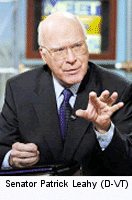
Senate Judiciary Committee Chairman Patrick Leahy (D-Vt.) Thursday issued a subpoena for top White House adviser Karl Rove to compel him to testify about the firing of several U.S. attorneys.

“The evidence shows that senior White House political operatives were focused on the political impact of federal prosecutions and whether federal prosecutors were doing enough to bring partisan voter fraud and corruption cases,” Leahy said. “It is obvious that the reasons given for the firings of these prosecutors were contrived as part of a cover-up and that the stonewalling by the White House is part and parcel of that same effort.”

Leahy issued the subpoenas, one to Rove and one to White House aide Scott Jennings, after consulting with Sen. Arlen Specter (R-Pa.), the committee’s ranking member.

“The Bush-Cheney White House continues to place great strains on our constitutional system of checks and balances,” Leahy added. “Not since the darkest days of the Nixon administration have we seen efforts to corrupt federal law enforcement for partisan political gain and such efforts to avoid accountability.”

The move is a further escalation of the constitutional battle between Congress and the White House over whether Bush administration officials must provide testimony and documents to legislative branch investigators.

Leahy said he is not taking this step lightly and only decided to proceed after “[exhausting] every avenue seeking the voluntary cooperation of Karl Rove and J. Scott Jennings.”

The Judiciary Committee chairman concluded that the investigation has “reached a point where the accumulated evidence shows that political considerations factored into the unprecedented firing of at least nine United States attorneys last year.”

In a letter to Rove, Leahy gives the White House official a week to appear before the panel and testify under oath.

“I hope that the White House takes this opportunity to reconsider its blanket claim of executive privilege, especially in light of the testimony that the President was not involved in the dismissals of these U.S. Attorneys,” Leahy said in his letter. “I am left to ask what the White House is so intent on hiding that it cannot even identify the documents, the dates, the authors and recipients that they claim are privileged.”


(In accordance with Title 17 U.S.C. Section 107, this material is distributed without profit to those who have expressed a prior interest in receiving the included information for research and educational purposes. I.U. has no affiliation whatsoever with the originator of this article nor is I.U endorsed or sponsored by the originator.)

The Nazis, Fascists and Communists were political parties before they became enemies of liberty and mass murderers.
Wednesday, July 25, 2007

Gonzo Just Keeps On Digging

(I wonder if has occurred to any of the Bushite gang of thugs that they are digging the grave of the GOP)

Just when it seemed that Attorney General Alberto Gonzales' reputation on Capitol Hill couldn't possibly get much worse, he showed up Tuesday for yet another hearing. And as with so many of his recent appearances before Congress, his testimony before the Senate Judiciary Committee raised a lot more troubling questions than it answered — not just about his own conduct of and honesty about the U.S. Attorney firings, but also about the Administration's domestic intelligence gathering programs.

That new wrinkle stemmed from Gonzales' testy exchange with Senator Arlen Specter, the panel's top Republican. Specter opened up with former Deputy Attorney General James Comey's testimony to the panel in May over Gonzales' actions while serving as White House Counsel. Comey had alleged that Gonzales tried to convince an ailing Attorney General John Ashcroft, who was in the hospital recovering from gallbladder surgery, to sign off on Bush's warrantless wiretapping program. "There are no rules saying he couldn't take back authority," Gonzales said, trying to explain that they had hoped Ashcroft might be able to sign off on an intelligence program due to expire the next day, a program that Comey as acting AG had refused to renew.

But what Specter really wanted to know was how that meeting squared with Gonzales' previous testimony that there had been no serious internal disagreements over the program. Gonzales seemed to believe he had a simple explanation. "The disagreement that occurred was about other intelligence activities, and the reason for the visit to the hospital was about other intelligence activities," the Attorney General said. "It was not about the terrorist surveillance program that the president announced to the American people."

Both Specter and later Senator Chuck Schumer latched onto Gonzales' puzzling comment. Schumer in particular brought up several examples where in sworn testimony Gonzales has named the Terrorist Surveillance Program as the one at issue during the hospital visit to Ashcroft's room. Committee Chairman Patrick Leahy then ordered a complete review of Gonzales' statements to the committee. "This is such a significant and major point," Leahy said. "There's a discrepancy here in sworn testimony and we're going to find out who's telling the truth."

Specter later circled back to Gonzales on the matter, warning him: "My suggestion to you is you review your testimony to find out if your credibility has been breached to the point of being actionable," Specter said. The maximum penalty for being caught lying to Congress is five years in prison and a fine of $250,000 per count. Specter wryly noted to reporters during a break that there is a jail in the Capitol complex.

Senator Jay Rockefeller, the top Democrat on the Intelligence Committee, who was involved in the briefings at the time of the hospital visit, said the so-called Gang of Eight — the eight top bipartisan members of Congress on intelligence issues — were not briefed about any sunset the program was facing, as Gonzales claimed. He also emphatically refuted Gonzales' statements that there was more than one program under discussion at the time and that the Gang of Eight had agreed the program was so important that if it had been allowed to lapse they were considering emergency legislation.

"Once again he's making up something to protect himself and creating situations that never happened," Rockefeller said, adding that "based on what I know about it, I'd have to say" Gonzales has committed perjury.

Gonzales' woes actually began even before he was sworn in. He took his seat as a protestor held a pink banner reading "Impeach" behind him and to yells of "Impeach him!" from protesters in the room, who were quickly escorted out. Specter threatened the appointment of a special prosecutor to look into the firings of the eight U.S. Attorneys last year and a Senate "trial" to hold in contempt those Administration officials refusing to comply with Senate subpoenas. Then Leahy gaveled in the proceedings, saying "the Attorney General has lost the confidence of the Congress and the American people." ( When asked about Specter's threat of holding a Senate trial on contempt citations, Senator Trent Lott, the No. 2 Senator Republican, said he didn't "believe that's necessary," adding he intended to speak with Specter about the issue.)

In his opening statement, Gonzales underlined all the important work the department is still engaged in, highlighting its hunt for sexual predators and its role in the war on terror. But when asked by Senator Herb Kohl, a Wisconsin Democrat, if his presence is more detrimental than helpful Gonzales said: "Ultimately, I have to decide is it better for me to leave: I've decided to stay and fix the problem and that's what I'm doing," he said over guffaws from hearing attendees. "We're bringing in good experienced people. We've changed policies, we've been made aware with some of the problems with our policies."

Much of Gonzales' time was spent telling the committee he couldn't remember, wasn't up to date or wasn't at liberty to discuss the details on everything from the department's controversial settlement with the makers of Oxycotin, a drug believed responsible for dozens of deaths and his consideration of death penalty cases. to his involvement in drafting U.S. torture guidelines while working at the White House and why he apparently lied to a Senate panel over President George W. Bush's warrantless wiretapping programs.

When Specter asked Gonzales whether the President has the right to prohibit the Department of Justice from pursuing Congressional charges of contempt against former White House Counsel Harriet Miers and White House Chief of Staff Josh Bolten — the House Judiciary Committee tomorrow is expected to issue two contempt citations for their refusal, citing executive privilege, to comply with subpoenas to testify — Gonzales had a short lawyerly response. "I am recused of speaking on that matter due to the ongoing investigation," he said.

Later, when Senator Diane Feinstein, a California Democrat, asked how many names were on the list of U.S. Attorneys to be fired that he approved, he said he couldn't recall. "After all this time and all of the investigations into this, I find it hard to believe you can't remember," Feinstein quipped. "I'll have to get back to you on that," Gonzales said.

He couldn't remember answers for even the rare friendly inquisitors. After Senator Orrin Hatch, a Utah Republican, tried to prod him about how long Comey was in Ashcroft's room — hinting that maybe he hadn't really been present for much of the conversation — Gonzales replied, "I don't remember."


(In accordance with Title 17 U.S.C. Section 107, this material is distributed without profit to those who have expressed a prior interest in receiving the included information for research and educational purposes. I.U. has no affiliation whatsoever with the originator of this article nor is I.U endorsed or sponsored by the originator.)

The Nazis, Fascists and Communists were political parties before they became enemies of liberty and mass murderers.

Tuesday, July 24, 2007

Leahy Wants Straight Answers From Lil' Alberto

Yeah, good luck with that, Mr. Leahy.

Leahy Demands Straight Answers From Gonzales On Tuesday

Senator Patrick Leahy (D-VT), weary of fighting to get honest answers out of Attorney General Alberto Gonzales in the political firings of eight federal prosecutors, took the unexpected step last week of sending Gonzales a list of the questions he should expect when he appears before the Senate Judiciary Committee on Tuesday.

Leahy, the committee's Chairman, sent a letter to Gonzales on July 17 pointing out the number of times the embattled Attorney General said he could "not recall" in response to previous direct questioning on his department's operations and saying that he "would like to avoid a repeat of that performance."

"When you last testified before the Senate Judiciary Committee on April 19, 2007, you often responded to questions from Senators on both sides of the aisle that you could 'not recall,'" wrote Leahy in his letter to Gonzales. "By some counts, you failed to answer more than 100 questions, by other counts more than 70, and the most conservative count had you failing to provide answers well over 60 times. As a result, the Committee’s efforts to conduct oversight were hampered."

So Leahy sent questions in advance hoping to give Gonzales a week to think about some better responses to the questions surrounding the U.S. Attorney firings, National Security Letter abuses and the White House's warrantless domestic spying program.

According to Leahy's office, the Judiciary Chairman "put the Attorney General on notice that the Committee would expect answers on inconsistencies in the Attorney General’s public statements and testimony involving the firing of several U.S. Attorneys as well as the President’s warrantless wiretapping program" including the following:
  • "On April 19, you testified to the Senate Judiciary Committee that you had not spoken with anyone involved in the firings about that process because you did not want to interfere with the investigation. Again, on May 10, you testified to the House Judiciary Committee that you had not spoken with anyone involved in order to protect the integrity of the investigation. Then on May 23, Monica Goodling testified under oath before the House Judiciary Committee that she had an 'uncomfortable' conversation with you during which you outlined your recollection of what happened and asked her for her reaction to your version. Is Ms. Goodling’s testimony accurate, and if so, how do you account for your previous, uncorrected testimony to this Committee?"
  • "On April 19 you testified before this Committee that your former Chief of Staff Kyle Sampson was responsible for putting together the list of U.S. Attorneys to be fired. But on May 15, the day after Deputy Attorney General Paul McNulty announced his intention to resign, you said that the firings were largely Mr. McNulty’s responsibility. Mr. McNulty has said that he had very limited involvement in the decision of which U.S. Attorneys to fire. Please describe all of your interactions with Mr. McNulty related to the replacement of the nine U.S. Attorneys and your understanding of his role in deciding which U.S. Attorneys would be fired. Why has your description of who made the decisions, and who was most involved in the decision-making process, changed over time?"
  • "When you were asked on February 6, 2006 if any senior Justice Department officials, including your former deputy, James Comey, expressed concerns about the Bush Administration’s warrantless electronic surveillance program, you testified: 'I do not believe that these DOJ officials . . . had concerns about this program.' Mr. Comey subsequently testified on May 15, 2007 that on March 9, 2004, he informed you, as White House counsel, and others including the Vice President, that the Justice Department had concluded that the Administration’s warrantless electronic surveillance program did not have a legal basis. He testified that you and former White House Chief of Staff Andrew Card tried to circumvent him, in his role as Acting Attorney General, by rushing to the hospital bedside of ailing former Attorney General John Ashcroft to try to persuade him to certify the program. Please provide a full explanation for the legal authorization for the President’s warrantless electronic surveillance program in March and April 2004."
You can also expect some tough questioning from Russ Feingold (D-WI) who has long been in Gonzales's face about the illegal domestic spying program and was a leader in trying to secure a no-confidence vote on the Attorney General last month.

"I voted against Alberto Gonzales to be the Attorney General because I was not convinced he would put the rule of law, and the interests of the country, above those of the President and the Administration," said Feingold in June. "Unfortunately, those concerns have been realized over and over. He has failed in a very significant way. He should resign."

We'll see if the hearings on Tuesday move us closer to that point.


(In accordance with Title 17 U.S.C. Section 107, this material is distributed without profit to those who have expressed a prior interest in receiving the included information for research and educational purposes. I.U. has no affiliation whatsoever with the originator of this article nor is I.U endorsed or sponsored by the originator.)


The Nazis, Fascists and Communists were political parties before they became enemies of liberty and mass murderers.

Friday, June 29, 2007

The CIA Document Dump is Like The Twilight Zone

Lessons of the CIA 'Family Jewels'

The CIA says it has left its shady past behind. But has the agency learned from its mistakes—and how much has really changed?

One of the more intriguing items is an internal memo recording how the agency’s "Division D"—its supersecret eavesdropping branch—had begun intercepting telephone calls between suspected Latin American drug traffickers and individuals living in New York in late 1972.

A May 7, 1973, memo, entitled “Potentially Embarrassing Activities Conducted by Division D,” records that officials in the division had questions about “the legality of this activity.”
The reason for the concern: even though the phone calls involved at least one party outside the
United States, the agency was still eavesdropping on the conversations of citizens inside the country without a judicial warrant.

“This is totally relevant to what is going on today,” said Thomas Blanton, director of the National Security Archive, a nonprofit group that filed the original Freedom of Information Act request for the family jewels file 13 years ago.

Fallout From Release of the CIA's 'Family Jewels'

Blanton notes that the legal issues of concern to the Division D eavesdroppers are the same as those involved in the intense, ongoing debate about the legality of President Bush’s warrantless wiretapping program. The still-classified operation, in which the National Security Agency intercepted phone conversations between suspected foreign terrorists and individuals within the United States without judicial warrants, was first conducted under Hayden's leadership. (Just today, the Senate Judiciary Committee—frustrated by the Bush administration’s refusal to turn over key material about the program — subpoenaed documents about it, setting up a potential court clash.)

CONTINUED

(In accordance with Title 17 U.S.C. Section 107, this material is distributed without profit to those who have expressed a prior interest in receiving the included information for research and educational purposes. I.U. has no affiliation whatsoever with the originator of this article nor is I.U endorsed or sponsored by the originator.)

The Nazis, Fascists and Communists were political parties before they became enemies of liberty and mass murderers.

Thursday, May 3, 2007

Leahy, Fed Up! Issues Subpoena For Rove's Emails

WASHINGTON (CNN) -- The Senate Judiciary Committee chairman issued a subpoena Wednesday to Attorney General Alberto Gonzales in an attempt to get e-mails that President Bush's top political adviser sent regarding last year's firings of eight U.S. attorneys.
Gonzales will have to appear before the committee if the Department of Justice does not respond to the subpoena for Karl Rove's e-mails by May 15.

Justice Department Spokesman Dean Boyd said the department had received the subpoena and was reviewing it. (Read the subpoena, PDF)

"The Justice Department has already turned over more than 6,000 pages of documents and e-mails to House and Senate committees and voluntarily provided Congress with hours of interviews of several senior Justice Department officials," Boyd said. "Furthermore, the attorney general last month provided six hours of testimony to the Senate Judiciary Committee."

In a letter to Gonzales, Sen. Patrick Leahy, D-Vermont, said he had asked Gonzales twice for the e-mails -- once at an April 19 hearing where the attorney general testified about the dismissals and again in an April 25 letter to the Cabinet member.

Rove's attorney said publicly that the e-mails -- many of which were reported to be "lost" -- had been turned over to U.S. Attorney Patrick Fitzgerald, according to Leahy.

Fitzgerald was using them in his investigation into the leak of the identity of CIA operative Valerie Plame, Rove's lawyer said. That probe led to the conviction of Lewis "Scooter" Libby, the former chief of staff for Vice President Dick Cheney.

Leahy said when he questioned Gonzales about the location of the e-mails at the hearing, he said he would look into it and get back to the senator.

"You responded at the hearing that you did not know but would check and get back to me. I have not heard back from you since in response to my question or the letter," Leahy said in the letter.

"I also ask for an immediate response to and full compliance with the outstanding requests for information by the committee and its members to avoid further subpoenas," Leahy wrote.

Gonzales has been accused of dismissing seven prosecutors because of concerns that they were either not doing enough to prosecute Democrats on voter fraud charges or were doing too much in pursuing corruption charges against Republicans. The White House has denied the claims.
The Bush administration has acknowledged that the White House counsel's office did approve replacing an eighth prosecutor, as U.S. attorney in Arkansas, with a protege of Rove.

The president can legally replace U.S. attorneys but usually does so at the start of a term of office. The midterm firings sparked accusations that some of the dismissals were politically motivated.

Leahy has insisted Rove and other top aides to Bush must testify publicly and under oath before the committee about the prosecutors. He has rejected suggestions that Rove and other Bush officials be interviewed privately instead.

(In accordance with Title 17 U.S.C. Section 107, this material is distributed without profit to those who have expressed a prior interest in receiving the included information for research and educational purposes. I.U. has no affiliation whatsoever with the originator of this article nor is I.U endorsed or sponsored by the originator.)


The Nazis, Fascists and Communists were political parties before they became enemies of liberty and mass murderers.

Wednesday, May 2, 2007

Will W.H. Prefer A Weakened DOJ To Confirmation Hearings For Gonzo Replacement

Probably.

The Bushites have no real use for the law, as has been demontrated time and time again, unless they can use it against their enemies.

Enemies? Would that be Al Qaeda?

Well, of course not! That would be Democrats, libruls, progressives.....

That would also be folks like me, and probably you, who disagree with them on things like "torture as American Policy," starting wars of aggression and lying to the American people, their representatives and senators about it; lying to the entire world, as a matter of fact, thereby flushing whatever was left of America's reputation down the drain for generations to come, right along with the Constitution.

Confirmation hearings for his successor could spawn criminal investigations of the White House.
By Elizabeth Holtzman,

ELIZABETH HOLTZMAN, a former Democratic congresswoman from New York, is the coauthor of "The Impeachment of George W. Bush: A Practical Guide for Concerned Citizens."May 1, 2007


NO MATTER how many members of Congress lose confidence in Atty. Gen. Alberto R. Gonzales, President Bush is unlikely to let him go. If Gonzales resigns, the vacancy must be filled by a new presidential nominee, and the last thing the White House wants is a confirmation hearing.

Already, the Senate is outlining conditions for confirming a Gonzales successor. Sen. Patrick J. Leahy (D-Vt.), chairman of the Judiciary Committee, has said that his panel would not hold confirmation hearings unless Karl Rove and other White House aides testify about the firing of U.S. attorneys to clarify whether "the White House has interfered with prosecution."

All this is reminiscent of the Watergate scandal.

In 1973, as the coverup was unraveling, the Senate imposed a condition on the confirmation of President Nixon's nominee for attorney general, Elliot Richardson. Richardson's predecessor had resigned because of Watergate troubles. Concerned that the Justice Department would not get at the truth, the Senate insisted that Richardson would name a special prosecutor to investigate Watergate. Richardson duly appointed Archibald Cox. The rest is history.

Cox's aggressive investigations led to the prosecution of top administration officials and the naming of Nixon as an unindicted co-conspirator in the coverup. When Cox sought White House tapes of Nixon's conversations with his staff, the president had him fired, unleashing a firestorm of protests.

Americans demanded that a previously reluctant Congress start impeachment proceedings against Nixon. Congress complied; the House Judiciary Committee, of which I was a member, voted for impeachment, and Nixon resigned.

Aspects of this history could easily repeat themselves. The Senate could demand, as it did in 1973, that a new attorney general appoint a special prosecutor, and this could again have dire consequences for the White House.

A new special prosecutor would have many questions to investigate.

For starters, were any of the firings of U.S. attorneys federal crimes — such as obstruction of justice, designed to stymie investigations or to retaliate for prosecutions of Republicans? If so, who is responsible and how high up does that responsibility go? Did Deputy Atty. Gen. Paul J. McNulty, who gave inaccurate testimony to Congress about the firings, commit any crime in doing so? Were those who briefed him for that testimony complicit?And what happened to the missing e-mail messages from Rove and others? Did these apparent violations of the Presidential Records Act — failure to keep copies of the exchanges — constitute federal crimes?

So there is ample work for a special prosecutor. The Senate could call for appointing one without waiting for Gonzales to resign. But in that case, Gonzales or McNulty would be making the appointment, and the integrity of the choice would be highly questionable.That leaves Senate confirmation hearings of a new attorney general nominee as the main leverage for Congress to secure an independent criminal investigation of the U.S. attorney firings.Moreover, the Senate might use such hearings to do more than secure testimony from White House aides about the firings, as Leahy indicated.

It also might use the opportunity to probe the Justice Department's role in mistreatment of detainees, four years of flouting the Foreign Intelligence Surveillance Act and other serious matters.

Rather than face such scrutiny, the White House may prefer keeping a drastically weakened Gonzales in place. But doing so exacts a high price for the Justice Department and the nation. It damages department morale and credibility, undermines its ability to recruit and could affect perceptions of federal prosecutors, jeopardizing important cases. By retaining Gonzales to preempt Senate action, the president has signaled that this is a price he is willing to make the nation pay.

(In accordance with Title 17 U.S.C. Section 107, this material is distributed without profit to those who have expressed a prior interest in receiving the included information for research and educational purposes. I.U. has no affiliation whatsoever with the originator of this article nor is I.U endorsed or sponsored by the originator.)

The Nazis, Fascists and Communists were political parties before they became enemies of liberty and mass murderers.

Saturday, April 21, 2007

What is it with D.C. and Memory Problems?


Is there something in the water supply?

Alzhiemer's seems to be rife in the Republican Party ever since Reagan!
Is it contagious?

People with memories this bad should be forced to resign for health reasons, if nothing else.

Gonzales Can't Recall Meetings That Led to Attorney Firings

By Jason Leopold t r u t h o u t Report

Thursday 19 April 2007

Embattled Attorney General Alberto Gonzales testified Thursday before a Senate committee that he could not recall the details of any of the meetings he participated in over the course of two years, in which he and his staff discussed a plan to fire eight US attorneys.

"I have searched my memory," Gonzales said, in response to a question by Sen. Jeff Sessions (R-Alabama) about one meeting Gonzales attended in November 2006 when he discussed the firings. "I have no recollection of the meeting.... I don't remember the contents of this meeting."


Gonzales was visibly defensive as a frustrated group of bipartisan senators pounded the attorney general with some tough questions about his role in firings. Throughout the daylong hearing, Gonzales testified more than 70 times that he could not recall any part of the conversations or details of the backdoor meetings he had with White House officials or members of his staff surrounding the questionable dismissals of the US attorneys. He added that he could not recall whether he had certain conversations over the telephone or in person.

Immediately following Gonzales's testimony, Sen. Chuck Schumer D-New York) said that if Gonzales wanted to restore integrity and credibility to the Department of Justice, he would "look into his heart, he would march over to Pennsylvania Avenue and submit his resignation."

The hearing began Thursday morning with an impassioned opening statement by Senate Judiciary Chairman Patrick Leahy, who said the Department of Justice has been "experiencing a crisis of leadership perhaps unrivaled during its 137-year history.

"There is the growing scandal swirling around the dismissal and replacement of several prosecutors, and persistent efforts to undermine and marginalize career lawyers in the Civil Rights Division and elsewhere in the department," Leahy said. "Since Attorney General Gonzales last appeared before this committee on January 18, we have heard sworn testimony from the former US attorneys forced from office and from his former chief of staff. Their testimony sharply contradicts the accounts of the plan to replace US attorneys that the attorney general provided to this committee under oath in January and to the American people during his March 13 press conference."

In his opening statement, Gonzales said he has "nothing to hide," but senators from both parties said Gonzales's failure to provide answers to their questions about why the attorneys were fired and how the plan to oust them was conceived left them with no choice but to conclude Gonzales was being less than truthful in his testimony, and to demand that he immediately resign.

Gonzales said he did not see how his resignation would solve the matter. He said he stood behind the decision to fire the attorneys because some of them were not tough on voter fraud or immigration issues and other performance-related issues. However, Justice Department documents released over the past few months show that the US attorneys in question had impeccable evaluations from their superiors. Still, if he had to do it over, Gonzales said, he would fire the attorneys again.

"At the end of the day, I know I did not do anything improper," Gonzales said.

But Sen. Lindsey Graham (R-South Carolina) told Gonzales he believed that the attorney general and Justice Department staffers had fabricated a story about the US attorneys' job performance in order to justify the purge.

Graham added that it was clear to him that some of the [US attorneys] had personality problems with people in the White House, and there was no truth, in his opinion, that the attorneys had performed poorly.

Thursday's testimony was seen as crucial in order for Gonzales to keep his job. Immediately after the committee adjourned, White House spokeswoman Dana Perino said President Bush still "has full confidence" in Gonzales's ability to perform his job as attorney general.

Sen. Chuck Schumer (D-New York), however, said Gonzales "made the case that he shouldn't stay."

"He took 20 steps back," Schumer told reporters at the conclusion of Gonzales's testimony.

"Republicans agree. He was dodging and weaving. Today's hearing set the White House cause back. It's hard to believe after today's performance the White House would want him to stay on."

Schumer said Gonzales's testimony did not answer lingering questions about why the US attorneys were fired, how they came to be included on a list prior to their dismissal last year, and what role White House political adviser Karl Rove and former White House counsel Harriet Miers played in the ordeal. The White House, citing executive privilege, has refused to allow Rove and Miers to testify under oath and with a public record of their testimony.

"I think it's really important to hear from Rove and Miers," Schumer said. "I think what happened today strengthens the case for Rove and Miers to come forward with transcripts.

Schumer said that, despite the fact that the committee could not get answers to their questions from Gonzales, they will continue to pursue the case.

"One thing I can assure you of is this is not over," Schumer said. "Far from it. There [are] so many loose ends in terms of their privilege argument. The claims of privilege almost never work. If you look at the times [the issue of executive privilege] has gone to court, it is usually resolved in months, not years," meaning the senator will pursue the issue, even if the committee fails to come to an agreement with the White House on Rove's and Miers's testimony and it ends up in court.

Jason Leopold is a former Los Angeles bureau chief for Dow Jones Newswire. He has written over 2,000 stories on the California energy crisis and received the Dow Jones Journalist of the Year Award in 2001 for his coverage on the issue as well as a Project Censored award in 2004. Leopold also reported extensively on Enron's downfall and was the first journalist to land an interview with former Enron president Jeffrey Skilling following Enron's bankruptcy filing in December 2001. Leopold has appeared on CNBC and National Public Radio as an expert on energy policy and has also been the keynote speaker at more than two dozen energy industry conferences around the country.


(In accordance with Title 17 U.S.C. Section 107, this material is distributed without profit to those who have expressed a prior interest in receiving the included information for research and educational purposes. I.U. has no affiliation whatsoever with the originator of this article nor is I.U endorsed or sponsored by the originator.)


The Nazis, Fascists and Communists were political parties before they became enemies of liberty and mass murderers.