Showing posts with label Patrick Leahy. Show all posts

Thursday, September 18, 2008

Suspicions Continue In Anthrax Case


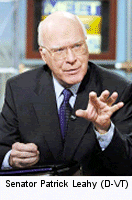
WASHINGTON (AP) — The chairman of the of Senate Judiciary Committee said Wednesday he does not believe that Dr. Bruce Ivins acted alone in the deadly 2001 anthrax attacks. Sen. Patrick Leahy was one of the targets of the lethal anthrax-laced letters that killed five and sickened 17 in fall 2001.


At a hearing in front of his committee, the Vermont Democrat told FBI Director Robert Mueller that he thinks other people must have been involved.


Leahy did not say why he believed Ivins had help and he also cast doubt that the Army scientist was the attacker in the first place.


"If he is the one who sent the letter, I do not believe in any way, shape or manner that he is the only person involved in this attack on Congress and the American people. I do not believe that at all," Leahy said.


He added: "I believe there are others involved, either as accessories before or accessories after the fact. I believe that there are others out there, I believe there are others who could be charged with murder. I just want you to know how I feel about it, as one of the people who was aimed at in the attack."


Mueller did not directly contradict Leahy, saying "I understand that concern."


Still, Mueller maintained the Justice Department's view that Ivins was the mastermind and sole attacker.


"In the investigation to date, we have looked at every lead and followed every lead to determine whether anybody else was involved, and we will continue to do so," Mueller told Leahy. "And even if the case does become closed, if we receive additional evidence, indicating the participation of any additional person, we certainly would pursue that."


The Justice Department and FBI have yet to close the case on the "Amerithrax" investigation after declaring Ivins its only suspect last month. Ivins killed himself in July after learning that prosecutors were preparing to indict him.


Republicans shared Leahy's doubts surrounding the case.


Sen. Arlen Specter of Pennsylvania, the top GOP member of the panel, said he had problems with some of the evidence against Ivins that has been made public. In a testy exchange with Mueller, he also demanded to have a say in selecting scientists who will be performing an independent review of the DNA fingerprinting analysis of the anthrax that lies at the heart of the government's case.


The review by the National Academy of Sciences will be made up of private scientists who did not assist the FBI in the investigation, and could take up to 18 months to complete. Mueller said he would consider allowing the Judiciary Committee to suggest scientists, but noted that the NAS and Justice Department likely would have to agree to it.


"What's there to consider, Director Mueller?" Specter said. "We'd like to have the authority to name some people there to be sure of its objectivity. We're not interlopers here. This is an oversight matter. What's there to consider?"


Mueller said "to the extent that the rules of the science allow that to happen, I have no objection to that request."


"Well, that's not far enough," Specter snapped.


NAS spokesman William Kearney said the organization would "welcome input on potential committee members" from Congress, federal agencies, scientific community and the general public. Still, all suggestions must be approved by the NAS president, Kearney said.


Sitting in the front row of the audience at the Senate hearing was Dr. Steven Hatfill, another Army scientist who for years was wrongly accused of orchestrating the attacks. The Justice Department in June settled a $5.8 million lawsuit with Hatfill, who claimed his privacy rights were violated by officials speaking with reporters about the case.


Sen. Charles Grassley, R-Iowa, a longtime skeptic of the anthrax investigation, grilled Mueller on how the FBI could have focused on Hatfill for years when investigators as early as 2002 had lab records showing Ivins was conducting late-night research in the days immediately before the deadly letters were mailed.


"Shouldn't the FBI apologize to Dr. Hatfill?" Grassley asked. "Please explain how chasing an innocent man for four years was not a mistake, as you said it was not a mistake."


Mueller said the FBI investigators acted appropriately throughout the case — based on the information they had at any given time.


Hatfill, smiling, left the hearing after Grassley's questions.


(In accordance with Title 17 U.S.C. Section 107, this material is distributed without profit to those who have expressed a prior interest in receiving the included information for research and educational purposes. I.U. has no affiliation whatsoever with the originator of this article nor is I.U endorsed or sponsored by the originator.)


The Nazis, Fascists and Communists were political parties before they became enemies of liberty and mass murderers.


Friday, November 30, 2007

Incontriverable Evidence Bush Not Involved In U.S. Attorney Mess

Therefore, the claim of executive privilege is out the window. If these criminal tricksters don't show up, hit 'em with contempt and send the capitol police to put them in jail until they honor the congressional subpoenas.

As far as Bush goes, he is does seem guilty of participating in the cover-up that followed.

Leahy: White House aides must comply with subpoenas

From Ted Barrett
CNN Washington Bureau
Decrease font

WASHINGTON (CNN) -- The chairman of the Senate Judiciary Committee rejected White House claims of executive privilege and demanded Thursday that key White House aides testify in the case of the controversial firings of U.S. attorneys.

art.leahy.afp.gi.jpg

Sen. Patrick Leahy ruled that president has no claim of executive privilege protecting Karl Rove and others.

The committee's investigation has found "significant and uncontroverted evidence that the president had no involvement in these firings," Sen. Patrick Leahy, D-Vermont, said. Thus, the White House can't claim executive privilege or immunity, which are meant to protect private communications between a president and White House aides, he ruled.

The committee has issued subpoenas for White House chief of staff Josh Bolten and former political adviser Karl Rove, among others.

The Bush administration has insisted that last year's firing of the attorneys was handled properly, but critics have charged that they were forced out for political motives and, in one case, to allow a protégé of Rove's to take one of the posts.

The ruling, which was expected, is a formal step necessary before the committee can vote to find the White House in contempt. Such a move would require a vote of the full Senate before being turned over to the U.S. attorney in Washington.

The attorney would have to decide whether to prosecute the administration that appointed him.

Besides Bolten and Rove, the committee issued subpoenas for former White House political director Sara Taylor and her deputy, Scott Jennings, both of whom Leahy and others on the committee think were involved in making political judgments on which U.S. attorneys to fire.

"In light of the evidence gathered by the committee showing the significant involvement of White House political officials in improper politicization of law enforcement, the White House is not entitled to withhold key evidence," Leahy wrote in his ruling.

He accused the White House and Justice Department of "lying, misleading, stonewalling, and ignoring the Congress" in its investigation.

"It is obvious that the reasons given for these firings were contrived as part of a cover-up and that the stonewalling by the White House is part and parcel of that same effort," Leahy wrote.

The White House has offered to allow Rove and others to be interviewed privately about their actions. The Democratic-led Congress has rejected that offer, in part, because of White House insistence no transcript be made.

The Judiciary Committee is likely to move on the matter in December, an aide to Leahy said.

Though U.S. attorneys are political appointees who serve at the pleasure of the president, the Justice Department's initial characterization of the dismissals as "performance-related" triggered angry protests from the former prosecutors

(In accordance with Title 17 U.S.C. Section 107, this material is distributed without profit to those who have expressed a prior interest in receiving the included information for research and educational purposes. I.U. has no affiliation whatsoever with the originator of this article nor is I.U endorsed or sponsored by the originator.)


The Nazis, Fascists and Communists were political parties before they became enemies of liberty and mass murderers.

Thursday, October 18, 2007

Se. Leahy on Mulkasey Nomination

Restoring the rule of law

October 18, 2007


Following is the text of the opening statement by Sen. Patrick Leahy, chairman of the Senate Judiciary Committee, on the nomination of Michael Mukasey as attorney general:


Early this year, as we began our consideration of the United States attorney firing scandal, I observed that we faced the most serious threat to the effectiveness and professionalism of the United States Department of Justice since the days of the Saturday Night Massacre, when President Nixon forced the firing of special prosecutor Archibald Cox.

I noted that unlike during Watergate, this time there was no Elliot Richardson or William Ruckelshaus around to defend the independence of federal prosecutors. Instead, high officials at the department and their staffs were complicit with White House political operatives. Now, the entire senior leadership and their staffs have resigned, as have Karl Rove and his two top aides at the White House.

The crisis of leadership that led to these resignations has taken a heavy toll on the tradition of independence that had long guided the Department of Justice and protected it from political influence. The firing of the U.S. attorneys, who are the chief federal law enforcement officers in their districts, sent a message to all U.S. attorneys and the career prosecutors working in those offices that only "loyal Bushies" would keep their jobs or advance in their careers. This crisis has taken a heavy toll in morale at the department and in confidence among the American people. As a former prosecutor I know that the dismay runs deep, from the career attorneys at Justice and in our U.S. attorney offices, straight down to the cops on the beat.

I start this hearing as I did the hearing this committee held on the last attorney general nomination, hoping to be able to support the nominee. After that hearing in 2005, I decided that I could not vote for the confirmation of Alberto Gonzales. I did so noting, as Justice James Iredell had in 1792, that the person who serves as attorney general "is not called attorney general of the president, but attorney general of the United States." There is good reason why the rule of law requires that we have an attorney general and not merely a secretary of the Department of Justice. This is a different kind of Cabinet position, distinct from all the others, and it requires greater independence. The departing attorney general never understood this. Instead, he saw his role as a facilitator for this White House's overreaching policies and partisan politics.

Restoring the Department of Justice begins by restoring integrity and independence to the position of attorney general of the United States. The attorney general's duty is to uphold the Constitution and the rule of law — not to work to circumvent it. Both the president and the nation are best served by an attorney general who gives sound advice and takes responsible action, without regard to political considerations — not one who develops legalistic loopholes to serve the ends of a particular administration. The attorney general cannot interpret our laws to mean whatever the current president wants them to mean. The attorney general is supposed to represent all of the American people, not just one of them.

Regrettably, the former attorney general enabled this administration to continue policies that are in fundamental conflict with American values, decades of law, sound military practice, international law, and human rights. We see it demonstrated, yet again, in the recent revelation that even after waging and losing a public battle to resist congressional efforts to outlaw torture and honor our obligations, this administration, enabled by the Justice Department, apparently secretly doubled back to redefine "torture" and "cruel, inhuman and degrading treatment" to allow the very conduct Congress had outlawed.

We have seen departures from this country's honorable traditions, practices, and established law in connection with interrogation methods that we condemn when they are used by others. Likewise, we have seen political influence corrupt the Department of Justice when it has departed from its longstanding practices and tradition, practices that historically serve to insulate it from partisanship in law enforcement. This lawlessness led to Abu Ghraib, Haditha, and Blackwater. And valuing loyalty over competence and accountability led to the bumbling aftermath of Hurricane Katrina, the failure to care for wounded veterans at Walter Reed, and the purge among U.S. attorneys.

There is much that has gone wrong that this administration has stubbornly refused to admit or correct. When President Bush ascribed Attorney General Gonzales' resignation to supposed "unfair treatment' and having "his good name ... dragged through the mud for political reasons," he mischaracterized the clear facts about a U.S. attorney firing scandal that has decimated morale at the Department of Justice. To reclaim our moral leadership, we need to acknowledge wrongdoing. These hearings are about a nomination, but these hearings are also about accountability.

We need a new attorney general. We need someone who understands that the responsibilities and duties of that office are not to act as a mouthpiece or validator for the administration, or as the chief defense lawyer for the White House. We are reminded by the examples of Elliot Richardson and William Ruckelshaus from the Watergate era — and more recently the examples of James Comey, Jack Goldsmith, and Alberto Mora — that law enforcement officials must enforce the law without fear or favor to their benefactors at the White House or their political party. We have now seen what happens when the rule of law plays second fiddle to a president's policy agenda and the partisan desires of political operatives.

We are the most powerful nation on earth, the most powerful nation the world has ever known, a country that cherishes liberty and human rights, a nation that has been a beacon of hope and freedom to the world. We face vicious enemies, and we need the confidence and the resolve to understand that we can and must defeat them without sacrificing our values and stooping to their level.

This is a job interview for a big job that has become even bigger. Along with helping keep Americans safe, protecting their rights, combating crime and enforcing the law, and managing more than 100,000 employees and a budget extending into the tens of billions of dollars, the next attorney general must regain public trust and begin the process of repair and restoration.

This nomination can begin the repair process. I hope all members of the Judiciary Committee, Democrats and Republicans alike, will join to restore the constitutional checks and balances that have been systematically eroded by this administration, and I hope that we can begin that process this week. I welcome the nominee and urge him to answer our questions so that we can join together in restoring the Department of Justice to be worthy of its name. The American people expect and deserve no less.


(In accordance with Title 17 U.S.C. Section 107, this material is distributed without profit to those who have expressed a prior interest in receiving the included information for research and educational purposes. I.U. has no affiliation whatsoever with the originator of this article nor is I.U endorsed or sponsored by the originator.)


The Nazis, Fascists and Communists were political parties before they became enemies of liberty and mass murderers.

Tuesday, October 16, 2007

Orwell in 2007

Go to Original


By Robert Weiner and John Larmett
The Oregonian

Sunday 14 October 2007

In "1984," the novel that most baby boomers read in high school, George Orwell creates a theoretical modern-day government with absolute power - a state in which government, called the Party, monitors and controls every aspect of human life to the extent that even having a disloyal thought is against the law.

On Sept. 26, a federal judge in Eugene ruled that crucial parts of the USA Patriot Act are unconstitutional because they allow federal surveillance and searches of American citizens without demonstrating probable cause. U.S. District Judge Ann L. Aiken said the federal government would "amend the Bill of Rights, by giving it an interpretation that would deprive it of any real meaning."

Ruling in favor of an Oregon lawyer who challenged the act after he was mistakenly linked to the 2004 train bombings in Madrid, Spain, Aiken stated: "A shift to a nation based on extra-constitutional authority is prohibited, as well as ill advised."

Earlier in September, another federal judge, this one in New York, ordered the FBI to stop obtaining e-mail and telephone data without first securing a warrant. The secrecy provisions are "the legislative equivalent of breaking and entering, with an ominous free pass to the hijacking of constitutional values," U.S. District Judge Victor Marrero wrote.

In "1984," the Party barrages citizens with psychological stimuli designed to overwhelm the mind. The giant telescreen in every room monitors behavior. People are continuously reminded of government's surveillance, especially by omnipresent signs reading, "BIG BROTHER IS WATCHING YOU." Individuals are encouraged to spy on each other, even children on their parents, and report any instance of disloyalty to the Party - i.e., government.

"1984" is happening in 2007.

Signs along interstate highways urge citizens, "Report Suspicious Behavior." Cameras mounted at strategic locations monitor our everyday movement (just as in the novel). Red, orange and yellow are no longer just bright, pretty colors: They now represent levels of national security alerts. Intelligence agencies now define "chatter" as "terrorist speak."

The Party in "1984" uses psychological manipulation to make citizens "doublethink" - hold two contradictory ideas contrary to common sense.

Back to 2007: The Patriot Act by its very name defies individuals to disagree with it, for to do so would be "unpatriotic."

The Patriot Act was passed hastily in October 2001, under a cloak of fear in response to the Sept. 11 terrorist attacks. ( More so, the Anthrax Attacks just prior to its passage) Some of the fundamental changes to American's traditional legal rights include:

Establishing a huge surveillance system on millions with no court approval, without probable cause.

Holding citizens indefinitely without access to the courts or counsel.

Monitoring library withdrawals and Internet communications.

Taping attorney-client communications.

Creating a national system for citizens to monitor and report on each other, regardless of reason, including paranoia or ethnic bias.

Developing a massive computer system to monitor every purchase. (Time for every American to revert to cash purchases; it's called non-cooperation)

Creating a national identification card.

The new federal court rulings are a step forward against threats to our freedom - as were other recent court rulings against the Bush administration's contention that the Geneva Conventions prohibiting torture were "obsolete" and "trite" and against our secret holding of prisoners abroad without due process.

9-11 was real, as the recent videos by Osama bin Laden confirm now more than six years after he attacked us. However, that fact does not allow playing on our fears and increasing our paranoia about our personal safety. Sen. Joseph McCarthy tried that with Communism in the 1950s. The administration has tried to condition the American people, just as Pavlov did with his dogs.

Congress is now revisiting the legality of the Patriot Act, warrantless surveillance programs, torture of prisoners in secret prisons and barring detainees from counsel and knowing the charges against them. By law, in the next few months, Congress must renew, change or end the Patriot Act and surveillance programs.

This week, House Judiciary Chairman John Conyers (D-MI) introduced legislation, passed by his committee and sent to the full House, guaranteeing that the courts oversee wiretaps and that the phone companies cannot just do what some federal investigator tells them and are held accountable for violations of civil liberties. The bill also requires independent audits by the DOJ Inspector General. These provisions continue effective monitoring of potential terrorists. As Conyers, a lifetime champion of individual rights, stated in introducing the bill, "It is possible to protect civil liberties and fight terrorism at the same time."

Senate Judiciary Chair Patrick Leahy (D-VT) has similar concerns, but both Conyers and Leahy must confront the different priorities of both bodies' Intelligence Committees. In addition, the Senate legislation does not penalize the phone companies for past abuses. The issues will be decided on the floor of both the House and Senate and in conference.

Congress must act quickly or the courts should permanently strike down presidential fear-based abuses. Americans' trust of the federal government is now lower than during Watergate, according to a Gallup poll released Sept. 26.

Al-Qaeda hates Americans of all creeds and races and will do whatever it can to destroy us and our way of life. James Madison warned, "If tyranny and oppression come to this land, it will be in the guise of fighting a foreign enemy." With the mightiest military and strongest technology on Earth, democracy can stand up to terrorism without becoming the mirror of our enemies.

--------

Robert Weiner was a Clinton White House public affairs director and spokesman for the US House Government Operations Committee. John Larmett was Judiciary Legislative Assistant to Rep. Jim McDermott, D-Wash., and legislative assistant to the late Sen. Gaylord Nelson, D-Wisc., and is senior policy analyst at Robert Weiner Associates.


(In accordance with Title 17 U.S.C. Section 107, this material is distributed without profit to those who have expressed a prior interest in receiving the included information for research and educational purposes. I.U. has no affiliation whatsoever with the originator of this article nor is I.U endorsed or sponsored by the originator.)


The Nazis, Fascists and Communists were political parties before they became enemies of liberty and mass murderers.

Wednesday, September 26, 2007

Leahy Hammers McConnell's Credibility

Leahy Challenges Spy Chief's Credibility
By Thomas Ferraro
Reuters

Wednesday 26 September 2007

Washington - A top U.S. senator on Tuesday joined a list of Democrats challenging the credibility of spy chief Michael McConnell, and accused the national intelligence director of unfairly criticizing lawmakers.

Senate Judiciary Committee Chairman Patrick Leahy blasted McConnell for suggesting some members of the Democratic-led Congress fail to appreciate the threat of attack. Leahy also criticized McConnell for telling Congress earlier this month that open debate about U.S. surveillance endangered lives.

"I hope we will not hear anymore irresponsible rhetoric about congressional inquiries risking Americans' safety," Leahy, a Vermont Democrat, told McConnell at a hearing. "Our job is to protect Americans' security and Americans' rights."

Congress last month passed a law to expand for six months the power of the government to conduct surveillance without court approval while tracking suspected enemy targets.

The White House wants to make the law permanent, but critics argue the measure must be revised to protect the rights of law-abiding U.S. citizens.

Some congressional Democrats, including Reps. Rush Holt of New Jersey and Anna Eshoo of California, have complained that misstatements by McConnell have eroded his credibility, particularly regarding the expanded surveillance power.

McConnell drew Leahy's ire for declaring in a prepared opening statement, "I heard a number of individuals - some from within the government, some from outside - assert that there really was no substantial threat to our nation justifying this authority."

"I have been accused of exaggerating the threats," McConnell said. "Allow me to dispel that notion. The threats we face are real, and they are serious."

Leahy, referring to McConnell's earlier appearances before other committees, told him, "I have concerns about some of the statements you made."

He said McConnell had suggested the new law had helped expose a suspected German bomb plot, but later was forced to clarify he was referring to the overall spy program, based on the 1978 Foreign Intelligence Surveillance Act.

Leahy also said McConnell earlier offered conflicting estimates of how much intelligence-gathering capability would be lost without the new law.


(In accordance with Title 17 U.S.C. Section 107, this material is distributed without profit to those who have expressed a prior interest in receiving the included information for research and educational purposes. I.U. has no affiliation whatsoever with the originator of this article nor is I.U endorsed or sponsored by the originator.)


The Nazis, Fascists and Communists were political parties before they became enemies of liberty and mass murderers.

Wednesday, August 22, 2007

Bush Enabling Terrorists' Stated Goals


Congress: Is it time to stop playing patty-cake with the mafioso in the White House. It's time to get serious. It's time to get tough.


Either, you. our elected officials in the legislative branch pull out all the stops and do your job or the we, the people, will have no choice but to act on our own behalf, not to mention our own self defense and that of our constitution.

Throwing Congressional Tantrums Won't Keep the Bush Administration from Its Domestic Spying for Political Purposes

A BUZZFLASH EDITORIAL

It hasn’t taken much courage to go out on a limb, as we did in our BuzzFlash editorial yesterday, to claim that the Bush Administration is almost certainly amassing its illegal and legal domestic spying powers for primarily partisan purposes.

No, it’s not courage. It’s just common sense.

We recently laid out the Bush Administration/Rovian three-pronged game book for firmly controlling election outcomes and unilaterally determining the law in the United States -- and don’t think Rove’s long-term strategy for one-party rule is going away, even if he has officially resigned from the White House (remember that this is the crew that openly and brazenly stole the 2000 election, and Rove hasn’t resigned from being a strategist for the Republican Party.)

The reason that the Bush/Cheney administration is so fiercely fighting the surrender of information about their illegal spying on American citizens is because what they have done is far, far worse than Watergate. They have violated the most basic of Constitutional guarantees to achieve political advantage.

Anyone who can’t see that this is what they are doing in their multiple front effort to expand domestic surveillance powers is either naïve or politically compromised.

When the fairly tame New York Times editorial board calls for the impeachment
of Alberto Gonzales, as it did on August 19th, you know that something is up, and that the White House has long ago crossed the threshold of legal behavior into the land where they have racked up potential felony charges far too numerous to count.

As much as we respect Nancy Pelosi and Pat Leahy for what they would do if we had a Democratic president (i.e., respect the Constitution and the rule of law), we find it hard to any longer tolerate their idle threats against the lawbreakers in the executive branch, in the absence of hard-nosed action.

Just yesterday, on August 20, Pat Leahy once again threatened to get tough with the White House over its failure to turn over their records that will indicate illegal non-FISA Court domestic spying (that’s our interpretation of their contents). After the Bush Administration refused to comply with a Congressional subpoena, Leahy declared, "The time is up," Senator Patrick J. Leahy
of Vermont, chairman of the Senate Judiciary Committee, said after the 2:30 p.m. deadline passed. "The time is up. We’ve waited long enough."

But in typical Democratic leadership fashion, Leahy added, "I prefer cooperation to contempt."

Ah, yes, we suppose Elliot Ness should have held out the olive branch to Al Capone! The next thing we know is that Pat Leahy is going to get so mad that he will kick an empty can of Van Camp Beans down the Capitol Hill Steps. That will make Bush and Cheney quiver, just wait!

What we have here folks, made even worse by the enhanced executive branch legal domestic surveillance powers just passed by a Democratic Congress, is spying on Americans to achieve political goals: i.e., the continued rule of the Republican Party in the executive branch, as they continue to pack the federal courts with partisan hacks who will uphold their "unitary" dictatorial powers as they incrementally increase them.

What the Bush Administration is doing is not only illegal, unconstitutional, and a subversion of democracy, it is accomplishing the goals of the terrorists -- as outlined by Bush himself -- for them.

Bush keeps telling us that the terrorists (whoever they might be on a given day) "hate us for our freedoms" and want to see democracy destroyed. So, Bush is enabling the terrorists: he is taking our freedoms away without their having to lift a finger at this point.

The terrorists don’t need to launch another 9/11 to see the completion of the dismantling of democracy and the rule of law.

Bush and Cheney are doing that for them.

They are achieving the objectives of the terrorists in the ultimate act of surrendering America.

Right now, at this very moment, the Bush Administration is using legal and illegal domestic spying powers (and now they are declaring that they will be using satellites to spy on us – which means that they already are) for political and self-serving goals.

Franklin Roosevelt displayed remarkable and inspiring leadership when he rallied Americans by saying that the only thing that we had to fear was fear itself.

In 2007, it is our own executive branch whom we have to fear the most, because they are lawbreakers who are working to emulate the Stasi.

Pat Leahy, getting mad won’t accomplish a thing except throwing a tantrum. You are a former prosecutor.

Start prosecuting, stop threatening.

We don’t need whining. We need a conviction.

Democracy, our freedom, and our Constitution depend upon it.

Lawbreakers of the most traitorous sort sit in the White House.

Leahy should know the risks.

His office – along with Tom Daschle’s – was a target of the still unsolved anthrax attacks, just at the time the Democrats temporarily controlled the senate and the "Patriot Act" was under consideration.

The weaponized anthrax used in those attacks (that also resulted in the deaths of postal workers) came from a U.S. bioweapons research lab, which functioned under military supervision. No one was prosecuted for the anthrax terrorist attacks (despite another Bush promise to find the perpetrator), but we do know that whoever did it was almost certainly in some way connected with the U.S. government. Odd coincidence, yes?

Pat Leahy, crimes have been committed – and they are continuing.

You don’t negotiate with the mob if you want to put them out of business – and keep them from spying on you, or sending you anthrax in the mail.


(In accordance with Title 17 U.S.C. Section 107, this material is distributed without profit to those who have expressed a prior interest in receiving the included information for research and educational purposes. I.U. has no affiliation whatsoever with the originator of this article nor is I.U endorsed or sponsored by the originator.)

The Nazis, Fascists and Communists were political parties before they became enemies of liberty and mass murderers.

Friday, July 27, 2007

Rover Gets His Subpoena

At least one was issued, but Old Rover might be hiding from it...maybe in one of Cheney's hidey holes.

I bet Rover has an underground political bunker somewhere in a cave in the mountains of Maryland.

Just kidding....I think.

Rove is THE untouchable, unelected official in the White House (that is if one believes that any of them were elected, which we don't, but let's pretend for a moment the Bush myth that Bush and Cheney actually were elected is true).

Karl Rove will never honor a subpoena from Congress...not in this lifetime.. They might as well go ahead and write up the contempt citation.

What if everyone in the United States, just for one week, acted like the Bushites?

They seem to believe what Nixon said. If the president does it it's legal. Well, if it's legal, it's legal.

Everyone who works for this administration is acting as an agent of the president, therefore everything they do must also be lawful.

So, forget showing up for court America! Screw subpoenas. Refuse to talk to anyone with any authority and if you do, lie your ass off. After all, you will only be following Dear Leader's example of how to conduct yourself as a patriotic America.

Leahy issues subpoena for Rove
July 26, 2007

Senate Judiciary Committee Chairman Patrick Leahy (D-Vt.) Thursday issued a subpoena for top White House adviser Karl Rove to compel him to testify about the firing of several U.S. attorneys.

“The evidence shows that senior White House political operatives were focused on the political impact of federal prosecutions and whether federal prosecutors were doing enough to bring partisan voter fraud and corruption cases,” Leahy said. “It is obvious that the reasons given for the firings of these prosecutors were contrived as part of a cover-up and that the stonewalling by the White House is part and parcel of that same effort.”

Leahy issued the subpoenas, one to Rove and one to White House aide Scott Jennings, after consulting with Sen. Arlen Specter (R-Pa.), the committee’s ranking member.

“The Bush-Cheney White House continues to place great strains on our constitutional system of checks and balances,” Leahy added. “Not since the darkest days of the Nixon administration have we seen efforts to corrupt federal law enforcement for partisan political gain and such efforts to avoid accountability.”

The move is a further escalation of the constitutional battle between Congress and the White House over whether Bush administration officials must provide testimony and documents to legislative branch investigators.

Leahy said he is not taking this step lightly and only decided to proceed after “[exhausting] every avenue seeking the voluntary cooperation of Karl Rove and J. Scott Jennings.”

The Judiciary Committee chairman concluded that the investigation has “reached a point where the accumulated evidence shows that political considerations factored into the unprecedented firing of at least nine United States attorneys last year.”

In a letter to Rove, Leahy gives the White House official a week to appear before the panel and testify under oath.

“I hope that the White House takes this opportunity to reconsider its blanket claim of executive privilege, especially in light of the testimony that the President was not involved in the dismissals of these U.S. Attorneys,” Leahy said in his letter. “I am left to ask what the White House is so intent on hiding that it cannot even identify the documents, the dates, the authors and recipients that they claim are privileged.”


(In accordance with Title 17 U.S.C. Section 107, this material is distributed without profit to those who have expressed a prior interest in receiving the included information for research and educational purposes. I.U. has no affiliation whatsoever with the originator of this article nor is I.U endorsed or sponsored by the originator.)

The Nazis, Fascists and Communists were political parties before they became enemies of liberty and mass murderers.

Wednesday, July 25, 2007

"Well, I don't trust you...."

Leahy to Gonzo

Anyone who does is a fool.

No one in this administration can be trusted, as almost every agency has been corrupted by politics on steroids.

We have got to bring this appalling era to a close, fast.

If there's been a more brutal treatment of a cabinet official before Congress in recent memory, I haven't seen it.

Senate Judiciary Committee Chairman Patrick Leahy (D-VT) and Ranking Member Arlen Specter (R-PA) failed to disguise their contempt for Alberto Gonzales in their opening statements. Leahy, after running down the laundry list of Gonzales' failures and instances of questionable testimony, said that the administration's stance on their surveillance programs was "just trust us." Well, "I don't trust you," said Leahy.


(In accordance with Title 17 U.S.C. Section 107, this material is distributed without profit to those who have expressed a prior interest in receiving the included information for research and educational purposes. I.U. has no affiliation whatsoever with the originator of this article nor is I.U endorsed or sponsored by the originator.)

The Nazis, Fascists and Communists were political parties before they became enemies of liberty and mass murderers.

Tuesday, July 24, 2007

Leahy Wants Straight Answers From Lil' Alberto

Yeah, good luck with that, Mr. Leahy.

Leahy Demands Straight Answers From Gonzales On Tuesday

Senator Patrick Leahy (D-VT), weary of fighting to get honest answers out of Attorney General Alberto Gonzales in the political firings of eight federal prosecutors, took the unexpected step last week of sending Gonzales a list of the questions he should expect when he appears before the Senate Judiciary Committee on Tuesday.

Leahy, the committee's Chairman, sent a letter to Gonzales on July 17 pointing out the number of times the embattled Attorney General said he could "not recall" in response to previous direct questioning on his department's operations and saying that he "would like to avoid a repeat of that performance."

"When you last testified before the Senate Judiciary Committee on April 19, 2007, you often responded to questions from Senators on both sides of the aisle that you could 'not recall,'" wrote Leahy in his letter to Gonzales. "By some counts, you failed to answer more than 100 questions, by other counts more than 70, and the most conservative count had you failing to provide answers well over 60 times. As a result, the Committee’s efforts to conduct oversight were hampered."

So Leahy sent questions in advance hoping to give Gonzales a week to think about some better responses to the questions surrounding the U.S. Attorney firings, National Security Letter abuses and the White House's warrantless domestic spying program.

According to Leahy's office, the Judiciary Chairman "put the Attorney General on notice that the Committee would expect answers on inconsistencies in the Attorney General’s public statements and testimony involving the firing of several U.S. Attorneys as well as the President’s warrantless wiretapping program" including the following:
  • "On April 19, you testified to the Senate Judiciary Committee that you had not spoken with anyone involved in the firings about that process because you did not want to interfere with the investigation. Again, on May 10, you testified to the House Judiciary Committee that you had not spoken with anyone involved in order to protect the integrity of the investigation. Then on May 23, Monica Goodling testified under oath before the House Judiciary Committee that she had an 'uncomfortable' conversation with you during which you outlined your recollection of what happened and asked her for her reaction to your version. Is Ms. Goodling’s testimony accurate, and if so, how do you account for your previous, uncorrected testimony to this Committee?"
  • "On April 19 you testified before this Committee that your former Chief of Staff Kyle Sampson was responsible for putting together the list of U.S. Attorneys to be fired. But on May 15, the day after Deputy Attorney General Paul McNulty announced his intention to resign, you said that the firings were largely Mr. McNulty’s responsibility. Mr. McNulty has said that he had very limited involvement in the decision of which U.S. Attorneys to fire. Please describe all of your interactions with Mr. McNulty related to the replacement of the nine U.S. Attorneys and your understanding of his role in deciding which U.S. Attorneys would be fired. Why has your description of who made the decisions, and who was most involved in the decision-making process, changed over time?"
  • "When you were asked on February 6, 2006 if any senior Justice Department officials, including your former deputy, James Comey, expressed concerns about the Bush Administration’s warrantless electronic surveillance program, you testified: 'I do not believe that these DOJ officials . . . had concerns about this program.' Mr. Comey subsequently testified on May 15, 2007 that on March 9, 2004, he informed you, as White House counsel, and others including the Vice President, that the Justice Department had concluded that the Administration’s warrantless electronic surveillance program did not have a legal basis. He testified that you and former White House Chief of Staff Andrew Card tried to circumvent him, in his role as Acting Attorney General, by rushing to the hospital bedside of ailing former Attorney General John Ashcroft to try to persuade him to certify the program. Please provide a full explanation for the legal authorization for the President’s warrantless electronic surveillance program in March and April 2004."
You can also expect some tough questioning from Russ Feingold (D-WI) who has long been in Gonzales's face about the illegal domestic spying program and was a leader in trying to secure a no-confidence vote on the Attorney General last month.

"I voted against Alberto Gonzales to be the Attorney General because I was not convinced he would put the rule of law, and the interests of the country, above those of the President and the Administration," said Feingold in June. "Unfortunately, those concerns have been realized over and over. He has failed in a very significant way. He should resign."

We'll see if the hearings on Tuesday move us closer to that point.


(In accordance with Title 17 U.S.C. Section 107, this material is distributed without profit to those who have expressed a prior interest in receiving the included information for research and educational purposes. I.U. has no affiliation whatsoever with the originator of this article nor is I.U endorsed or sponsored by the originator.)


The Nazis, Fascists and Communists were political parties before they became enemies of liberty and mass murderers.

Friday, June 15, 2007

Subpoenas Have Been issued, to Taylor and Miers


Why Were They Fired?
By Dan Froomkin

Special to washingtonpost.com
Thursday, June 14, 2007; 1:20 PM

President Bush last month complained that the congressional probes into the firings of nine U.S. attorneys were being "drug out . . . for political reasons." White House spokesman Tony Snow yesterday dismissed the issuance of congressional subpoenas to two former White House aides as an attempt to "create some media drama."

But if anyone is to blame for the dragging out of the probes and the drama, it's Bush himself. He and his aides have consistently refused to tell the American people why those federal prosecutors were fired.

Democrats have reason to suspect that at least some of the firings were set in motion by Karl Rove's White House political staff and were intended to affect politically charged cases in ways that would benefit the Republican Party.

Those are serious allegations. But the official White House response has been a non-denial. That U.S. attorneys "serve at the pleasure of the president" is immaterial. And the absence thus far of definitive evidence of wrongdoing at the White House level may be due more to effective stonewalling than to any lack of actual wrongdoing.

There's certainly a growing body of evidence to suggest that Attorney General Alberto Gonzales has essentially turned over control of the traditionally independent Justice Department to political operatives.

If Bush wants this media drama to go away -- and if there is, in fact, an innocent explanation for the firings -- then it's in his best interest to come clean, in public, and sooner rather than later.

Why wait for a congressional hearing?

But that's not what's happening. Instead, the White House's carefully parsed and entirely unforthcoming statements on this matter are reminiscent of the response four years ago to allegations that White House aides had leaked CIA agent Valerie Plame's identity to reporters.
Back then, Bush could well have demanded an answer from his staffers and then shared it with the American people. He chose not to. Whether he chose not to because he knew that two of his top aides were involved in the leaking is still, to this day, not entirely clear. By stonewalling, Bush was able to postpone that revelation until after getting reelected.

Had the Democrats been in a position to issue subpoenas, things might have turned out differently.

And today, with the White House simply refusing to respond forthrightly to some very troubling charges, it is entirely reasonable for Congress -- and the press -- to ask, over and over again:

Why were they fired?

Today's Coverage
The House and Senate Judiciary chairmen yesterday issued subpoenas for former White House counsel Harriet Miers and former White House political director Sara M. Taylor.
Dan Eggen and Paul Kane write in The Washington Post: "The decision by two congressional panels to issue subpoenas to the White House yesterday escalates a constitutional showdown over the Justice Department's firing of nine U.S. attorneys that could end up being decided by the federal courts. . . .

"The White House gave no indication that it intends to comply with the demands. 'It's clear that they're trying to create some media drama,' said spokesman Tony Snow, referring to Democratic lawmakers.

"By targeting two former administration officials, Sen. Patrick J. Leahy (D-Vt.) and Rep. John Conyers Jr. (D-Mich.) are hoping that Miers and Taylor might decide to reach accords with the House and Senate committees, regardless of the administration's interests, according to congressional aides. . . .

"Sen. Charles E. Schumer (D-N.Y.) said Democrats are keenly interested in obtaining testimony from presidential adviser Karl Rove but must first question other White House officials. A succession of Justice Department officials have denied responsibility for placing prosecutors' names on the firing lists. . . .

"'We still haven't found out who actually concocted this scheme,' Schumer said. . . .

"One constitutional-law expert said yesterday that the White House is in a difficult legal position, with little ability to refuse the subpoenas. 'They're in the unsustainable position of refusing to explain the increasing evidence of a coverup,' said Charles Tiefer of the University of Baltimore Law School.

"Tiefer, a former deputy House counsel, said the White House does not have standing to try to quash the subpoenas preemptively. That leaves White House counsel Fred F. Fielding with the choice of a negotiated settlement or a showdown in federal court.

"If the White House refuses the subpoenas, Leahy and Conyers could move to hold the White House in contempt, then forward those citations to the full House and Senate for approval. The contempt citations would then be sent to the U.S. attorney for the District of Columbia, Jeffrey A. Taylor, who is required to empanel a grand jury to consider indictments. Taylor may have to recuse himself because of his involvement in events as a U.S. attorney."

Richard B. Schmitt writes in the Los Angeles Times: "Except in cases involving national security or military secrets, the executive branch enjoys no absolute privilege to withhold documents from Congress. In most disputes, courts balance the interests of the administration to keep the documents private, against the public or congressional interests in learning about the material.
"Some legal experts said they believe that Congress would prevail in any court fight over the U.S. attorney documents.

"'I think if you were to stand back from this and say, "Who has the better argument?", the answer is going to be Congress,' said Peter M. Shane, an expert at the Ohio State University law school on the separation of powers.

"Shane said that conditions the White House has insisted on before making officials available for questioning appear unreasonable. The current White House counsel, Fred F. Fielding, has agreed to permit officials to answer questions from members of Congress but only if the testimony is private, unsworn and there is no transcript.

"'Saying that the investigation can proceed but not with an oath or transcript, I think, is a ridiculous offer,' Shane said. 'If there cannot be a firm record of what is actually said, then it is quite literally a pointless investigative technique. If I were advising the majority counsel on either side, I cannot imagine accepting that offer. It is worse than nothing.'"

David Johnston writes in the New York Times: "Congressional investigators have largely completed their interviews of Justice Department officials and assembled thousands of pages of departmental documents. Yet they still cannot definitively answer such basic questions as who initiated the effort to oust the nine prosecutors, how the nine were selected and whether their dismissals were motivated by a desire to push a political agenda, like accelerating investigations of Democrats or protecting Republican elected officials from scrutiny, as some members of Congress have asserted.

"The inquiry has at least made clear that Ms. Miers and Ms. Taylor, among others at the White House, helped orchestrate the effort, despite an early statement by the Bush administration denying such a role.

"Ms. Miers, starting as early as March 2005, was exchanging e-mail with D. Kyle Sampson, the attorney general's former chief of staff, discussing prosecutors who could be removed. . . .

"Ms. Taylor, the e-mail has shown, played an important role in the appointment of J. Timothy Griffin, a former aide to Karl Rove, President Bush's chief political adviser, as the interim United States attorney in Arkansas. He replaced H. E. Cummins III, one of the prosecutors removed."

In a joint press release from the two chairmen, Leahy said: "The White House cannot have it both ways -- it cannot stonewall congressional investigations by refusing to provide documents and witnesses, while claiming nothing improper occurred. The involvement of the White House's political operation in this project, including former Political Director Sara Taylor and her boss Karl Rove, has been confirmed by information gathered by congressional committees. Some at the White House may hope to thwart our constitutional oversight efforts by locking the doors and closing the curtains, but we will keep asking until we get to the truth."

Conyers said: "Let me be clear: this subpoena is not a request, it is a demand on behalf of the American people for the White House to make available the documents and individuals we are requesting to help us answer the questions that remain,' said Chairman Conyers. 'The breadcrumbs in this investigation have always led to 1600 Pennsylvania. This investigation will not end until the White House complies with the demands of this subpoena in a timely and reasonable manner so that we may get to the bottom of this."

In a letter to Fielding, Leahy wrote: "The White House's continued stonewalling leads to the obvious conclusion that the White House is hiding the truth because there is something to hide. "

And in a summary of findings thus far, the Democrats reported:

"Mr. Sampson, who has testified that he 'aggregated' the list of U.S. Attorneys to be fired, was in frequent contact with White House officials about multiple versions of proposed lists of possible U.S. Attorneys for dismissal and potential replacements over the course of nearly two years, sending draft lists for review in March 2005, January 2006, April 2006, and several drafts in September 2006 through the firings on December 7, 2006. . . .

"The evidence gathered so far also shows significant White House involvement -- including by Mr. Rove -- in the decision to dismiss David Iglesias as U.S. Attorney for the District of New Mexico. We have learned from the testimony of the Attorney General and Mr. Sampson that Mr. Rove directly complained to the Attorney General about concerns that prosecutors were not aggressively pursuing voter fraud cases in districts in Pennsylvania, Wisconsin, and New Mexico. . . .

"Since the firings of these U.S. Attorneys for political reasons became public, there has been an effort to minimize, and in some instances, cover up, the role of White House officials. According to documents and the testimony of Mr. Sampson, the Attorney General was upset after the February 6, 2007, testimony of Deputy Attorney General Paul McNulty because Mr. McNulty's testimony put the White House involvement in the firings into the public domain. Former Justice Department White House Liaison Monica Goodling recently told the House Judiciary Committee that she was told not to attend a briefing by Deputy Attorney General Paul McNulty on the firings to the Senate Judiciary Committee in February, 2007, because of the concern that her presence might prompt Senators to ask questions about White House involvement."


(In accordance with Title 17 U.S.C. Section 107, this material is distributed without profit to those who have expressed a prior interest in receiving the included information for research and educational purposes. I.U. has no affiliation whatsoever with the originator of this article nor is I.U endorsed or sponsored by the originator.)

The Nazis, Fascists and Communists were political parties before they became enemies of liberty and mass murderers.

Friday, June 8, 2007

NYT To Leahy: It's Time To Put Up Or Shut Up

I'm not quite sure what remedy the NYT editor thinks that Leahy and the Judiciary Committee have, after the subpoenas are issued and ignored, but if there is one, we agree and add our voice to that of the Times.

June 8, 2007
Editorial

It’s Subpoena Time

For months, senators have listened to a parade of well-coached Justice Department witnesses claiming to know nothing about how nine prosecutors were chosen for firing. This week, it was the turn of Bradley Schlozman, a former federal attorney in Missouri, to be uninformative and not credible. It is time for Senator Patrick Leahy, the chairman of the Judiciary Committee, to deliver subpoenas that have been approved for Karl Rove, former White House counsel Harriet Miers and their top aides, and to make them testify in public and under oath.

Mr. Schlozman was appointed United States attorney in Missouri while the state was in the midst of a hard-fought Senate race. In his brief stint, he pushed a lawsuit, which was thrown out by a federal judge, that could have led to thousands of Democratic-leaning voters being wrongly purged from the rolls. Just days before the election, he indicted voter registration workers from the liberal group Acorn on fraud charges. Republicans quickly made the indictments an issue in the Senate race.

Mr. Schlozman said it did not occur to him that the indictments could affect the campaign. That is hard to believe since the Justice Department’s guidelines tell prosecutors not to bring vote fraud investigations right before an election, so as not to affect the outcome. He also claimed, laughably, that he did not know that Acorn was a liberal-leaning group.

Mr. Schlozman fits neatly into the larger picture. Prosecutors who refused to use their offices to help Republicans win elections, like John McKay in Washington State, and David Iglesias in New Mexico, were fired. Prosecutors who used their offices to help Republicans did well.

Congress has now heard from everyone in the Justice Department who appears to have played a significant role in the firings of the prosecutors. They have all insisted that the actual decisions about whom to fire came from somewhere else. It is increasingly clear that the somewhere else was the White House. If Congress is going to get to the bottom of the scandal, it has to get the testimony of Mr. Rove, his aides Scott Jennings and Sara Taylor, Ms. Miers and her deputy, William Kelley.

The White House has offered to make them available only if they do not take an oath and there is no transcript. Those conditions are a formula for condoning perjury, and they are unacceptable. As for documents, the White House has released piles of useless e-mail messages. But it has reported that key e-mails to and from Mr. Rove were inexplicably destroyed. At the same time, it has argued that e-mails of Mr. Rove’s that were kept on a Republican Party computer system, which may contain critical information, should not be released.

This noncooperation has gone on long enough. Mr. Leahy should deliver the subpoenas for the five White House officials and make clear that if the administration resists, Congress will use all available means to get the information it needs.

Copyright 2007 The New York Times Company


(In accordance with Title 17 U.S.C. Section 107, this material is distributed without profit to those who have expressed a prior interest in receiving the included information for research and educational purposes. I.U. has no affiliation whatsoever with the originator of this article nor is I.U endorsed or sponsored by the originator.)

The Nazis, Fascists and Communists were political parties before they became enemies of liberty and mass murderers.
Saturday, May 5, 2007

Is Leahy Going For Rove's Plame Emails?


Leahy Subpoenas Rove's Plame Emails
By Jason Leopold
t r u t h o u t Report
Thursday 03 May 2007

Senate Judiciary Committee Chairman Patrick Leahy issued a subpoena on Wednesday to Alberto Gonzales seeking emails that White House Political Adviser Karl Rove turned over to Patrick Fitzgerald related to the special prosecutor's investigation into the leak of covert CIA operative Valerie Plame Wilson and the role the White House political adviser played in her unmasking.

The subpoena comes on the heels of news reports that said the Justice Department's inspector general is investigating a claim that former Gonzales aide Monica Goodling used political affiliation as the basis for screening applicants for assistant US attorney positions. The Justice Department said federal law prohibits such considerations in hiring prosecutors.

"Whether or not the allegation is true is currently the subject" of the investigation by the inspector general and the agency's Office of Professional Responsibility, Justice Department spokesman Dean Boyd said in a statement.

In a letter to Gonzales on Tuesday afternoon, Leahy reminded Gonzales that he had asked the attorney general during a hearing last month, and again in a letter dated April 25, whether the Justice Department was in possession of Rove's emails and if Gonzales would turn them over to the Judiciary Committee voluntarily.

"You responded at the hearing that you did not know, but would check and get back to me," Leahy wrote Gonzales. "I have not heard back from you since."

The lack of a response from Gonzales prompted the Judiciary Committee to issue a subpoena on Tuesday compelling the Justice Department to turn over Rove's emails, many of which were allegedly "lost" and later turned over to Fitzgerald, Leahy said, quoting Rove's attorney Robert Luskin about the whereabouts of the documents. Leahy has set a deadline of May 15 for the emails to be turned over to his committee.

The subpoena covers a wide range of emails Rove sent over the past four years, some of which are also related to investigations underway by Congressional committees about the circumstances behind the firings of eight US attorneys last year. The firings appear to be politically motivated, Leahy said, and were apparently coordinated between the White House and officials in the Justice Department.

"This subpoena includes any such emails that were obtained by Mr. Fitzgerald as part of the Plame investigation," Leahy's letter says. Furthermore, Leahy wants Gonzales to turn over "any and all emails and attachments to emails to, from or copied to Karl Rove related to the committee's investigation into the preservation of prosecutorial independence and the Department of Justice's politicization of the hiring, firing and decision-making of United States attorneys from any (1) White House account, (2) Republican National Committee [RNC] account, or (3) other account in the possession, custody or control of the Department of Justice."

Last month, the RNC disclosed that thousands of emails Rove sent over a four-year period via an email account maintained by the RNC may have been destroyed. The nonprofit government watchdog group Citizens for Responsibility and Ethics in Washington revealed in April that its own probe discovered that as many as five million White House emails were missing, in violation of the Presidential Records Act.

In a story first reported by Truthout last year, in a federal court document filed in January 2006 in US District Court in Washington, DC, Fitzgerald revealed that his investigative team "learned that not all email of the Office of the Vice President and the Executive Office of the President for certain time periods in 2003 was preserved through the normal archiving process on the White House computer system." That document was filed during the discovery phase of the perjury and obstruction-of-justice trial against former vice presidential staffer I. Lewis "Scooter" Libby.

Less than two weeks after Fitzgerald revealed that emails from the White House were missing, 250 pages of emails from President Bush and Vice President Dick Cheney's offices were turned over to investigators working for the special prosecutor - more than two years after the investigation began.

The White House offered no official explanation concerning the circumstances regarding the sudden reappearance of the emails it turned over to Fitzgerald on February 6, 2006, or if there was any truth to Fitzgerald's allegations that the emails were not automatically archived. At the time, a White House spokeswoman would only say that staffers "discovered" the batch of documents during a search.

In late January 2004, Fitzgerald sent a letter to then-acting Attorney General James Comey seeking confirmation that he had the authority to investigate and prosecute suspects in the leak case for additional crimes, including evidence destruction.

The leak investigation had primarily been centered on an obscure law that made it a felony for any government official to knowingly disclose the identity of an undercover CIA officer.

Comey, who is scheduled to testify before Congress on Thursday about his knowledge of the events leading up to the firings of the US attorneys last year, responded to Fitzgerald in writing on February 6, 2004, confirming that Fitzgerald did indeed have the authority to prosecute those crimes, including "perjury, obstruction of justice, destruction of evidence and intimidation of witnesses."

Fitzgerald wrote Comey in part because he had become suspicious that White House Political Adviser Karl Rove had either hidden or destroyed an important document tying him to the leak and the effort to discredit Plame's husband, Ambassador Joseph Wilson. The document Fitzgerald believed Rove had destroyed or withheld was an email Rove sent to Stephen Hadley, then-deputy national security adviser, in early July 2003. That email proved Rove had a conversation with Time magazine reporter Matthew Cooper about issues related to the CIA leak. Rove did not disclose that conversation when he was first interviewed by the FBI three months after he had emailed Hadley.

The same day that Fitzgerald received the written reply from Comey, the White House faced a deadline to turn over administration contacts with 25 journalists to the grand jury investigating the Plame Wilson leak. Cooper was one journalist cited in the subpoena sent to the White House on January 22, 2004. Curiously, the email Rove sent to Hadley did not show up during a search ordered by then-White House Counsel Alberto Gonzales in September 2003. Gonzales enjoined all White House staff members to turn over any communication pertaining to Plame Wilson and her husband, Joseph Wilson, a vocal critic of the Iraq war who had accused the Bush administration of twisting pre-war Iraq intelligence.

The directive came 12 hours after senior White House officials had been told of the pending investigation.

A number of theories emerged at the time in an attempt to explain why the emails had not been preserved. Media reports settled on the idea that White House computers simply broke down and failed to archive the emails.

According to a report in Newsweek, FBI investigators did not initially find the email Rove sent to Hadley because "the right search words weren't used" three years ago.

The Washington Post, citing an unnamed source, reported that Rove had sent the email to Hadley from his government account and it was "unclear" why the email did not turn up during a search in 2003.

Whether Fitzgerald knew in late January or early February 2004 about the existence of Rove's email to Hadley is unknown. Neither Fitzgerald nor his spokesman would respond to questions about the leak investigation.

During two of his five appearances before the grand jury investigating the Plame Wilson leak, Rove testified that the first time he discussed Valerie Plame with journalists was after syndicated columnist Robert Novak revealed her identity and CIA status in July 2003. Rove did not disclose that he had actually been a source for Cooper, whose story about Plame's work for the CIA was published less than a week after Novak's column was published.

When Fitzgerald applied pressure to Cooper to testify about the identity of the source who told him that Plame worked for the CIA, Rove's attorney Robert Luskin made a startling discovery: He found the email Rove sent to Hadley.

Luskin told Fitzgerald that he had a conversation with Time magazine reporter Viveca Novak in February 2004 and she inadvertently revealed that Rove had been a source for her colleague Matt Cooper.

Following his meeting with Viveca Novak, Luskin met with Rove and told him that Novak said he was Cooper's source. Luskin and Rove then did an exhaustive search through White House phone logs and emails to find any evidence that Rove spoke with Cooper. That's when the email Rove sent to Hadley was discovered, Luskin said, which he promptly turned over to Fitzgerald and which led Rove to change his testimony.

However, Luskin would not say when he turned it over, or why the email wasn't found when the White House was subpoenaed on January 22, 2004 or when White House Counsel Alberto Gonzales ordered all White House staff in October 2003 to turn over emails and other documentary evidence that showed officials had spoken with journalists.

Luskin testified on December 2, 2005 regarding his meeting with Viveca Novak. He said that he met with her in late January or early February 2004, the very month in which Fitzgerald had sought the authority to prosecute officials if they were found to have hindered his investigation into the leak.

Viveca Novak (who bears no relation to the columnist Robert Novak), however, testified that she met Luskin in either March or May 2004. Still, Rove didn't reveal to the grand jury until October 15, 2004 that he had spoken with Cooper.

Luskin has said that Rove did not intentionally withhold information from Fitzgerald or the grand jury about his conversation with Cooper. Rather, he said, Rove had simply forgotten about it and Luskin's meeting with Novak had jogged his memory.

Jason Leopold is a former Los Angeles bureau chief for Dow Jones Newswire. He has written over 2,000 stories on the California energy crisis and received the Dow Jones Journalist of the Year Award in 2001 for his coverage on the issue as well as a Project Censored award in 2004. Leopold also reported extensively on Enron's downfall and was the first journalist to land an interview with former Enron president Jeffrey Skilling following Enron's bankruptcy filing in December 2001. Leopold has appeared on CNBC and National Public Radio as an expert on energy policy and has also been the keynote speaker at more than two dozen energy industry conferences around the country.

(In accordance with Title 17 U.S.C. Section 107, this material is distributed without profit to those who have expressed a prior interest in receiving the included information for research and educational purposes. I.U. has no affiliation whatsoever with the originator of this article nor is I.U endorsed or sponsored by the originator.)

The Nazis, Fascists and Communists were political parties before they became enemies of liberty and mass murderers.
