
Friday, July 20, 2007

No Surprises Here, only confirmation of what already knew.

July 19, 2007

New Glimpse at Players in Group Led by Cheney

WASHINGTON, July 18 — For six years, Vice President Dick Cheney has guarded the secrecy of the discussions and participants in his energy task force, which produced a report in May 2001 calling for accelerated development of domestic oil and gas supplies to deal with the nation’s energy needs.

Now, thanks to an unidentified former White House official who provided The Washington Post a partial list of individuals, companies and groups that met with the task force, it is possible to identify with greater precision who may have influenced its deliberations.

The list bears the names, The Post reported Wednesday, of nearly 300 people and organizations that met with the vice president or his staff during the months that the task force was preparing its report. It is not, however, the complete accounting that Congress and some environmental groups have demanded.

It has long been known that the oil industry was well represented at the task force meetings and found a receptive audience in Mr. Cheney, who had spent five years as chief executive of Halliburton, a leading oil-field-services company. He was given the energy assignment by President Bush, who himself had had a career in the oil business.

Virtually every major oil and diversified energy company, from British Petroleum to Enron to Reliant Energy, participated in one or more meetings of the Cheney group, according to the list. Trade groups and lobbyists representing industrial energy users, pipeline companies, utilities and mining concerns were also amply represented at multiple task force sessions. By contrast, leaders of 13 environmental groups were invited to a single session late in the process, weeks after most of the industry representatives had been heard.

Employees of companies that participated in the deliberations have given millions to Republican candidates and causes since 1999 and have been among the party’s largest donors over that period, according to campaign finance records. And employees of the companies on the new list contributed more than $570,000 to the Bush-Cheney campaigns of 2000 and 2004, the records show.

There is little surprising about the people and interests Mr. Cheney consulted in drawing up his energy plan, and many participants long ago came forward to confirm that they had taken part. In fact, officials of a number of companies who do not appear on the latest list acknowledged years ago that they spoke to the task force. Among those companies are Ashland Oil, Anadarko Petroleum, Chevron and Peabody Energy, the nation’s largest coal company.

But the White House has refused to give Congress the names of participants and has vigorously defended the secrecy of the deliberations in court, saying confidentiality of internal executive branch discussions is crucial to the separation of powers. The Supreme Court upheld that position in 2004.

Asked about The Post’s report, Lea Anne McBride, a spokeswoman for Mr. Cheney, would not confirm the authenticity of the list or otherwise comment on the task force’s deliberations. She said in a statement that the vice president “respectfully but resolutely” asserts the importance of executive branch confidentiality on matters of national policy.

The energy debate in the United States has moved far beyond where it stood in 2001, when the emphasis in the White House and among Republicans in Congress was on producing more power from oil, coal and nuclear plants. Many of those in the oil and electric power industries have expressed disappointment at the Bush administration’s inability to open vast new tracts of public lands and waters to oil drilling and speed the licensing of new nuclear generators.

Red Cavaney, president of the American Petroleum Institute, a trade group that represents the nation’s major oil companies, said he had met several times with Mr. Cheney’s aides and submitted detailed position papers. He said that his group’s recommendations on new drilling in Alaska, the Rockies and offshore had been reflected in the final report, but that Congress and the administration had been unable to follow through.

Griffin Palmer contributed reporting from New York.


(In accordance with Title 17 U.S.C. Section 107, this material is distributed without profit to those who have expressed a prior interest in receiving the included information for research and educational purposes. I.U. has no affiliation whatsoever with the originator of this article nor is I.U endorsed or sponsored by the originator.)

The Nazis, Fascists and Communists were political parties before they became enemies of liberty and mass murderers.

Thursday, July 19, 2007

Voinovich: "Bush has Effed Up The War"

So, what did you really expect, Mr. Voinivich? The war was based on deceit and fear-mongering. It was bound to fail.

Besides, Junior has drilled more dry wells than any oil man in history. He has failed at just about everything he has ever tried to do, including running for president. The simple fact is, he has never actually won a national election.


What did you expect from a man who had to be bailed out of at least one financial disaster by Salim bin Laden, Osama's oldest brother?

You, Mr. Voinovich, and your comrades in the GOP (Greedy Old Pukes) have helped Junior fail this country because you have, for over 6 years, conspired with him to wreck it. You have covered-up for the administration by refusing to do the oversight Congress is supposed to do. You all refused to do your damn jobs.

So while Junior should be put in stockades on the Capitol lawn, most of the GOP should be there with him.

May you all rot in hell!

Bush told Iraq war has helped al-Qa’eda


By Tim Shipman in Washington
Last Updated: 9:23am BST 18/07/2007

President George W Bush was facing increasingly blunt criticism of his Iraq policy last night as a US intelligence report suggested that the war has made al-Qa'eda attacks on American soil more likely.

George W Bush: Iraq war has helped al-Qa'eda, says Bush ally
President Bush is losing support from Republicans in Congress

Senator George Voinovich, a close ally of Mr Bush, delivered a withering assessment of the situation in Iraq, declaring that the Bush administration had "f****d up the war".

The Ohio senator revealed that he warned Karl Rove - the President's chief political adviser - last week that Mr Bush must devise a new plan for Iraq or he would vote with Democrats on Capitol Hill to withdraw troops from Iraq.

He spoke out as a declassified National Intelligence Estimate of the terrorist threat to the US indicated that the Iraq war has helped al-Qa'eda "raise resources and to recruit and indoctrinate operatives, including for homeland attacks".

The document, which represents the considered views of 16 US intelligence agencies, appeared at odds with Mr Bush's repeated claims that America must prosecute the war in Iraq to prevent terrorists "following us home" with attacks in the US. The three-page report, two pages of which were released to the public, argues that "al-Qa'eda will probably seek to leverage the contacts and capabilities of al-Qa'eda in Iraq".

The findings echo similar assessments of the terror threat from British spy chiefs.

They inflamed an already febrile atmosphere in Congress, where Mr Bush is hemorrhaging support from Republicans.

Mr Voinovich had previously indicated that he would delay any vote to leave Iraq until September, when General David Petraeus, the commander in Iraq, reports to Congress on the status of his surge strategy. But Mr Voinovich shocked political Washington, where personal criticisms and profanity are generally more muted than in Westminster, with the vehemence of his views - which he stated in the halls of the senate. Mr Voinovich, who meets Mr Bush and his inner circle regularly, revealed that he told Mr Rove the President must change course, or face a new mutiny.

"The President is a young man and should think about his legacy. He should know history will not be kind unless he can come up with a plan that protects the troops and stabilizes the region," he said.

He said other Republicans were close to speaking out against the President's current strategy. "I have every reason to believe that the fur is going to start to fly, perhaps sooner than what they may have wanted," he said.

Mr Voinovich is not the only ally of the President losing faith. Yesterday, the Pittsburgh Tribune-Review, owned by the hitherto loyal businessman Richard Mellon Scaife, branded the Bush administration's plans to stay the course in Iraq a "prescription for American suicide". In an editorial, the paper condemned Mr Bush's performance at a press conference last week, in which he vowed to press on with the surge, saying "we had to question his mental stability".

Democrat leaders last night ordered the Senate into an all-night session in an attempt to force Republicans to back a motion calling for troops to withdraw from Iraq by the end of April 2008. Later this week another motion, proposed by the Republican senators Richard Lugar and John Warner and calling on Mr Bush to get a new strategy in place by mid-October, is also due for debate.


(In accordance with Title 17 U.S.C. Section 107, this material is distributed without profit to those who have expressed a prior interest in receiving the included information for research and educational purposes. I.U. has no affiliation whatsoever with the originator of this article nor is I.U endorsed or sponsored by the originator.)

The Nazis, Fascists and Communists were political parties before they became enemies of liberty and mass murderers.

Wednesday, July 18, 2007

There is something about this man I do not trust

At least not yet.

Despite Rhetoric, Obama Pushed Lobbyists’ Interests

by Justin Rood

Away from the bright lights and high-minded rhetoric of the campaign trail, Democratic presidential hopeful Sen. Barack Obama, D-Ill., has quietly worked with corporate lobbyists to help pass breaks worth $12 million.

In his speeches, Obama has lambasted lobbyists and moneyed interests who “have turned our government into a game only they can afford to play.” 0716 02

“It’s an entire culture in Washington — some of it legal, some of it not,” the Democratic hopeful told a New York crowd in June, rallying support for his ethics reform agenda.

But last year, at the request of a hired representative for an Australian-owned chemical corporation Nufarm, Obama introduced nine separate bills exempting the company from import fees on a range of chemical ingredients it uses in the manufacture of pesticides and herbicides. Nufarm’s U.S. subsidiary is based in Illinois.

Nufarm wasn’t the only beneficiary of Obama’s efforts to reduce customs fees and duties. In early May of 2006, two Washington lobbyists registered to work on behalf of Astellas Pharma, a Japanese-owned drug company which also has offices in Illinois.

The lobbyists’ task? “Introduce legislation to temporarily suspend customs duties for the importation of a pharmaceutical ingredient,” they wrote on their lobbying forms. Less than three weeks later, the men had earned their $20,000 fee, thanks to Obama. On May 26, he introduced S. 3155, a bill specifically exempting Astellas’ key ingredient from tariff payments. The bill cost the federal government more than $1 million in lost revenue, according to government estimates.

Together, Obama’s obscure measures — known as tariff suspensions — steered more than $12 million away from federal coffers, according to government estimates.

A spokesman for the senator defended Obama’s efforts on behalf of the two firms.

“Sen. Obama helped his constituents obtain foreign products necessary for their business at an affordable rate,” said Ben LaBolt, noting that Obama made sure all the products “met strong environmental standards” before pushing to make it cheaper to import them.

While legal, Obama’s bills on behalf of Nufarm and other companies are part of the special treatment machine Washington rolls out for special interests, say good-government watchdogs.

“If you have a company…there’s a whole factory set up to help you get these suspensions,” said Steve Ellis, president of the Washington, D.C.-based watchdog group Taxpayers for Common Sense. “It’s a pay-to-play system you have to rev up and work.” Hire the right lobbyist, pay the right fee, and you can save millions, he explained.

In Nufarm’s case, Obama’s staff met with a lawyer representing the company, Joel Junker, in person and on the phone several times, Junker told ABC News. Junker says he worked with Obama’s staff to craft the nine bills and keep them moving forward.

“To the extent [the legislation] needs a little shepherding, you work with their staff, to be aware of the status, and work with the committee staff,” he said, and spoke highly of Obama’s staff. “Everything was very professional, very constituent-service oriented.”

Unlike Astella’s representatives, Junker did not register to lobby on behalf of Nufarm and did not disclose his fees. In an interview, Junker declined to say whether he believed his work could be considered “lobbying.”

Obama’s office said its staffers met once with Junker and once with the Astellas lobbyists, but it did not know how often the senator’s staffers spoke with Junker or the Astellas lobbyists by phone. Astellas did not respond to a request for comment on this story. Nufarm Americas’ marketing director, Tim Stoehr, confirmed his company had requested several tariff suspensions, including on products it “bought” from other Nufarm subsidiaries overseas.

A review of campaign finance records turned up no record of contributions from Nufarm to Obama. Astellas Pharma employees gave $1,100 to Obama’s campaign in recent months, the documents show.

Junker defended tariff suspensions as good for American businesses. The high fees are charged to protect American manufacturers from being undercut by cheap imports, argued the former U.S. trade official. If no U.S. firm makes a particular item, the cost only hurts a company which needs to buy it overseas.

“It’s nothing to be embarrassed, ashamed or suspicious of,” he said.

In letters to Congress supporting Obama’s measures, Junker justified the breaks for Nufarm to import a chemical known as 2,4 D and other ingredients by claiming they would “eliminate these unnecessary and avoidable…costs to [Nufarm’s] consumers.”

In a statement to ABC News defending the measures, Obama’s spokesman echoed Junker’s argument.
“Just like he fought for funding to ensure Chicago’s transit system remains affordable and to invest in ethanol research, Senator Obama helped keep costs low for Illinois residents by helping them get the goods they need to do their jobs,” Ben LaBolt wrote.

But the company’s financial reports indicate that may not be the case. In a glowing financial report issued just two months after Obama introduced Nufarm’s numerous tariff-lifting bills, Nufarm told its shareholders it was making more money than ever before in North America because it had increased its prices on its U.S. and Canadian customers, predominantly farmers.

Nufarm saw “strong revenue growth” in North America, it said in a July 31, 2006, company report. “Net profit was also up strongly,” driven in part by “price rises on key products,” it said. Nufarm trades on the Australian Stock Exchange.

When asked about the company’s contrasting statements, Nufarm America’s Stoehr told ABC News the financial report wasn’t accurate.

“I don’t know if I believe that,” he said. “A lot of that is a little more hype.” If the company had increased its prices, said Stoehr, it was only because its costs had “skyrocketed.” “Our profit remained steady,” said the executive.

In particular, “price rises on phenoxy herbicides,” a family which includes 2,4 D, “improved the profitability of those products, despite no significant increase in sales volumes.”

Economics aside, some medical researchers also harbor concerns over 2,4 D. Studies have purported to find a link between high exposure to the chemical and non-Hodgkin’s lymphoma, a type of cancer. Defenders of the chemical say it is safe, and note that even scientists who believe a link exists cannot explain how the chemical may cause the cancer.

With a dozen tariff suspension bills to his name, Obama stands out as the most prolific of any Democratic presidential hopeful on the topic. Sen. Hillary Clinton, N.Y., has introduced none, although she has co-sponsored 19 that were introduced by Sen. Charles Schumer, D-N.Y. Seven were to benefit the Honeywell Corporation, whose lobbyist has contributed $6,500 to Clinton since 2005. Sen. Joseph Biden, Del., has introduced none.

Only one other 2008 presidential hopeful has introduced more tariff suspension bills than Obama. Longshot GOP candidate Sen. Sam Brownback, Kan., introduced 30 such measures in the 109th Congress. Fellow dark horse candidate Rep. Tom Tancredo, R-Colo., introduced one in 2001; Sen. John McCain, R-Ariz., and Rep. Duncan Hunter, R-Calif. have introduced none.

Some say the tariff suspension process isn’t how Washington should operate.

“We all saw ‘Schoolhouse Rock’ and learned how Washington is supposed to work,” Taxpayers for Common Sense president Steve Ellis told the Blotter on ABCNews.com. “There’s no ‘Schoolhouse Rock’ episode on tariff suspensions.”

In his speeches, Sen. Obama seems to agree.

“We need a president who sees government not as a tool to enrich well-connected friends and high-priced lobbyists, but as the defender of fairness and opportunity for every American,” the candidate said in his June speech. “That’s the kind of president I intend to be.”

Mansi Mehan contributed to this report.

Copyright © 2007 ABCNews Internet Ventures


(In accordance with Title 17 U.S.C. Section 107, this material is distributed without profit to those who have expressed a prior interest in receiving the included information for research and educational purposes. I.U. has no affiliation whatsoever with the originator of this article nor is I.U endorsed or sponsored by the originator.)

The Nazis, Fascists and Communists were political parties before they became enemies of liberty and mass murderers.

King George: Madison's, and Our, Worst Nightmare

King George W.: James Madison’s Nightmare

by Robert Scheer

George W. Bush is the imperial president that James Madison and other founders of this great republic warned us about. He lied the nation into precisely the “foreign entanglements” that George Washington feared would destroy the experiment in representative government, and he has championed a spurious notion of security over individual liberty, thus eschewing the alarms of Thomas Jefferson as to the deprivation of the inalienable rights of free citizens. But most important, he has used the sledgehammer of war to obliterate the separation of powers that James Madison enshrined in the U.S. Constitution.

With the “war on terror,” Bush has asserted the right of the president to wage war anywhere and for any length of time, at his whim, because the “terrorists” will always provide a convenient shadowy target. Just the “continual warfare” that Madison warned of in justifying the primary role of Congress in initiating and continuing to finance a war-the very issue now at stake in Bush’s battle with Congress.

In his “Political Observations,” written years before he served as fourth president of the United States, Madison went on to underscore the dangers of an imperial presidency bloated by war fever. “In war,” Madison wrote in 1795, at a time when the young republic still faced its share of dangerous enemies, “the discretionary power of the Executive is extended … and all the means of seducing the minds are added to those of subduing the force, of the people.”

How remarkably prescient of Madison to anticipate the specter of our current King George imperiously undermining Congress’ attempts to end the Iraq war. When the prime author of the U.S. Constitution explained why that document grants Congress-not the president-the exclusive power to declare and fund wars, Madison wrote, “A delegation of such powers [to the president] would have struck, not only at the fabric of our Constitution, but at the foundation of all well organized and well checked governments.”

Because “[n]o nation could preserve its freedom in the midst of continual warfare,” Madison urged that the constitutional separation of powers he had codified be respected. “The Constitution expressly and exclusively vests in the Legislature the power of declaring a state of war … the power of raising armies,” he wrote. “The separation of the power of raising armies from the power of commanding them is intended to prevent the raising of armies for the sake of commanding them.”

That last sentence perfectly describes the threat of what President Dwight Eisenhower, 165 years later, would describe as the “military-industrial complex,” a permanent war economy feeding off a permanent state of insecurity. The collapse of the Soviet Union deprived the military profiteers and their handsomely rewarded cheerleaders in the government of a raison d’être for the massive war economy supposedly created in response to it. Fortunately for them, Bush found in the 9/11 attack an excuse to make war even more profitable and longer lasting. The Iraq war, which the president’s 9/11 Commission concluded never had anything to do with the terrorist assault, nonetheless has transferred many hundreds of billions in taxpayer dollars into the military economy. And when Congress seeks to exercise its power to control the budget, this president asserts that this will not govern his conduct of the war.

There never was a congressional declaration of war to cover the invasion of Iraq. Instead, President Bush acted under his claimed power as commander in chief, which the Supreme Court has held does allow him to respond to a “state of war” against the United States. That proviso was clearly a reference to surprise attacks or sudden emergencies.

The problem is that the “state of war” in question here was an al-Qaida attack on the U.S. that had nothing whatsoever to do with Saddam Hussein’s Iraq. Perhaps to spare Congress the embarrassment of formally declaring war against a nation that had not attacked America, Bush settled for a loosely worded resolution supporting his use of military power if Iraq failed to comply with U.N. mandates. This was justified by the White House as a means of strengthening the United Nations in holding Iraq accountable for its WMD arsenal, but as most of the world looked on in dismay, Bush invaded Iraq after U.N. inspectors on the ground discovered that Iraq had no WMD.

Bush betrayed Congress, which in turn betrayed the American people-just as Madison feared when he wrote: “Of all the enemies to public liberty war is, perhaps, the most to be dreaded, because it compromises and develops the germ of every other.”

Robert Scheer is editor of Truthdig.com and a regular columnist for The San Francisco Chronicle.

© 2007 TruthDig.com


(In accordance with Title 17 U.S.C. Section 107, this material is distributed without profit to those who have expressed a prior interest in receiving the included information for research and educational purposes. I.U. has no affiliation whatsoever with the originator of this article nor is I.U endorsed or sponsored by the originator.)

The Nazis, Fascists and Communists were political parties before they became enemies of liberty and mass murderers.
Habeas Corpus: Defense Against The Dark Arts

by Caroline Arnold

This week our Air Force announced the deployment of “Reaper” - a remotely-controlled cyber-raptor loaded with hellfire and holocaust designed to deliver death and devastation to any target at any distance, for any reason - or for none - on behalf of … who? what?

This week our Senate is debating the Habeas Corpus Restoration Act of 2007, designed to restore habeas corpus rights denied by the Military Commissions Act of 2006 to some 12 million legal residents of the U.S. It will not, we should note, restore the right of habeas corpus to any person accused of being an “enemy combatant, ” nor to anyone detained pending determination of their status.

As I read these stories I kept recalling my son Seth’s accusation, at age four, that I had buttered his toast on the wrong side. Of course I laughed - how can anyone tell the right from the wrong side of a piece of toast, especially before it’s been buttered?

But I also recognized that it represented a child’s exploration of the parameters of the world unfolding around him. Kids must constantly test the real world; they need to find out what consequences follow various words or actions, they need to be aware of cultural assumptions on which their lives may depend; they need to learn right and wrong, and who may be trusted and who should be feared; they need to develop some confidence that the society they live in is rational and lawful, and reasonably predictable. And they need to develop some defenses against whatever “dark arts” are abroad in the world they live in.

All of us today have to come to grips with such things, in a world of unimaginable complexity, fiendish technologies, information overload, managed news and a President and Vice President who actively practice dark arts of fear: lies, secrets, spying, illegal detainment, torture, war.

Too many Americans today are deeply insecure in their understanding of fundamental systems that affect their lives. They aren’t quite sure where their livers are located, or the names of both their Senators; they don’t know whether they should doubt evolution or believe global warming; they’re uncertain about who to trust and who to fear; they’re not altogether convinced that their society is rational and lawful; they’re not quite sure how we should fight terrorism, and they’re hazy about habeas corpus.

But they experience real fear when they read about people being detained without knowing the charges against them. They wonder “What if I got arrested, but didn’t know what for?” “What if my son was detained and I couldn’t find out what he had done or where he was?” Then they wonder further: “How do I know that I won’t be next?” “What should I do or not do to make sure someone doesn’t accuse me and have me arrested?”

We begin to see that the cancellation of habeas corpus was an artful move to make citizens more insecure, more distrustful of one another, and more fearful.

Equally frightening should be the collective impact of the loss of habeas corpus: “If we-the-people cannot know the charges against detainees, how can we know that those in power are acting within the law and on behalf of the common good, and not to enrich or empower themselves, to settle personal grudges or to impose their religious or ideological beliefs on everyone?”

The present abuses of habeas corpus also divide human beings into those deserving of the basic rights and protections of the law, and those who can be excluded. This should terrorize all of us: who can know when he or she may be put out of the human family?

When people don’t know what is going on or why, they feel powerless. When they don’t know who stands beside them and who stands against them, they fear, and that fear overrides not only reason, but also common sense, generosity, forgiveness, our Yankee penchant for fixing things, our human capacity to learn from our mistakes, and the ability to laugh at our absurdities (What else can we do when the head of Homeland Security tells us he has a “gut feeling” that Al Qaeda is buttering our toast on the wrong side?)

The dark arts of Bush & Cheney - including their insubstantial fictions of Saddam’s Weapons of Mass Destruction and the too, too solid hardware and devilishly ingenious software of their grim new “Reaper” - may yet defeat the bright hopes we have for ourselves and our children.

But we cannot give up. First we must tell Congress: If you won’t or can’t impeach Bush & Cheney you must at least restore the universal right to habeas corpus, and reaffirm all the Constitutional rights to due process and speedy and public trials and the protections against cruel and unusual punishment and unreasonable search and seizure. You must give us the means to defend ourselves from the artists of darkness who have taken over our nation, and help us rebuild our confidence that we live in a lawful, rational society in which we, the people, are sovereign, and all of us are members of one human family.

* * *

Postscript: My son, now 42, points out that if you secure a piece of toast with the buttered side against a cat’s belly and drop the cat from some height it will spin indefinitely in midair and never land. That’s because, as the necromancers of White House science would tell us, cats must always land on their feet and toast always lands with the buttered side down.

Caroline Arnold csarnold@neo.rr.com served 12 years on the staff of U.S. Senator John Glenn and is now active in community and environmental affairs in Kent, Ohio.


(In accordance with Title 17 U.S.C. Section 107, this material is distributed without profit to those who have expressed a prior interest in receiving the included information for research and educational purposes. I.U. has no affiliation whatsoever with the originator of this article nor is I.U endorsed or sponsored by the originator.)

The Nazis, Fascists and Communists were political parties before they became enemies of liberty and mass murderers.
There ought to be a scary march on Wall Street

Subsidies for Fund Managers: Wall Street's Giant Trough
By Dean Baker
t r u t h o u t | Columnist

Monday 16 July 2007

We all know about the proper role of government - giving as much money as possible to those who already have the most. That is the principle behind the special tax treatment of compensation for managers of private equity and hedge funds.

The basic story here is very simple. Most workers have their wages taxed as normal income. Low and moderate income workers typically pay tax at a 10 or 15 percent marginal rate. More middle class workers, like teachers or firefighters, generally face a marginal tax rate of 25 percent. Higher paid professionals, like doctors or lawyers, will generally face a marginal tax rate of 33 percent. Very high-end workers pay a marginal tax rate of 35 percent; that is, unless they manage a private equity or hedge fund.

In its infinite wisdom, and search for campaign contributions, Congress decided equity and hedge fund managers needed a special hand from the government. Therefore, instead of paying the normal tax rate on their earnings, Congress decided these managers should just pay the 15 percent tax rate charged on investment income.

This is real money. Hedge fund managers often make more than $100 million a year, and some have earned more than $1 billion. For those in the $1 billion club, this tax subsidy is worth more than $200 million. That's enough money to pay for health care coverage for more than 70,000 children. It could provide child care for almost as many kids. This is almost one-tenth as much as the United States contributes to efforts to combat AIDS in Sub-Sahara Africa.

We all know fund managers have it tough - the price of yachts, vacation homes, top colleges and private jets has been soaring - but it's time for the boys and girls (almost all boys) to stand on their own two feet. They should be able to make ends meet without a special subsidy from the government.

Just to be clear, this tax break is not an arguable point. This is not like the Bush tax cuts, where there is at least a plausible argument the incentives created by lower tax rates will create enough growth that they are worth the loss in government tax revenue. The evidence shows lowering tax rates leads to little, if any, increased growth, but it is at least possible investors and workers would change their behavior in a big way in response to lower tax rates.

By contrast, it is difficult to even imagine an argument as to why the government should subsidize equity and hedge fund managers. Proponents of these tax breaks say these managers take a risk. This is true in the sense they get paid on commission, but so do realtors and shoe salespeople. I haven't seen any members of Congress proposing special tax breaks for realtors or shoe salespeople.

In fact, if we want tax breaks that compensate for risk on the job, fund managers probably would not stand at the top of the line. How about firefighters, police officers or poultry workers? All of these workers face much greater risks on their jobs, but none of them get special subsidies from the government.

Fund managers may not have much of an argument as to why they deserve a special tax break, but they have something worth much more in Washington politics: money. They have filled the pockets of candidates of both political parties. That is why the Fund managers are likely to keep their tax subsidy.

But, we should thank the fund managers because they have done the country a valuable service. Since there is no rationale for the fund manager tax break, we know any member of Congress who supports the tax break is doing it for the money, pure and simple. In short, the fund managers have given us the equivalent of a DNA test to assess political corruption. Let's see how many members of Congress flunk the test.


Dean Baker is the co-director of the Center for Economic and Policy Research (CEPR). He is the author of The Conservative Nanny State: How the Wealthy Use the Government to Stay Rich and Get Richer (www.conservativenannystate.org). He also has a blog, "Beat the Press," where he discusses the media's coverage of economic issues. You can find it at the American Prospect's web site.

(In accordance with Title 17 U.S.C. Section 107, this material is distributed without profit to those who have expressed a prior interest in receiving the included information for research and educational purposes. I.U. has no affiliation whatsoever with the originator of this article nor is I.U endorsed or sponsored by the originator.)

The Nazis, Fascists and Communists were political parties before they became enemies of liberty and mass murderers.

Senate Pulls all-nighter: GOP determined to commit suicide


Somebody, please give them all guns. Why postpone the inevitable?

Democrats stage all-night debate on Iraq

By ANNE FLAHERTY, Associated Press Writer1 hour, 11 minutes ago

Senate Democrats made Republicans stand, talk and sit for marathon arguments against the protracted war in Iraq in an all-night session where the most eye-catching props were the beds brought in for the sleepy.

Republicans, indeed, responded with a yawn — agreeing to stay around as Tuesday turned to Wednesday and respond to any votes that might be scheduled even though they remained steadfast in their opposition to the Democrats' anti-war legislation.

"This is nonsense," said Sen. Ted Stevens, R-Alaska.

Added Sen. Tom Coburn, R-Okla., of his Democratic colleagues: "I bet I can stay up longer than they can." (How old is this guy, 5 -6?)

And so he did, speaking on the floor after even Senate Majority Leader Harry Reid had retired a little after midnight, to a cot set up in a parlor adjacent to his office.

Reid had pushed through a motion minutes earlier, on a 41-37 roll-call vote, instructing the Senate Sergeant-at-arms to "request the attendance of absent senators" in an effort to keep members near the chamber. Having made his point, Reid than announced there would be no further votes before 5 a.m. EDT.

By then, attendance had fallen off. As the day dawned, bleary-eyed senators passed the same motion 37-23.

Thus, most senators got a chance for a few hours of shuteye even while a handful of their colleagues took turns droning on through the night with floor speeches.

The "live" audience for the speeches was sparce, however, and there was no indication how aggressive the sergeant-at-arms was being in carrying out his official instructions to keep members near the chamber — or whether he was insisting that they be awake.

With a half-dozen spectators watching from the gallery, Republican Sens. Susan Collins of Maine and John Thune of South Dakota were among those speaking during the long night, joined by Democrats Bob Menendez of New Jersey, Debbie Stabenow of Michigan and Jim Webb of Virginia. Republican presidential candidate John McCain of Arizona finished his speech around 4:10 a.m. He was followed by White House hopeful Hillary Clinton, D-N.Y.

Sen. John Kerry of Massachusetts, the Democratic presidential nominee in the last election, had the floor as the sun started rising over Capitol Hill.

The Senate was to vote later in the morning on legislation by Sens. Carl Levin, D-Mich., and Jack Reed, D-R.I., that would require President Bush to begin pulling troops out of Iraq in 120 days. After April 30, an unspecified number of troops would be allowed to remain in Iraq to fight terrorists, protect U.S. assets and train Iraqi security forces. (Yeah, like thats gonna happen)

The legislation was expected to attract the support of a narrow majority of senators — around 52 votes — but fall short of the 60 votes needed to cut off debate and end a filibuster.

"Will the all-night session change any votes? I hope so," said Reid, D-Nev. "Because it will focus attention on the obstructionism of the Republicans."

Secretary of State Condoleezza Rice planned to spend most of Wednesday on Capitol Hill lobbying lawmakers on Bush's Iraq policy, a senior State Department official said.

Rice's plans included spending up to five hours in the morning and early afternoon in group and private meetings in both the Senate and House. The focus would be Iraq and other foreign policy issues, including the Middle East, the official said.

While the issue was momentous — a war more than four years in duration, costing more than 3,600 U.S. troops their lives — the proceedings were thick with politics.

MoveOn.org, the anti-war group, announced plans for more than 130 events around the country to coincide with the Senate debate, part of an effort to pressure Republicans into allowing a final vote on the legislation. A candlelight vigil and rally across the street from the Capitol was prominent among them, with House Speaker Nancy Pelosi, D-Calif., among those attending.

Republican Sens. Gordon Smith of Oregon and Olympia Snowe of Maine appeared with Democratic supporters of the legislation at a news conference. Sen. Chuck Hagel, R-Neb., was also expected to endorse the measure.

"We are at the crossroads of hope and reality, and the time has come to address reality," said Snowe, who said the Iraqi government was guilty of "serial intransigence" when it came to trying to solve the country's political problems.

Smith, who is seeking re-election next year, said Iraqis appeared focused on "revenge, not reconciliation," and that the administration needed to change its approach. "The American mission is to make sure that Iraq doesn't fall into the hands of al-Qaida," he said, rather than referee a civil war.


(In accordance with Title 17 U.S.C. Section 107, this material is distributed without profit to those who have expressed a prior interest in receiving the included information for research and educational purposes. I.U. has no affiliation whatsoever with the originator of this article nor is I.U endorsed or sponsored by the originator.)

The Nazis, Fascists and Communists were political parties before they became enemies of liberty and mass murderers.

Little noticed, but dangerous in the extreme.

The Coming Conflict in the Arctic
Russia and US to Square Off Over Arctic Energy Reserves


Global Research, July 17, 2007


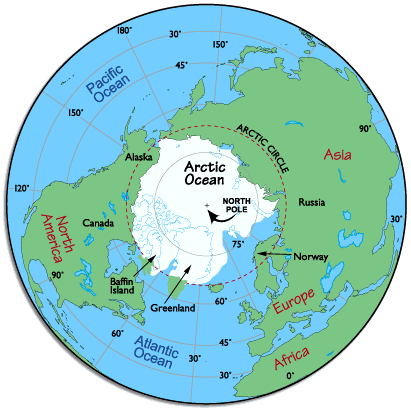
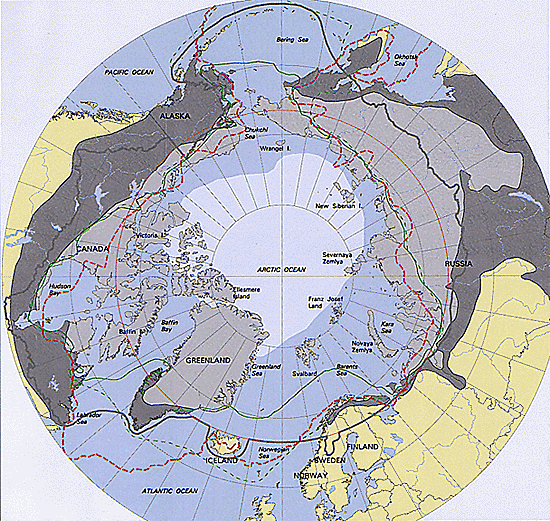
Russia has recently laid claim to a vast 1,191,000 sq km (460,800 sq miles) chunk of the ice-covered Arctic seabed. The claim is not really about territory, but rather about the huge hydrocarbon reserves that are hidden on the seabed under the Arctic ice cap. These newly discovered energy reserves will play a crucial role in the global energy balance as the existing reserves of oil and gas are depleted over the next 20 years.

The media and international affairs experts have been portraying missile defense in Europe and the final status of Kosovo as the two most contentious issues between Russia and the United States, with mutual recriminations over “democracy standards” providing the background for the much anticipated onset of a new Cold War. But while this may well be true for today, the stage has been quietly set for a much more serious confrontation in the non-too-distant future between Russia and the United States – along with Canada, Norway and Denmark.

Russian President Vladimir Putin and U.S. President George W. Bush spent most of their time at the “lobster summit” at Kennebunkport, Maine, discussing how to prevent the growing tensions between their two countries from getting out of hand.


Russia has the world's largest gas reserves and is the second largest exporter of oil after Saudi Arabia, but its oil and gas production is slated to decline after 2010 as currently operational reserves dwindle. Russia’s Natural Resources Ministry estimates that the country’s existing oil reserves will be depleted by 2030.

The 2005 BP World Energy Survey projects that U.S. oil reserves will last another 10 years if the Arctic National Wildlife Refuge is not opened for oil exploration, Norway’s reserves are good for about seven years and British North Sea reserves will last no more than five years – which is why the Arctic reserves, which are still largely unexplored, will be of such crucial importance to the world’s energy future. Scientists estimate that the territory contains more than 10 billion tons of gas and oil deposits. The shelf is about 200 meters (650 feet) deep and the challenges of extracting oil and gas there appear to be surmountable, particularly if the oil prices stay where they are now – over $70 a barrel.

The Kremlin wants to secure Russia's long-term dominance over global energy markets. To ensure this, Russia needs to find new sources of fuel and the Arctic seems like the only place left to go. But there is a problem: International law does not recognize Russia’s right to the entire Arctic seabed north of the Russian coastline.

The 1982 International Convention on the Law of the Sea establishes a 12 mile zone for territorial waters and a larger 200 mile economic zone in which a country has exclusive drilling rights for hydrocarbon and other resources.

Russia claims that the entire swath of Arctic seabed in the triangle that ends at the North Pole belongs to Russia, but the United Nations Committee that administers the Law of the Sea Convention has so far refused to recognize Russia’s claim to the entire Arctic seabed.

In order to legally claim that Russia’s economic zone in the Arctic extends far beyond the 200 mile zone, it is necessary to present viable scientific evidence showing that the Arctic Ocean’s sea shelf to the north of Russian shores is a continuation of the Siberian continental platform. In 2001, Russia submitted documents to the UN commission on the limits of the continental shelf seeking to push Russia's maritime borders beyond the 200 mile zone. It was rejected.

Now Russian scientists assert there is new evidence that Russia’s northern Arctic region is directly linked to the North Pole via an underwater shelf. Last week a group of Russian geologists returned from a six-week voyage to the Lomonosov Ridge, an underwater shelf in Russia's remote eastern Arctic Ocean. They claimed the ridge was linked to Russian Federation territory, boosting Russia's claim over the oil- and gas-rich triangle.

The latest findings are likely to prompt Russia to lodge another bid at the UN to secure its rights over the Arctic sea shelf. If no other power challenges Russia’s claim, it will likely go through unchallenged.

But Washington seems to have a different view and is seeking to block the anticipated Russian bid. On May 16, 2007, Senator Richard Lugar (R-Indiana), the ranking Republican on the Senate Foreign Relations Committee, made a statement encouraging the Senate to ratify the Law of the Sea Convention, as the Bush Administration wants. The Reagan administration negotiated the Convention, but the Senate refused to ratify it for fear that it would unduly limit the U.S. freedom of action on the high seas.

Lugar used the following justification in his plea for the United States to ratify the convention: “Russia has used its rights under the convention to claim large parts of the Arctic Ocean in the hope of claiming potential oil and gas deposits that might become available as the polar ice cap recedes due to global warming. If the United States did not ratify the convention, Russia would be able to press its claims without the United States at the negotiating table. This would be directly damaging to U.S. national interests.” President Bush urged the Senate to ratify the convention during its current session, which ends in 2008.

The United States has been jealous of Russia’s attempts to project its dominance in the energy sector and has sought to limit opportunities for Russia to control export routes and energy deposits outside Russia’s territory. But the Arctic shelf is something that Russia has traditionally regarded as its own. For decades, international powers have pressed no claims to Russia’s Arctic sector for obvious reasons of remoteness and inhospitability, but no longer.

Now, as the world’s major economic powers brace for the battle for the last barrel of oil, it is not surprising that the United States would seek to intrude on Russia’s home turf. It is obvious that Moscow would try to resist this U.S. intrusion and would view any U.S. efforts to block Russia’s claim to its Arctic sector as unfriendly and overtly provocative. Furthermore, such a policy would actually help the Kremlin justify its hardline position. It would certainly prove right Moscow’s assertion that U.S. policy towards Russia is really driven by the desire to get guaranteed and privileged access to Russia’s energy resources.

It promises to be a tough fight.


Global Research Articles by Vladimir Frolov


(In accordance with Title 17 U.S.C. Section 107, this material is distributed without profit to those who have expressed a prior interest in receiving the included information for research and educational purposes. I.U. has no affiliation whatsoever with the originator of this article nor is I.U endorsed or sponsored by the originator.)

The Nazis, Fascists and Communists were political parties before they became enemies of liberty and mass murderers.

ICYMI: Alberto Been Lyin'

FBI Records Show Gonzales Knew About Years of Chronic NSL Problems

EFF Lawsuit Uncovers History of Surveillance Mistakes

Washington, D.C. - Documents obtained by the Electronic Frontier Foundation (EFF) show years of chronic problems with the Federal Bureau of Investigation's use of National Security Letters (NSLs) to collect Americans' personal information and that Attorney General Alberto Gonzales has long been aware of these problems.

The documents were disclosed after EFF sued the government under the Freedom of Information Act (FOIA) earlier this year for records related to a scathing Justice Department critique of FBI NSL activity. The records detail more than 40 instances of improper, unauthorized collection of information about individuals, including unlawful access to phone records and email. The records show that Gonzales himself was sent several of these problem reports, including one less than a week before he told a congressional committee that no civil liberties abuses have resulted from the USA PATRIOT Act. He also voiced surprise when the Justice Department report on NSL misuse was made public earlier this year.

"These chronic privacy problems have long been known within the Justice Department but still were kept secret from those who really needed to know -- members of the American public, including those who were surveilled," said EFF Staff Attorney Marcia Hofmann. "The FBI can't be trusted to police its own agents. It's time for Congress to provide oversight to protect American citizens."

The FBI's use of NSLs was expanded under the USA PATRIOT Act in 2001, allowing federal agents to gather private records about anyone's domestic phone calls, emails, and financial transactions without any court approval -- as long as an FBI agent claims that the information could be related to a terrorism or espionage investigation. EFF submitted a FOIA request about the reported misuse of NSLs in March, and when no documents were forthcoming, EFF sued the FBI for their immediate release. Last month, a judge held that the FBI was required to release records related to the inspector general's report beginning on July 5, with more documents to be disclosed every 30 days. In all, 1138 pages of NSL records were released to EFF late last week in the first batch of documents complying with the court's order.

"This is by no means the whole story on NSL abuse," said EFF Senior Counsel David Sobel. "We're looking forward to receiving the rest of the documents. Americans deserve the whole story on the FBI's deeply flawed program to issue NSLs."

For the complete FBI documents and more analysis:
http://www.eff.org/flag/07656JDB/

Contacts:

Marcia Hofmann
Staff Attorney
Electronic Frontier Foundation
marcia@eff.org

David Sobel
Senior Counsel
Electronic Frontier Foundation
sobel@eff.org

Rebecca Jeschke
Media Coordinator
Electronic Frontier Foundation
press@eff.org

(In accordance with Title 17 U.S.C. Section 107, this material is distributed without profit to those who have expressed a prior interest in receiving the included information for research and educational purposes. I.U. has no affiliation whatsoever with the originator of this article nor is I.U endorsed or sponsored by the originator.)

The Nazis, Fascists and Communists were political parties before they became enemies of liberty and mass murderers.

There is something afoot, me thinks

Is it just me, or have you noticed it too? Something is afoot -- maybe. All of a sudden I am reading and seeing on TV individuals who wear suits and can quote the US constitution from memory, talking about the impeachment of George W. Bush and his sidekick.


My first clue was when I read last week that House Speaker Nancy Pelosi told a radio station, “We can't take impeachment off the table.”

Holy whiplash, Batman, isn't that exactly the opposite of what she's been saying since crowned Speaker last January? What happened there?

Then there was the extraordinary interview Bill Moyers did last week with John Nichols of The Nation magazine and Bruce Fein, a former Justice Department official during the Reagan administration who drafted articles of impeachment against Bill Clinton.

(If you missed it, you shouldn't have. Here are the highlights: )

Neocons may dismiss Nichol's views as those of a “known liberal,” but what about Fine? No lib there. Fine is the guy conservatives tapped to craft and pen the case against Clinton. Now he wants to do the same thing for Bush – and for precisely the same reasons.

Both men explained that impeachment, always framed by mainstream media as a “constitutional crisis,” is actually precisely the opposite. Impeachment, they explained, is the solution to a constitutional crisis. The real constitutional crisis occurs when Congress fails to protect and maintain the balance of power the Founders enshrined in the constitution.

“The Founders gave congress the power to impeach as the remedy to an imperial presidency,” Fine noted.

Of course those on the right will claim that any talk of impeaching Bush and Cheney is purely political – as though that were something bad. Hello! Of course it's political. It's a political process created and delineated by the cornerstone political document – our US constitution. You remember that the document, the user manual for our democracy. (Maybe it would be more popular if the Founders had entitled it, “Democracy for Dummies.”)

Back when Republicans pushed to impeach Bill Clinton for perjury Democrats screamed, “politics,” too. But Fine explained that Bill Clinton got himself in that jam by trying to put himself above the law. Never mind that what he lied about was hardly a matter of national security, all Fine cares about it that he lied, committed a crime – perjury. The rest is simply back-story.

Fine says that there is now plenty of evidence that Bush and Cheney too have lied -- more than once and about matters far more serious than Clinton's little walk on the wild side. Fien says that is why Congress should have begun impeachment hearings long ago. Not so much to remove Bush and Cheney from office, but as way of laying down constitutional markers, lines in the sand over which Congress was not about to allow the executive branch to simply ignore.

Fien adds that even now that their term in office is short, Congress should still proceed with impeachment hearings in order to reestablish and reinforce the constitutional balance – the whole “co-equal branches” business – as the Founders intended.

But Congress still has not done so. Will they?

Democrats worry that trying to impeach Bush and Cheney would blow back on them in the 2008 elections, by making them appear petty and politically motivated. A perception which is, of course their own damn fault. If they hadn't spent the last six years acting like such a pack of conniving little weasels maybe we'd be less likely to jump such a conclusion.

Now that they've richly earned that reputation they'll have to undo it. And the only way to do that is to start talking to us straight from the heart. Believe me, we do know the difference. We can feel it, even more than we hear it. We know when you're just jerking us off – again. We and, while far and few between, we know immediately when a pol has had it and suddenly starts blathering truth. And we love it when that happens.

1 | 2 | 3


(In accordance with Title 17 U.S.C. Section 107, this material is distributed without profit to those who have expressed a prior interest in receiving the included information for research and educational purposes. I.U. has no affiliation whatsoever with the originator of this article nor is I.U endorsed or sponsored by the originator.)

The Nazis, Fascists and Communists were political parties before they became enemies of liberty and mass murderers.

Bush, Cheney and Lieberman: Deport Them!

Let's not forget the biggest opportunity of all; the anthrax attacks, making the way smooth for the "Enabling Act." (patriot act)

Opportunistic Tyrants

A. Alexander, July 8th, 2007

If politicians, especially the likes of Joe Lieberman, Dick Cheney and George W. Bush should ever wonder why the American people no longer consider their counsel on terrorism to be worthy of deliberation, they need only observe their own politically opportunistic behavior.

These politicians too often pat themselves on the back, after having directed the FBI to find a group of mentally challenged individuals and helping make them into terrorists; they preoccupy themselves by trying to spin a faraway and farfetched terror plot to their domestic political advantage; or they simply make up lies about al Qaeda having overrun Iraq. In all instances, at best, the claims of these particular politicians are based firmly upon half-truths and regardless of the circumstance, they are always trying to use events primarily as the means to strip away from the American people, their individual rights and freedoms.

If there is a bomb anywhere in the world, these politicians immediately link it to the war in Iraq and a need for more domestic spying. There is no tragedy that they aren't willing to exploit for their own nefarious political ends.

The latest London plots proved to be no exception. Mister Bush quickly moved to link it to the importance of victory in Iraq. Mister Lieberman found himself on the Sunday morning talk show circuit and called for more cameras to be placed here-there-everywhere within American cities. He also attacked Democrats for trying to hold the Bush administration's actions within the confines of the Constitution and rule of law. According to Lieberman, Democrats are terrible people for daring to, in light of the London plots, set rules and limits on the government's ability to spy upon innocent American citizens - as if the one had anything to do with the other. Their only response to terrorism anywhere, is to limit freedom everywhere.

Who could trust such lowlife opportunists? Mister Bush, Cheney and Lieberman fancy themselves as being too smart for everyone to figure out, but they and their motivation have become transparent enough to make it possible for one to read through them the fine print of a health insurance policy. These politicians aren't interested in keeping the American people safe. They are only interested in manipulating the fear of the American people and furthering their own stygian political objectives, which involve increasingly consolidating power in the hands of a select few.

The opinions and counsel of these politicians, especially the likes of Joe Lieberman, Dick Cheney and George W. Bush, are no longer considered by the American people because they have been exposed for the opportunistic tyrants that they are.


(In accordance with Title 17 U.S.C. Section 107, this material is distributed without profit to those who have expressed a prior interest in receiving the included information for research and educational purposes. I.U. has no affiliation whatsoever with the originator of this article nor is I.U endorsed or sponsored by the originator.)

The Nazis, Fascists and Communists were political parties before they became enemies of liberty and mass murderers.

We're all going to die....and it's Bushco's fault

The findings of the new NIE should come as no surprise to anyone. What is truly stunning is that it has taken the so-called "Intelligence community" this long to figure it that invading and occupying Iraq would be the worst possible response to 9/11 and al Qaeda.

But then it wasn't done in response to 9/11 and al Qaeda. It was in response to PNAC and the NeoCons, if there is actually a difference.

Intelligence Puts Rationale For War on Shakier Ground

By Michael Abramowitz
Washington Post Staff Writer
Wednesday, July 18, 2007; A05

The White House faced fresh political peril yesterday in the form of a new intelligence assessment that raised sharp questions about the success of its counterterrorism strategy and judgment in making Iraq the focus of that effort.

Since the attacks of Sept. 11, 2001, President Bush has been able to deflect criticism of his counterterrorism policy by repeatedly noting the absence of any new domestic attacks and by citing the continuing threat that terrorists in Iraq pose to U.S. interests.

But this line of defense seemed to unravel a bit yesterday with the release of a new National Intelligence Estimate that concludes that al-Qaeda "has protected or regenerated key elements of its Homeland attack capability" by reestablishing a haven in Pakistan and reconstituting its top leadership. The report also notes that al-Qaeda has been able "to recruit and indoctrinate operatives, including for Homeland attacks," by associating itself with an Iraqi subsidiary.

These disclosures triggered a new round of criticism from Democrats and others who say that the administration took its eye off the ball by invading Iraq without first destroying Osama bin Laden's organization in Afghanistan.

Confronted with a political brush fire, the president and his aides retreated to familiar ground, highlighting the parts of the report that they saw as supportive of their policies, particularly the need to confront Islamic radicals on the ground in Iraq.

In talking with reporters in the Oval Office yesterday, Bush concentrated on a single paragraph in the assessment that placed the enemy in Iraq in a larger context of international terrorism. The estimate said bin Laden's organization will "probably seek to leverage the contacts and capabilities of al-Qa'ida in Iraq, its most visible and capable affiliate and the only one known to have expressed a desire to attack the Homeland."

Although only a portion of the instability in Iraq is attributed to al-Qaeda and the group had no substantial power base there before the U.S. invasion, Bush again cast the war as a battle against its members, whom his aides have described as key provocateurs there.

"These people have sworn allegiance to the very same man who ordered the attack on September the 11th, 2001: Osama bin Laden," the president said. "And they want us to leave parts of the world, like Iraq, so they can establish a safe haven from which to spread their poisonous ideology. And we are steadfast in our determination to not only protect the American people, but to protect these young democracies."

Bush's top advisers also pushed back at the proposition from many Democrats that the White House allowed the pursuit of al-Qaeda to be diverted by going after Saddam Hussein. Briefing reporters yesterday, Frances Fragos Townsend, Bush's homeland security adviser, took issue with the suggestion that the president had ignored warnings from the intelligence community that attacking Iraq would stimulate al-Qaeda's drive for recruits and influence.

"You're assuming it's a zero-sum game, which is what I don't understand," Townsend said. "The fact is, we were harassing them in Afghanistan, we're harassing them in Iraq, we're harassing them in other ways, non-militarily, around the world. And the answer is, every time you poke the hornet's nest, they are bound to come back and push back on you. That doesn't suggest to me that we shouldn't be doing it."

But many Democrats questioned the administration's explanations, seizing on the key judgments of the new intelligence estimate as yet another reason to begin withdrawing troops from Iraq and changing the administration's mission of the past four years.

Senate Majority Leader Harry M. Reid (Nev.) said the current situation in Iraq "has helped to energize" al-Qaeda. "Changing our strategy in Iraq and narrowing our military mission to countering al-Qaeda terrorism -- as a bipartisan majority in the Senate now favors -- would be the single greatest thing we could do to undermine al-Qaeda's ability to use Iraq as a recruiting and propaganda tool fueling the growth of regional terrorist groups," he said in a statement.

Al-Qaeda's participation in the Iraqi violence has figured particularly heavily in recent administration arguments for a continued U.S. troop presence there, because White House strategists regard it as a politically salable reason for staying and continuing to fight.

Some terrorism analysts say Bush has used inflated rhetoric to depict al-Qaeda in Iraq as part of the same group of extremists that attacked the United States on Sept. 11 -- noting that the group did not exist until after the U.S.-led invasion of Iraq in 2003. These analysts say Bush also has overlooked the contribution that U.S. actions have made to the growth of al-Qaeda in Iraq, which has been described as kind of a franchise of the main al-Qaeda network headed by bin Laden.

Paul R. Pillar, a former CIA analyst who has been involved in previous intelligence estimates, said that the administration has correctly identified the danger posed by al-Qaeda in Iraq and that there are indeed links between the Iraq group and the larger international terrorist network. But he said the White House is drawing the wrong conclusion, and argued instead that it is the U.S. presence in Iraq that is fueling the terrorists' cause.

"Iraq matters because it has become a cause celebre and because groups like al-Qaeda in Iraq and al-Qaeda central exploit the image of the United States being out to occupy Muslim lands," Pillar said.

Referring to al-Qaeda in Iraq, Clinton administration official Daniel S. Benjamin, who has written books and articles on international terrorism, said: "These are bad guys. These are jihadists." He added: "That doesn't mean we [should] stay in Iraq the way we have been, because we are not making the situation any better. We're creating terrorists in Iraq, we are creating terrorists outside of Iraq who are inspired by what's going on in Iraq. . . . The longer we stay, the more terrorists we create."


(In accordance with Title 17 U.S.C. Section 107, this material is distributed without profit to those who have expressed a prior interest in receiving the included information for research and educational purposes. I.U. has no affiliation whatsoever with the originator of this article nor is I.U endorsed or sponsored by the originator.)

The Nazis, Fascists and Communists were political parties before they became enemies of liberty and mass murderers.