Showing posts with label General Petraeus. Show all posts

Thursday, May 22, 2008

Questions Petraeus Cannot Avoid This Time

Today, confirmation hearings will be held to name General David Petraeus the head of U.S. Central Command (CentCom) in the Middle East and Central Asia. General Petraeus is currently the U.S. Commander in Iraq and the architect of the strategy which dramatically increased the number of U.S. troops in Iraq -- commonly known as "the surge." During General Petraeus' prior confirmation hearing for his current post, he avoided questions about the Bush administration's Iraq strategy and its overall effect on our national security. He also refused to answer questions regarding the administration's Iraq Strategy and the effect on the military readiness of our troops. General Petraeus' rationale, was that as the U.S. Commander in Iraq, he was limited to policy in Iraq and he would therefore limit his answers to questions regarding Iraq instead of America's national security and troop readiness.

What a difference a year makes. Now that General Petraeus is nominated to oversee the entire Middle East and Central Asia, there are questions that he must address in his confirmation hearing which he refused to answer in his prior hearing. As the head of CentCom for the Middle East and Central Asia, General Petraeus will leave his mark on U.S. foreign policy and military readiness for generations to come and in one of the most hostile areas in the world.

Michael Hayden, the Director of the CIA, is on the record as saying that the Afghanistan/Pakistan border region is "a clear and present danger" to the West and specifically to the United States. Director Hayden went on to say that if the U.S. is going to suffer another terrorist attack on American soil, it will almost certainly originate in this area. That said, I have a few questions for General Petraeus.

  • With a Nuclear Pakistan, does this prompt a change in strategy from America's current foreign policy?
  • Do you, General Petraeus, agree with Director Hayden's analysis?
  • If you do, will you advocate for a strategic redeployment of our troops from Iraq and focus more on the Afghan/Pakistan border area?

General Petraeus is the author of the U.S. strategy on counterinsurgency operations. An instrumental part to the counterinsurgency strategy is having experienced company level commanders. In 2007, 58% of the West Point class of 2002 left active duty after completing their initial commitment. This is a 30 year high with previous years averaging between 10% and 30%. The Army is currently facing a deficit of 3,000 Captains and Majors this year and those numbers are likely to increase over the next few years .

  • Does it concern you that the Army is facing these shortfalls?
  • Without a change of strategy in Iraq, how will you maintain the deployment schedule our soldiers currently face?

I am a former Army Captain who left the Army after completing my initial commitment. I submit to you, General Petraeus: if the shortfalls and deployment schedule do not concern you, they should.

As an Iraq War Veteran, as a Congressional Candidate and as an American Citizen, these are just some of the questions for which I think we all deserve answers.


(In accordance with Title 17 U.S.C. Section 107, this material is distributed without profit to those who have expressed a prior interest in receiving the included information for research and educational purposes. I.U. has no affiliation whatsoever with the originator of this article nor is I.U endorsed or sponsored by the originator.)


The Nazis, Fascists and Communists were political parties before they became enemies of liberty and mass murderers.

Thursday, October 4, 2007

Lee Dynamics, General Petraeus and Bribery?

Decide for yourselves but, at the very least, it seems that General Petraeus should have been more aware of what was going on in his own command.

August 31, 2007

U.S. Says Company Bribed Officers for Work in Iraq

WASHINGTON, Aug. 30 — An American-owned company operating from Kuwait paid hundreds of thousands of dollars in bribes to American contracting officers in efforts to win more than $11 million in contracts, the government says in court documents.

The Army last month suspended the company, Lee Dynamics International, from doing business with the government, and the case now appears to be at the center of a contracting fraud scandal that prompted Defense Secretary Robert M. Gates to dispatch the Pentagon inspector general to Iraq to investigate.

Court documents filed in the case say the Army took action because the company was suspected of paying hundreds of thousands in bribes to Army officers to secure contracts to build, operate and maintain warehouses in Iraq that stored weapons, uniforms, vehicles and other matériel for Iraqi forces in 2004 and 2005.

A lawyer for the company denied the accusations.

One of the officers, Maj. Gloria D. Davis, a contracting official in Kuwait, shot and killed herself in Baghdad in December 2006. Government officials say the suicide occurred a day after she admitted to an Army investigator that she had accepted at least $225,000 in bribes from the company. The United States has begun proceedings to seize Major Davis’s assets, a move her heirs are contesting.

The company has been known as American Logistics Services.

Details of the case have come to light because the company contested the Army’s decision, on July 9, to suspend it from obtaining contracts. That forced the government to disclose details in court papers, including a seven-page statement by an Army investigator.

Howell Roger Riggs, a lawyer or the company, denied the accusations and said the company was appealing to have the suspension lifted. Mr. Riggs acknowledged that the company was under a Justice Department investigation but said that no charges had been filed against the company or its officials.

“This is based solely on a declaration that is unsubstantiated and uncorroborated,” Mr. Riggs said in a telephone interview. “If they want to come forward with hard evidence and accusations, we’ll deal with it at that time.”

The case is now part of a broader investigation in which the Army has a high-level team reviewing 18,000 contracts valued at more than $3 billion that the Kuwait office has awarded over four years.

The Army has suspended 22 companies and individuals, at least temporarily, from pursuing government work because of contract fraud investigations in Iraq, Kuwait and Afghanistan, an Army spokesman said Thursday. A total of 18 companies and individuals are barred for a definite period from government work. Seven more face debarment.

The court papers make clear that investigators have concluded that Lee Dynamics paid large bribes to numerous United States officials in Iraq and Kuwait. Major Davis is one official cited. Another is an Army officer, identified in the investigator’s report as “Person B,” because he is now cooperating with the investigation. He acknowledged receiving $50,000 in cash bribes from the company, the court papers said. Two people with direct knowledge of the investigation or the contracting office in Iraq at the time said “Person B” was Lt. Col. Kevin A. Davis, who worked with an officer who has emerged as a focus of the investigation in the weapons case in Iraq.

That officer, Lt. Col. Levonda Joey Selph, was at the heart of the effort to strengthen the fledgling Iraqi security forces in 2004 and 2005. She worked closely with Gen. David H. Petraeus, who commanded the effort at the time. The general is now the top commander in Iraq. There is no indication that investigators have uncovered any wrongdoing by General Petraeus.

In a brief phone conversation Thursday, Colonel Selph confirmed the connection between her and Colonel Davis in Iraq. “I worked for Kevin Davis,” Colonel Selph said. She said she wanted to consult her lawyer before speaking further and did not respond to subsequent messages.

A woman identifying herself as Kevin Davis’s wife said on the phone that he was out of town and not available for comment. She said that he had gone to work for Lee Dynamics after retiringfrom the army. It is not believed he is related to Gloria Davis.

As the case expands, investigators are looking at the possibility that it has connections to what had appeared to be a separate major corruption scandal. Last week, Maj. John Cockerham, a former Army contracting officer in Kuwait, and his wife and his sister were indicted on charges that they accepted up to $9.6 million in bribes for defense contracts in Iraq and Kuwait.

Court documents, say Major Davis also served as a contracting officer at Camp Arifjan, Kuwait, from in 2003 and 2004 and awarded millions of dollars in contracts to American Logistics and its affiliate companies, raising the question of whether the cases are related.

Lee Dynamics appears to be emblematic of scores of companies formed since the Iraqi government fell to take advantage of billions of dollars in contracts to clothe, feed and arm American troops in Kuwait and to sustain Iraq security forces in Iraq.

According to a July 9 statement by Larry S. Moreland, an agent with the Army’s Criminal Investigation Command, the company’s founder, George H. Lee, and an unnamed person formed American Logistics Services, a Kuwait-based company, to provide logistical support to the military.

In 2004, the company was awarded $11.7 million in contracts to build, operate and maintain several warehouses in Iraq. The court papers contend that as a result of bribes, the company illegally received advance information about the contracts.

In May 2005, the document said, Mr. Lee and his son, Justin W. Lee, shifted assets and contracts to Lee Dynamics, and its contract to maintain the warehouses was renewed in July 2005 even though its performance had been abysmal, said two American officials who were in the country at the time.

That month, after Major Davis moved to the Pentagon, Lee Dynamics was awarded a $12 million warehousing contract. Before the award, Major Davis told George Lee that his company would receive a “glowing report” during the bidding, court documents in the government’s case to seize Major Davis’s assets say.

Between August 2005 and April 2006, the company transferred more than $220,900 in three separate deposits to bank accounts controlled by Major Davis, according to the court filings.

According to its Web site, Lee Dynamics’ warehouses in Taji, Umm Qasr, Ramadi, Mosul and Tikrit, all in Iraq, “have received, stored and issued a large part of the more than a billion dollars worth of materials and equipment that has been ordered for the reconstruction of Iraq.”

Eric Schmitt reported from Washington, and James Glanz from Baghdad. Margot Williams contributed reporting from New York.


(In accordance with Title 17 U.S.C. Section 107, this material is distributed without profit to those who have expressed a prior interest in receiving the included information for research and educational purposes. I.U. has no affiliation whatsoever with the originator of this article nor is I.U endorsed or sponsored by the originator.)


The Nazis, Fascists and Communists were political parties before they became enemies of liberty and mass murderers.

Wednesday, September 26, 2007

Much Ado....

This whole Petraeus/ Betrayus mess is nothing but a distraction from what is really important; the lies, the damnable lies that got us into this Mes-o-Potamia and are keeping us there. Move On simply tried to point out what is true, General Petraeus has been, on more than one occasion, part of the Bush disinformation campaign directed at the American people.

When General Petraeus chose to become a policy advocate, especially for this administration of known liars, instead of a soldier who is merely executing policy, he gave up the right to not have his integrity and/or his credibility questioned. He is no longer a troop, but a co-conspirator in one of the worst crimes ever committed against his country, not to mention Iraq.

Last week the U.S. Senate voted to condemn the New York Times for running an ad that was critical of the administration and it’s lackey, Gen. David Petraeus. The inevitable consequences of this government imposition of approved thought are already becoming manifest.

The Times itself is slamming its ad sales group for accepting the ad from MoveOn.org and offering them a rate reserved for stand-by advertisers. Public Editor Clark Hoyt enumerated the list of grievances from opponents of the ad. They include:

  • More than 4,000 e-mail messages with words like “despicable,” “disgrace” and “treason.”
  • George W. Bush called the ad “disgusting.”
  • Dick Cheney said the charges in the ad were “an outrage.”
  • Thomas Davis III, (R-VA) demanded a House investigation.
  • The American Conservative Union filed a complaint with the FEC against MoveOn.org and the Times.
  • FreedomsWatch asked the Times to investigate.

And what did this flurry of hard-core conservative pressure yield? Well, the so-called liberal Times caved in to the rightists and proved the effectiveness of shouting down lawful dissent. Hoyt argued that the Times violated it’s advertising policy which states that they, “do not accept opinion advertisements that are attacks of a personal nature.” But criticizing Petraeus’ intention to go before Congress and parrot the views of the White House is not a personal attack. It is a substantive expression of a viewpoint that is shared by millions of Americans. What’s more, Hoyt didn’t bother to level the same complaint against rebuttal ads by Rudy Giuliani or FreedomsWatch. Hoyt went even further in defining the lengths to which he would go to muzzle free speech saying…

“…I’d have demanded changes to eliminate ‘Betray Us,’ a particularly low blow when aimed at a soldier.”

Had Hoyt been in a position to do so, he would have forced a private advocacy group to alter the message they wished to convey. And as justification, he implies that a general, who is being used as a political prop by the White House, cannot be called to account for abandoning the American people in favor of his boss, the President. Submission accomplished, Mr. Hoyt.

Another example of the fallout from this campaign of suppression is the refusal of the New York Metro to run an ad from the anti-war group, World Can’t Wait. The Metro deemed the ad “too inflammatory” for its criticism of Bush’s thinly veiled threats against Iran. WCW has a right to be disturbed by this rejection and they succinctly explain what’s at stake for our nation’s coveted rights under the First Amendment to the Constitution:

“One of the few avenues to get the truth into the major media - buying advocacy ads - will be in effect closed down if publishers are afraid to sell space. The White House will be the strong-arm arbiter of what is acceptable in terms of political criticism.”

(Visit World Can’t Wait for more info about the ad and how to contact the Metro).

The dominoes are falling. It began with an orchestrated assault on free speech by right-wingers in response to MoveOn’s ad. Then the Senate capitulates and condemns said speech. Then newspapers, feeling the heat, reject ads by independent groups of citizens seeking to engage the public. What’s next? An Official Doctrine of Acceptable Speech?

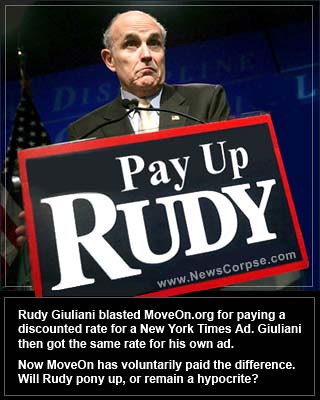
nullFinally, MoveOn responded to the Times’ assertion that the stand-by rate they were charged was a mistake by volunteering to pay the $77,508 difference. Will MoveOn’s critics, who so vociferously complained about the discount, acknowledge that gesture? Will Rudy Giuliani and FreedomsWatch, two of the most clamorous complainants, who themselves received an equivalent discount, pay back the difference they were afforded? If they do not, they should hear about it, and since the Conventional Media probably won’t do it, it’s up to the blogosphere, again.

Update: Lane Hudson at News For The Left has filed a complaint with the FEC against Giuliani. Good luck Lane.

Also, Giuliani is refusing to pay the difference between the stand-by rate he received and the full rate, as MoveOn did. His spokeswoman said that the ad “was placed at the standby rate with no commitment it would run on a specific date.” But she is contradicting her boss who you can listen to here for yourself.


(In accordance with Title 17 U.S.C. Section 107, this material is distributed without profit to those who have expressed a prior interest in receiving the included information for research and educational purposes. I.U. has no affiliation whatsoever with the originator of this article nor is I.U endorsed or sponsored by the originator.)


The Nazis, Fascists and Communists were political parties before they became enemies of liberty and mass murderers.

Friday, September 14, 2007

Just a reminder. Iran, Iran, Iran


Let's not overlook that Petraeus, Crocker and Bush all pointed their collective fingers at Iran, again. Weird diplomacy, I'd say.


It's easy to overlook such things in the circus like atmosphere in the news media this week.

Hawk

Thanks, Hawk.

Right you are.

The Iran card is being played every day and we ignore that at our own peril.

Powered by ScribeFire.

Wednesday, September 12, 2007

Petraeus Moment: Blotting Out The World


For me, the most telling moment was when Senator John Warner asked the general if the Iraq war was making the U.S. more safe.

Good question, since that is the main reason we were given for unlawfully invading and occupying Iraq to begin with and the one we still hear daily.

Petraeus said he didn't know. He said that he really had not thought about that very much. He said that he had been very focussed on a strategy to meet the administrations goals in Iraq.

It's not that this general is new to Iraq. He was the man in charge of training the Iraqi military. That hasn't gone too well. Thousand of weapons went missing during his tenure. It has never entered his mind to assess whether or not the administration's policies are really keeping Americans more safe as we are being told by the Bushites?

He said he doesn't know. Oh yes he does. The answer is, no, and most thinking people know it.

Imperial Autism

The Petraeus Moment Blots Out the World
By Tom Engelhardt

The former Cockney flower-girl turned elegant-English-speaker Eliza Doolittle caught something of our moment in these lyrics from My Fair Lady: "Oh, words, words, words, I'm so sick of words.... Is that all you blighters can do?" Of course, all she had to do was be Galatea to a self-involved language teacher/Pygmalion. We've had to bear with the bloviating of almost every member of Congress, the full-blast PR apparatus of the White House, and two endless days of congressional testimony from General David Petraeus and Ambassador Ryan Crocker, not to speak of the flood of newspaper, radio, and TV stories about all of the above and the bevy of experts who are hustled out to do the horse-race assessments of how the general and ambassador performed, whether they "bought" time for the President, and the like.

And -- count on it -- that's just the beginning. The same cast of characters will be talking, squabbling, spinning, and analyzing stats of every sort for weeks to come -- with a sequel promised next spring. Everyone knows that's the case, just as everyone has known since mid-summer that we would get to this point and, when we did, that things similar to those said (and written) in the last two days would indeed be said (and written), and that nothing the blighters would say or write would matter a whit, or change the course of events, or the tide of history, even though whole forests might be pulped in the process and it would be springtime for hyperbole and breathless overstatement in the world of news.

There has been a drumbeat of growing excitement in the press, preparing us for "pivotal reports," a "pivotal hearing," "highly anticipated appearances," and "long-awaited testimony," or, as both the Washington Post on its front page and ABC World News in a lead report put it, "the most anticipated congressional testimony by a general since the Vietnam War."

Petraeus himself has been treated in the media as a celebrity, somewhere between a conquering Caesar and the Paris Hilton of generals. Nothing he does has been too unimportant to record, not just the size of his entourage as he arrived from Baghdad, or the suite he was assigned at the Pentagon, or even his "recon" walk through the room in the House of Representatives where he would testify Monday, but every detail. Somehow, when he refused to give interviews before his "long-awaited" appearance, lots of Petraeus-iana slipped out anyway:

"[H]e also has taken short breaks for walks with his wife.... for dinner with their daughter, who lives in the area, and for lunch with his wife's parents. On his daily jogging route he maintains a brisk, steady pace over a seven-mile route, snaking from Fort Myer, across the Potomac and through Georgetown…"

Sigh…

So who, exactly, was so eagerly awaiting the jogging general's testimony? If a recent Washington Post-ABC News poll is any indication, a majority of Americans weren't among that crowd. They had already discounted whatever he would say -- I doubt the ambassador even registered -- as "exaggerated" and "a rosier view" than reality dictated before his face and that chest full of ribbons hit the TV screens. ("Just 23 percent of Democrats and 39 percent of independents expected an honest depiction of conditions in Iraq.") This was simple good sense. What exactly could anyone outside of Washington have expected the general -- who had a hand in creating the President's "surge" strategy, is now in charge of the "surge" campaign, and for months has been delegated the official administration front man for what was, from day one, labeled a "progress report" -- to say? An instant online headline caught the mood of the Petraeus moment while his first round of testimony was still underway: "Gen. Petraeus Sees Iraq Progress." Ah, yes…

And what in the world could anyone have eagerly anticipated from our unbudgeable President? Just what occurred. And yet, in our media, and inside Washington, the drumbeat for "an anticipated moment of truth" continued, as if something were actually at stake. Take just one example. On Sunday, the Washington Post had a hard-breathing piece by no less than six of its best journalists, with the headline, "Among Top Officials, 'Surge' Has Sparked Dissent, Infighting."

It focused on a reported "clash" between Gen. Petraeus and his theoretical boss, Centcom Commander Adm. William J. Fallon. It seems that the two fell into a near end-of-the-world-style struggle because Fallon had begun "developing plans to redefine the U.S. mission and radically draw down troops." ("'Bad relations?' said a senior civilian official with a laugh. ‘That's the understatement of the century.... If you think Armageddon was a riot, that's one way of looking at it.'") Naturally, Petraeus, like the President, wanted to continue to surge full strength (as we now know -- not that we didn't before -- from his slow-as-molasses plan to drawdown American forces). But what did that radical Fallon have in mind that led to a "schism"? According to a source who spoke to a Post reporter, it "involved slashing U.S. combat forces in Iraq by three-quarters by 2010." Imagine a Centcom commander as a force slasher!

But hold on a moment. Combat forces make up, at best, less than half of all U.S. forces in Iraq; so if, by 2010, the good admiral wants only three-quarters of those combat troops withdrawn, then we're still left with at least 80,000 or more troops in that country three years from now.

Well, I'm with Eliza D -- and so, evidently, was the technology of the House hearing room in which the general and the ambassador appeared on Monday. After chairman of the House Armed Services Committee Ike Skelton (D-MO) and various other Congressional representatives introduced the hearings for what seemed like hours, the general was finally given the floor for his "long-awaited" testimony. His mouth began to move but in a resounding silence. The mike had failed and (except for Code Pink protesters rising from the audience to shout and be escorted out) the room fell into just about the only Iraqi silence of these past, "eagerly anticipated" months -- and what a relief that was. While Skelton fumed, the announcer on MSNBC suggested, "The commander of U.S. forces in Iraq is apparently powerless over the sound system in the hearing room."

It was a moment that had Iraq written all over it. After all, has anything worked as planned or dreamed since March 2003?

Of course, fifteen minutes later the mike had been replaced (though the room lights then proceeded to flicker as if in distant communion with electricity-less Baghdad) -- in Iraq, you suspect, people would have just started shouting -- and the general did finally launch on his monotonal, mind-numbing, expectably boiler-plate testimony. He promised that, if all went well, American troops would be back to pre-surge levels by mid-July 2008, ten months from now, 18 months from that plan's beginning. "Progress" indeed.

The general's testimony would be dealt with in the tones of gravitas that journalists-cum-pundits and pundits-cum-pundits reserve for moments like this. Yet, given the original expectations of the Bush administration, some of the testimony Petraeus (and later Crocker) had to offer would have been little short of hilarious if the subject weren't so grim. (Good news! Four years after the invasion of Iraq, we finally have the former Baathists of al-Anbar Province, whom our President used to refer to as "dead-enders," on our side! Even better, we're arming them and all is going swimmingly!)

Buying a precious extra six-plus months for the White House, the general also suggested that it would be premature to think beyond next July, when it came to "drawdown" plans, and that we should, instead, all reconvene in mid-March 2008 for more of the same.

Sigh…

You can, of course, already begin writing the script for that "eagerly anticipated," "long awaited," "pivotal" moment when the situation in Iraq will be predictably worse, predictably more precarious, and predictably surprising to the general and the ambassador.

As aids for his testimony, Petraeus had brought along a profusion of enormous, multicolored charts to illustrate his points. Many of them -- amazingly enough -- seemed to have more or less the same blue, red, or yellow lines, each of which crested about chart middle and then essentially nosedived toward the present moment. The message was clear: Good news on the numbers! Everything's falling! You didn't need an expert -- you essentially didn't need to know a thing -- to find the confluence of those descending lines with the general's appearance in Washington a tad tidy.

As for me, I found it hard to believe that those charts hadn't been recycled from the Vietnam era, when Petraeus' equivalent, General William Westmoreland, used similar brightly colored, bar-coded, son-et-lumière aids to wow visiting congressional delegations with the metrics of "progress" in his war. Now, once again, we're knee deep in the Big Metric, flooded with so many different kinds of stats that you can hardly tell one from another (though most involve dead bodies). If you remember the Vietnam era, there's a simple rule here: When the top brass hauls out the pretty charts, duck…

In the meantime -- mind you, this is Iraq where nothing has been orderly -- everything was, we were assured, to proceed in an orderly fashion, summed up in the general's wonderfully tidy, if somewhat Orwellian-sounding formula, "from leading to partnering to overwatch."

Hmmm… "overwatch." I wonder who first woke up in a sweat in the middle of the night with that lovely term on the brain? I wonder what it even means? I wonder where we'll be "overwatching" from? Perhaps from that monstrous embassy that we've almost completed in Baghdad, the largest on this or any other planet, or from our vast permanent-seeming base towns like the one with the 17-mile security perimeter that the President visited in Iraq's western desert, but that no reporter accompanying him even thought to describe for us. (Oh, back in November 2006, that base, as a British reporter described it, already had the requisite Subway and pizza outlets, a football field, a Hertz rent-a-car office, a swimming pool, a movie theater showing the latest flicks, and two bus routes.)

Like Eliza, I'm for skipping the words at this point. After all, what does all the talk mean if, in September 2007, the U.S. is building yet another base in Iraq, this time near the Iranian border, as the Wall Street Journal reported on Monday. The military describes it as a "life support area" -- don't ask me what that means -- with this added definition: "[It's] not really permanent, although it will be manned 24/7 and will be used for as long as necessary."

What does all the talk mean if, as the Washington Post's indefatigable Walter Pincus noted, also on Monday, the U.S. Commerce Department is looking for a new legal adviser for Iraq with a contract running through July 31, 2008, plus two possible 12-month extensions. (There we are in 2010 again!) This adviser is to help the poor, ignorant Iraqis as "they draft the laws and regulations that will govern Iraq's oil and gas sector." After all, as the proposal makes clear, the Commerce Department (U.S., not Iraqi) "will be providing technical assistance to Iraq to create a legal and tax environment conducive to domestic and foreign investment in Iraq's key economic sectors, starting with the mineral resources sector." And "conducive" is just such a nice word! Even nicer than "sovereignty."

What do the words mean, if the far edge of Armageddon, as defined in Washington or in military-insider politics, leaves enough American troops in Iraq to fill a couple of baseball stadiums -– or several gigantic bases -- in 2010?

At some level, the situation seems remarkably uncomplicated, if you skip the words (and the words about the words). As has always been true, the top figures of the Bush administration remain completely unmoved by, and unmovable by, words which, as is well known, are only meant to move other people; the Republicans in Congress -- after all this time, despite all the dismal polling figures -- are still on bended knee to the Bush administration, so powerless that they feel incapable of striking off on their own. (Senator John Warner, R-VA, who isn't even seeking reelection, recently begged the President to please, please, pretty please, send home a few thousand troops, any troops at all, and call it a day. And, in his testimony, General Petraeus threw the Senator a carefully gnawed bone, agreeing to do just that.)

The Congressional Democrats are too weak (and divided) to change policy -- and let's be honest, even if they did, this administration would undoubtedly pay no attention whatsoever to anything they mandated. The Republican candidates for President (minus the maverick Ron Paul, who isn't really a Republican at all) have bowed down low before presidential Iraq policy, as if before a pagan idol in the desert, in search of the "base vote." Democratic candidates for President (Bill Richardson and Denis Kucinich excepted) are running "tough" (which means running scared and cautious) on Iraq. If, in 2008, the war actually proves good for business at the polls for Democrats, then, to their consternation, they'll find they've just inherited a disastrous war, that they're likely to be blamed for losing it, and that they're in charge of Hell, not the Oval Office or Congress. (And note that, out of kindness to all of you, I'm not even mentioning Iran.... though there was that nice, giant block of type over Iranian territory on a Petraeus-displayed map labeled "Major Threats to Iraq" that said: "Lethal Aid, Training, Funding.")

Given this line-up of forces, how could it have been anything but "words, words, words" in Washington, even while it was death, death, death in Iraq?

What those words do, however, is fill all available space, reinforcing a powerful sense that Washington's importance in the scheme of things is the one unquestionable reality on our planet. The rest of the world hardly registers, except in the mode of frustration.

Is there a single ounce of humility anywhere in Washington? Can we even imagine that, somewhere on Earth, someone doesn't think about us?

General Petraeus, always identified as having "earned a Ph.D. in international relations from Princeton University as a young officer," is said to be a man with a high regard for his own reputation. Hasn't he noticed, then, that, for one extra star and his Warholian 15 minutes of fame, he's made himself this country's fourth commander of American forces in Iraq in less than five years? Each of those commanders had a plan. Each was confident. Each claimed "progress." And, once upon a time, each was embraced by the President as the man to give him "advice." Ambassador Crocker is similarly the fourth American civilian viceroy to head up our caliphate of Baghdad. He now has "carte blanche" there. But carte blanche to do what?

Could these men really believe that, with them, the occupation of a crucial country in the embattled oil heartlands of the planet would finally head down the IED-pocked path of success? Is the vanity of American officials as great as that? Was it really worth turning so many Iraqis into red and blue lines, into military metrics?

To grasp the Petraeus moment, you really have to re-imagine official Washington as a set of drunks behind the wheels of so many SUVs tearing down a well-populated city avenue -- and all of them are on their cell phones. They hardly notice the bodies bouncing off the fenders. For them, the world is Washington-centered; all interests that matter are American ones. Nothing else exists, not really. Think of this as a form of imperial autism and the Petraeus moment as the way in which the White House and official Washington have, for a brief time, blotted out the world.

Tom Engelhardt, who runs the Nation Institute's Tomdispatch.com, is the co-founder of the American Empire Project. His book, The End of Victory Culture (University of Massachusetts Press), has just been thoroughly updated in a newly issued edition that deals with victory culture's crash-and-burn sequel in Iraq.

Copyright 2007 Tom Engelhardt


(In accordance with Title 17 U.S.C. Section 107, this material is distributed without profit to those who have expressed a prior interest in receiving the included information for research and educational purposes. I.U. has no affiliation whatsoever with the originator of this article nor is I.U endorsed or sponsored by the originator.)


The Nazis, Fascists and Communists were political parties before they became enemies of liberty and mass murderers.

Tuesday, August 21, 2007

Petraeus to testify on 9/11?


Are the Bushites in such a bubble that they don't know how transparent they are to the rest of us?

Al Qaeda attacked us on 9/1/01 (with or without inside help; we're betting on the latter.

The Bushites have been using that as an excuse attacking us every day since.

Petraeus might testify to Congress about Iraq on September 11th

Picphoto082007wtc Now we know why President Bush wanted General Petraeus to testify in September. We should have seen this one coming. Today the White House announced that Petraeus will testify to Congress either on September 11th or the following day, overshadowing the six-year anniversary of the attacks on our country:

Read More At http://www.thebluestate.com


(In accordance with Title 17 U.S.C. Section 107, this material is distributed without profit to those who have expressed a prior interest in receiving the included information for research and educational purposes. I.U. has no affiliation whatsoever with the originator of this article nor is I.U endorsed or sponsored by the originator.)

The Nazis, Fascists and Communists were political parties before they became enemies of liberty and mass murderers.
Monday, July 30, 2007

So which bus will Petraeus be thrown under?

....all to protect the spoiled, little, rich prick, who avoided Nam like the plague.

This is absolutely sickening!!!!!

Who Really Took Over During That Colonoscopy
By Frank Rich
The New York Times

Sunday 29 July 2007

There was, of course, gallows humor galore when Dick Cheney briefly grabbed the wheel of our listing ship of state during the presidential colonoscopy last weekend. Enjoy it while it lasts. A once-durable staple of 21st-century American humor is in its last throes. We have a new surrogate president now. Sic transit Cheney. Long live David Petraeus!

It was The Washington Post that first quantified General Petraeus's remarkable ascension. President Bush, who mentioned his new Iraq commander's name only six times as the surge rolled out in January, has cited him more than 150 times in public utterances since, including 53 in May alone.

As always with this White House's propaganda offensives, the message in Mr. Bush's relentless repetitions never varies. General Petraeus is the "main man." He is the man who gives "candid advice." Come September, he will be the man who will give the president and the country their orders about the war.

And so another constitutional principle can be added to the long list of those junked by this administration: the quaint notion that our uniformed officers are supposed to report to civilian leadership. In a de facto military coup, the commander in chief is now reporting to the commander in Iraq. We must "wait to see what David has to say," Mr. Bush says.

Actually, we don't have to wait. We already know what David will say. He gave it away to The Times of London last month, when he said that September "is a deadline for a report, not a deadline for a change in policy." In other words: Damn the report (and that irrelevant Congress that will read it) - full speed ahead. There will be no change in policy. As Michael Gordon reported in The New York Times last week, General Petraeus has collaborated on a classified strategy document that will keep American troops in Iraq well into 2009 as we wait for the miracles that will somehow bring that country security and a functioning government.

Though General Petraeus wrote his 1987 Princeton doctoral dissertation on "The American Military and the Lessons of Vietnam," he has an unshakable penchant for seeing light at the end of tunnels. It has been three Julys since he posed for the cover of Newsweek under the headline "Can This Man Save Iraq?" The magazine noted that the general's pacification of Mosul was "a textbook case of doing counterinsurgency the right way." Four months later, the police chief installed by General Petraeus defected to the insurgents, along with most of the Sunni members of the police force. Mosul, population 1.7 million, is now an insurgent stronghold, according to the Pentagon's own June report.

By the time reality ambushed his textbook victory, the general had moved on to the mission of making Iraqi troops stand up so American troops could stand down. "Training is on track and increasing in capacity," he wrote in The Washington Post in late September 2004, during the endgame of the American presidential election. He extolled the increased prowess of the Iraqi fighting forces and the rebuilding of their infrastructure.

The rest is tragic history. Were the Iraqi forces on the trajectory that General Petraeus asserted in his election-year pep talk, no "surge" would have been needed more than two years later. We would not be learning at this late date, as we did only when Gen. Peter Pace was pressed in a Pentagon briefing this month, that the number of Iraqi battalions operating independently is in fact falling - now standing at a mere six, down from 10 in March.

But even more revealing is what was happening at the time that General Petraeus disseminated his sunny 2004 prognosis. The best account is to be found in "The Occupation of Iraq," the authoritative chronicle by Ali Allawi published this year by Yale University Press. Mr. Allawi is not some anti-American crank. He was the first civilian defense minister of postwar Iraq and has been an adviser to Prime Minister Nuri al-Maliki; his book was praised by none other than the Iraq war cheerleader Fouad Ajami as "magnificent."

Mr. Allawi writes that the embezzlement of the Iraqi Army's $1.2 billion arms procurement budget was happening "under the very noses" of the Security Transition Command run by General Petraeus: "The saga of the grand theft of the Ministry of Defense perfectly illustrated the huge gap between the harsh realities on the ground and the Panglossian spin that permeated official pronouncements." Mr. Allawi contrasts the "lyrical" Petraeus pronouncements in The Post with the harsh realities of the Iraqi forces' inoperable helicopters, flimsy bulletproof vests and toy helmets. The huge sums that might have helped the Iraqis stand up were instead "handed over to unscrupulous adventurers and former pizza parlor operators."

Well, anyone can make a mistake. And when General Petraeus cited soccer games as an example of "the astonishing signs of normalcy" in Baghdad last month, he could not have anticipated that car bombs would kill at least 50 Iraqis after the Iraqi team's poignant victory in the Asian Cup semifinals last week. This general may well be, as many say, the brightest and bravest we have. But that doesn't account for why he has been invested by the White House and its last-ditch apologists with such singular power over the war.

On "Meet the Press," Lindsey Graham, one of the Senate's last gung-ho war defenders in either party, mentioned General Petraeus 10 times in one segment, saying he would "not vote for anything" unless "General Petraeus passes on it." Desperate hawks on the nation's op-ed pages not only idolize the commander daily but denounce any critics of his strategy as deserters, defeatists and enemies of the troops.

That's because the Petraeus phenomenon is not about protecting the troops or American interests but about protecting the president. For all Mr. Bush's claims of seeking "candid" advice, he wants nothing of the kind. He sent that message before the war, with the shunting aside of Eric Shinseki, the general who dared tell Congress the simple truth that hundreds of thousands of American troops would be needed to secure Iraq. The message was sent again when John Abizaid and George Casey were supplanted after they disagreed with the surge.

Two weeks ago, in his continuing quest for "candid" views, Mr. Bush invited a claque consisting exclusively of conservative pundits to the White House and inadvertently revealed the real motive for the Petraeus surrogate presidency. "The most credible person in the fight at this moment is Gen. David Petraeus," he said, in National Review's account.

To be the "most credible" person in this war team means about as much as being the most sober tabloid starlet in the Paris-Lindsay cohort. But never mind. What Mr. Bush meant is that General Petraeus is famous for minding his press coverage, even to the point of congratulating the ABC News anchor Charles Gibson for "kicking some butt" in the Nielsen ratings when Mr. Gibson interviewed him last month. The president, whose 65 percent disapproval rating is now just one point shy of Richard Nixon's pre-resignation nadir, is counting on General Petraeus to be the un-Shinseki and bestow whatever credibility he has upon White House policies and pronouncements.

He is delivering, heaven knows. Like Mr. Bush, he has taken to comparing the utter stalemate in the Iraqi Parliament to "our own debates at the birth of our nation," as if the Hamilton-Jefferson disputes were akin to the Shiite-Sunni bloodletting. He is also starting to echo the administration line that Al Qaeda is the principal villain in Iraq, a departure from the more nuanced and realistic picture of the civil-war-torn battlefront he presented to Senate questioners in his confirmation hearings in January.

Mr. Bush has become so reckless in his own denials of reality that he seems to think he can get away with saying anything as long as he has his "main man" to front for him. The president now hammers in the false litany of a "merger" between Osama bin Laden's Al Qaeda and what he calls "Al Qaeda in Iraq" as if he were following the Madison Avenue script declaring that "Cingular is now the new AT&T." He doesn't seem to know that nearly 40 other groups besides Al Qaeda in Mesopotamia have adopted Al Qaeda's name or pledged allegiance to Osama bin Laden worldwide since 2003, by the count of the former C.I.A. counterterrorism official Michael Scheuer. They may follow us here well before any insurgents in Iraq do.

On Tuesday - a week after the National Intelligence Estimate warned of the resurgence of bin Laden's Qaeda in Pakistan - Mr. Bush gave a speech in which he continued to claim that "Al Qaeda in Iraq" makes Iraq the central front in the war on terror. He mentioned Al Qaeda 95 times but Pakistan and Pervez Musharraf not once. Two days later, his own top intelligence officials refused to endorse his premise when appearing before Congress. They are all too familiar with the threats that are building to a shrill pitch this summer.

Should those threats become a reality while America continues to be bogged down in Iraq, this much is certain: It will all be the fault of President Petraeus.

(In accordance with Title 17 U.S.C. Section 107, this material is distributed without profit to those who have expressed a prior interest in receiving the included information for research and educational purposes. I.U. has no affiliation whatsoever with the originator of this article nor is I.U endorsed or sponsored by the originator.)


The Nazis, Fascists and Communists were political parties before they became enemies of liberty and mass murderers.
