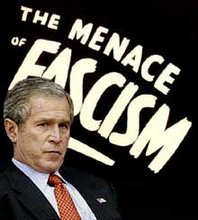


Bush and Cheney haven't gone anywhere. They may not.
Even if they do, candidates are lining up to carry on their evil with corporatist glee.
We are far from out of the woods yet.
Robert Parry Reporting on the Disastrous Bush Presidency, and the News Media's Helping Hand
A BUZZFLASH INTERVIEW
You don't have liberty if the leader of the country can lock you up without a trial. You don't have liberty if the leader of the country can ignore the ban in the Bill of Rights against cruel and unusual punishment. These are classic definitions of tyranny.
-- Robert Parry, investigative reporter and author of Neck Deep: The Disastrous Presidency of George W. Bush
* * *
Robert Parry is a former AP and Newsweek investigative reporter who now runs the website, Consortiumnews.com. Parry made his reputation reporting on Iran-Contra and corruption and governmental misdeeds in Central America. Now his Consortiumnews is a respected and invaluable online resource exposing the right-wing betrayal of the Constitution and democracy.
Parry's newest book, Neck Deep: The Disastrous Presidency of George W. Bush, places the troubling events of the George W. Bush era into the fullest historical context. The book's title references Pete Seeger's anti- Viet Nam war lyric: "We were neck deep in the Big Muddy, and the big fool said to push on." Says Parry of the Bush debacle, "It was a perfect storm that has been building for a quarter of a century. Aggressive Republicans, accommodating Democrats, and a press corps driven more by careerism than a search for truth have caused our country to become what the Founders fought against."
* * *
Robert Parry: My experience in Washington has convinced me that false narratives get people killed. That may sound odd, but the United States is living with a series of false narratives about how history developed. Especially on the right-wing side of things, a tremendous investment is made in creating these dishonest, false narratives. The only way we can protect the country from the consequences of these lies and deceptions is to put out in a fairly comprehensive way a truthful narrative.
Neck Deep is an effort to do that -- to establish some of the details about George W. Bush's administration, and how it fits into the historical pattern that we've been living with for thirty or so years. This is part of a continuum that goes back a number of years. If the American people better understood that real history, the true narrative, they would be given some protection from the kind of tragedies that they've encountered over these past several years.
In the book, for instance, one chapter provides a mini-biography of Colin Powell. We look at the time of the Florida recount, when African Americans were likely being disenfranchised by the efforts of Jeb Bush and his Secretary of State, Katherine Harris. They were going to the Supreme Court to have the votes of many blacks and Jews thrown out and not be counted because they lived in poorer sections of Florida which had lousier voting machines. At that key point, Colin Powell shows up at the Texas ranch and poses with Dick Cheney and George W. Bush. That's a very reassuring image to many -- especially to the journalists and pundits in Washington, because they have this great fondness for the wisdom of Colin Powell. He represented the classic adult, and we should recall that they talked about how the adults would be back in charge under George W. Bush.
In our chapter we go back in time and show the real Colin Powell -- not the myth, but the Colin Powell who was an officer in Vietnam. He was among the original advisors in Vietnam in '63. Some of those advisors, like John Paul Vann, appealed to the administration not to continue down this road, because it was creating more enemies than it was eliminating. Colin Powell kept quiet, tended to his career, and tended to moving ahead.
He then returns in '68, not a combat officer, but as an executive officer in the Americal Division. The first indications of the My Lai massacre actually end up on his desk, coming from a tormented Americal soldier who was writing about, not just the My Lai massacre, but describing an overall tendency of that unit to abuse Vietnamese civilians. Colin Powell does a cover-up investigation where he just says there's nothing to any of this. It serves his career very well to have been part of this cover-up, even though, later, other Americal soldiers helped to bring to light this horrible crime. In fact, the Army Inspector General does a pretty good job of doing the investigation that Colin Powell should have done, but didn't.
BuzzFlash: A sense of history is important to a democracy as it develops public policy. The Bush administration has mastered its narrative and overall themes like freedom, liberty, democracy, fear against terrorism, the enemy without a face. It's just terror of the other, really. Those are the narratives.
But when Bush speaks, you rarely see an article that compares a statement on any given day to what he said the week before, or the month before, or the year before. It's all ahistorical. It's just "the President said," and nothing seems to be in context. Whatever Bush says that day is the new story of the day. It's almost like a news announcement -- "The President said ..." They might go to a key Democrat to get a response, but they don't put it into context. They don't say, well, last week Bush said something else, which was in contradiction. They don't see that as their role.
Robert Parry: If the American republic has any hope of surviving, it's going to require the American people to master a lot of this information. When the press fails, when the political system fails, when the various checks and balances that the public counts on to protect the republic fail for various reasons, the American people will be the last hope to prevent a complete collapse and move to a whole different form of government.
A key point in Neck Deep is that we are very much on that precipice. We are at this point of no return, and much of this can be explained by understanding the history of the last thirty years.
if you also look back at my previous book, Secrecy and Privilege, the idea was to create a real, truthful history, an interesting story, the interesting, truthful narrative, of what happened really from the post-Watergate, post-Vietnam period on through to the present. So, in a sense, Neck Deep is a sequel to Secrecy and Privilege.
But the key thing is that we're now at the point where the very foundations of the republic have been swept away. The idea of an inalienable right, that the Founders created and that really defined this country -- those inalienable rights have been removed. If you follow Bush's arguments and legal theories, he is asserting as the plenary powers of Commander in Chief the unitary executive. He is saying that he decides, much like a king would have back in the ancient times. He decides if you get those inalienable rights, so they're not inalienable anymore. They're selective. He selects.
That's a crucial point for the American people to understand in all of this talk about liberty and freedom that Bush has used. He's actually representing the opposite of liberty and freedom. The things he has done, and the positions he has taken, define tyranny. They don't define liberty. You don't have liberty if the leader of the country can lock you up without a trial. You don't have liberty if the leader of the country can ignore the ban in the Bill of Rights against cruel and unusual punishment. These are classic definitions of tyranny.
But Bush has been able to flip language into its opposite. Freedom becomes the same as slavery. There's an Orwellian quality. How has that happened? Why do people say, in Bush's "war on terror," that we're protecting freedom and liberty? In fact, the key points of Bush's war on terror are to destroy freedom and liberty. I'm looking at how that came about.
BuzzFlash: Al Gore, in his most recent book, looks at the role of television in this process. Television has transformed our society in ways we can hardly comprehend. The 5:30 news, or CNN Headline News, which is the USA Today McNugget news of television, is just like pulses of pseudo-information that we can hardly even digest, without any context. There's no perspective, except when an attractive anchor person comments for a brief second or two. Unless we read a book like yours, there's very little to base public policy on, other than the official statements of the Bush administration, which tends to be an elitist, arrogant, tyrannical government that believes it knows better than the democracy.
It's very elitist. It's very monarchical. It's very paternalistic. Bush is constantly saying, in his own bumbling way, I'm the decider. I'm the educator. People don't have to worry about the war. That's my job. He's not responsible to people. The people, in a way, have to obey him, because he's the self-appointed leader that is omniscient and knows better than the people.
The press still treats Bush with credibility, for the most part. They may report he's low in the polls, but it's not the same sort of derision you saw when Clinton was in the White House and the right wing was going after him. You still see The New York Times writing very Bush-oriented slanted stories. Their reporter on Iran, who had formerly been paired with Judith Miller, writes just what the United States military in Iraq or at the Pentagon says -- like that Iran is responsible for killing our soldiers through a certain type of explosive, for instance. It's presented in The New York Times as though it's fact, without any investigation. The government's word is taken at face value. We know that we've been told a series of lies, and yet they just repeat what the Bush administration said.
Not long ago, the Bush administration and the Pentagon suddenly started calling all the opposition in Iraq "al Qaeda in Iraq." They just started saying, "our war against al Qaeda in Iraq." Immediately, The New York Times and Washington Post changed from the term "insurgents" to "al Qaeda in Iraq."
Robert Parry: To understand this, you do have to go back to that period in the mid- to late 1970s, when the conservatives felt they had been unfairly treated by the media. They felt that Nixon was innocent and Watergate had been railroaded. They felt that the war in Vietnam would have been won if people hadn't lost their nerve. These are essentially myths, but that's what many on the right felt. So they began to build a counter-establishment, as they called it -- a new infrastructure.
They built up their own media. Previously the U.S. press corps had pursued a more professional, objective kind of journalism -- not perfectly, but that was the goal. Then we started seeing the birth of a consciously ideological media, and think tanks, and pressure groups that would take aim at reporters and individual congressmen or senators who were too far out of line, or causing trouble, or being threats, in the view of the right. That built up, and it was not really challenged.
When you get into the Reagan years, Reagan threw the weight of his administration behind these efforts. He collaborated with some of these groups. The Washington Times would get regular leaks from the Reagan administration, so it would bolster them. You had the public diplomacy operations, which were State, but also came out of the CIA. These groups took aim at journalists who were getting in the way. Over these years, the pressure built up on the mainstream media to tilt to the right. That's how you protected your career.
You also had many executives in the news organizations who were fairly conservative. They sometimes were elitists. They might have been with the Council on Foreign Relations and had a kind of Cold War view. Or they might have been, like Abe Rosenthal, executive editor of The New York Times. He was kind of a neo-conservative, at least in the early days of the New York conservatives. So you had this trending of the media to the right, which created a hostile environment for anybody who was seen as being a liberal.
That was the climate that prevailed during the 1980s. And then you get to the 1990s. Bill Clinton manages to eke out his victory in the Presidential race, but the press corps turns on him. First we have the right-wing press corps, which is determined to destroy him. Then you had the mainstream press -- and, of course, I was part of this. You had senior people in the mainstream media saying they were going to prove they weren't liberal by being tougher on any Democrat than they were on any Republican. They consciously tried to beat up Bill Clinton to prove their objectivity. It was kind of an Orwellian concept there, too. That's what we saw happen during the 1990s.
Obviously his legal scandals really weren't worth much but were blown way out of proportion. That continued right through to the impeachment over Monica Lewinsky. When Clinton survived that, the Washington news media -- The New York Times and the Washington Post, in the lead in many cases -- turned on Al Gore, and tried to destroy Al Gore. They even invented quotes. They made up stuff. They made silly issues out of his clothing. We go through all that in Neck Deep. We show exactly what was done -- how false information was being presented by The New York Times and the Washington Post, and echoed in the right-wing media, and in some ways, embroidered further.
This pattern takes us right through the election of 2000, where there was almost a hunger, on the part of the news media, for Bush to be made the winner, because that was "bringing back the adults." Bring back Colin Powell. Bring back all these people that were loved by the media. That was the climate going into 2001, where Bush was given a tremendous amount of latitude.
Suddenly, instead of being the tough guys, as the press behaved when Clinton came in, they wanted to bring the country together in 2001. That was the view of the press - that we don't want too much division. And Bush was given an extended honeymoon. Of course, then 9/11 occurs.
At that point, if you remember, the press was doing its own presidential election recount. A group of major news outlets looked at the Florida vote, and their results did not come out until November of 2001. The results actually showed that, under any standard used to assess the chads and so on, Al Gore won the election in Florida and should have been President of the United States. No matter what kind of category you used -- if you counted all the legal votes in Florida, Al Gore won.
But because 9/11 had happened, that was not a result that the press could present to the American people, in its view, in November of 2001. No one wanted to undermine the credibility of the President, so the press used hypothetical situations, trying to present that, gee, if this had happened, George Bush still would have won. But if you actually dug into the fortieth-something paragraph of their stories, and looked at the data, what you find out was that Al Gore was the legitimate winner in Florida, and the legitimate winner of the White House.
That couldn't be talked about at that time because the press was trying to be "patriotic" and stand with unity. So the truth took a back seat. People stopped doing their jobs in the press corps because they didn't want to be accused of being unpatriotic, and they knew that they would be attacked severely. They might lose their jobs and their careers, so they played ball.
By the end of 2001, you have Tim Russert sitting there on "Meet the Press," with First Lady Laura Bush, Mayor Giuliani of New York, and a Catholic cardinal. Tim Russert is suggesting in his question that God had chosen George Bush to be our leader at this terrible time, and the only person in the group that disagreed with that was Laura Bush. She said, that's not how God works. That's not how it's done.
But Giuliani pipes up -- oh, no, I have to disagree with the First Lady. I think that there was some "divine guidance" -- that's where we were. The American news media had forsaken its responsibility to simply tell the American people the facts. Everyone had to be on board.
That later feeds in to what happened going into the Iraq war. The press corps knew, deeply in its bones, that the way you were going to advance or protect your career was to play ball with whatever the White House is telling you. Let's say you challenged the WMD claims in 2002 -- the evidence isn't there. Some people did do this -- not many, but some. But what if it turned out that Saddam was hiding WMDs?
If you were that reporter, your career would have been ruined. At Consortiumnews.com, for example, we were doing work and were making these points about how the evidence wasn't really there. Even though we were obviously much smaller fry than if you were working for a major news organization, we received angry e-mails all the time after the invasion of Iraq. We received demands that we apologize. You're idiots. You're wrong. You're traitors. That was the tone.
The journalists knew that if you were going to be wrong, you better be wrong in lockstep with George W. Bush, because there's almost no price to pay there. But if you go against the White House and are wrong, your career is over.
So there were a lot of reasons why we ended up where we ended up. The point of Neck Deep is to show that it wasn't just Bush doing things. It was a systemic failure in Washington -- the press, the Democrats, the Republicans, the think tanks. There was a systemic failure. Everyone was doing what was perceived to be in their short-term interests, but the country was betrayed.
BuzzFlash: One of the things that just baffles us is that the mainstream press constantly supports Bush's and Cheney's statements on Iran and Iraq although, by any standards, this is a miserable failure. It's longer than World War II, longer than the Korean War. You have Bush basically turning a relatively small terrorist group into something more formidable than the Nazi war machine. Hundreds of billions of dollars, tens of thousands of Americans' lives lost or injured. The Iraqi deaths, up to a million. And we're told that this may go on for another ten years. A colossal misconception of what terrorism is, and a colossal failure to deal with what it is.
How can anyone really assert that Osama bin Laden has more military power and more capability than Adolph Hitler? We beat, not only Adolph Hitler,but the Japanese war machine in World War II in a shorter period of time. How have they gotten away with the narrative that these terrorists we face are more formidable than the powers we faced in World War II? And how is it not a failure on the Bush administration's part to deal with what was perhaps a criminal problem? How did they get away with a narrative that it's not their failure, it's that these terrorists are so formidable that they have these Superman powers, that the Bush administration has basically given to them.
From our perspective, the Bush administration has blown this entire anti-terror effort out of all proportion. Sure, we may have another terrorist attack. They've had them in Europe forever. That's not something any of us wants. But the Bush administration has ascribed a power to the terrorists which the terrorists don't really have, unless it's given to them by the President of the United States.
So is it a problem of the terrorists' strength, or of Bush's weakness? We perceive it as this administration's completely failed policy in Iraq. Yet Bush and Cheney get away with the narrative that it's really the power of al Qaeda that is so formidable. How have they done that?
Robert Parry: Again, they get a lot of power from the media, both in terms of the right-wing media, which actively and aggressively promotes their narrative, and the mainstream media, which acquiesces to their narratives. That also has influenced the Democrats, to some degree. I'm not going to give them any kind of pass on this. They're certainly responsible for what they've done in enabling some of this behavior.
But there is this sense that if you go against the powerful narrative that the Bush administration has put together, and which is aggressively enforced through the various media outlets, you're putting yourself and your career in danger. If you're a Democratic candidate running for election, you're going to be called soft on terror, and pilloried with nasty commercials, and called a traitor. You will have a much tougher time getting elected, and you may well lose, as happened to a number of people.
Similarly, in the news media, there's no downside to playing ball with these people. There's a huge downside in standing up to them. For simple self-interest reasons, the press has allowed itself to be used and become complicit in this atrocity that's going on.
Al Qaeda was a group of losers. They were a bunch of exiles. They'd been defeated in country after country in the Middle East, not by U.S. intervention, but just by their own governments. Zawahiri was an Egyptian. Zarqawi was a Jordanian. Bin Laden is a Saudi. They'd been driven out of country after country. They even got booted completely out of the Sudan, for goodness sakes! And they ended up in what might be considered the edge of the earth, caves in Afghanistan. We now know that they desperately wanted to provoke the United States into some kind of overreaction. That was the reason they went after the USS Cole. They did the Cole bombing, and Osama bin Laden then raced around from safe house to safe house, assuming there'd be a very quick reaction to that.
But because the Clinton administration could not verify quickly who had done it, they passed that information to the Bush people who were coming in, in 2001. They didn't want to box them in with some policy. Then Bush chose not to do anything.
So al Qaeda moved ahead with something that was already underway, their plan for 9/11. Again, of course, there was the overreaction. Bush had some success in Afghanistan, but didn't finish the deal. He failed to block off the escape routes from Tora Bora, and bin Laden escaped, along with a number of his top people. And then Bush pivoted to what he really wanted to do, which was to invade Iraq, which had nothing to do with 9/11.
We ended up with a symbiotic relationship between Bush and bin Laden. Bin Laden was getting exactly what he wanted. That's a very important point to understand. Bush has played consistently into bin Laden's hands. The goal of bin Laden was to move al Qaeda back toward the mainstream of the Islamic world, off its fringe, by getting the Americans to overreact. The Americans not only overreacted in various ways, they invaded an Arab country that had nothing to do with 9/11.
In a sense it created an opportunity for bin Laden to recover by having the American forces redeployed towards Iraq. Secondly, it granted him a great propaganda advantage and they started recruiting in large numbers and raising money. What you began to see with the Iraq conflict was an opportunity for bin Laden to make al Qaeda much more important than it was, and also to survive.
We now know, for instance, that Bush simply changes his story in front of a news conference. He starts saying that Saddam brought the war on himself because he refused to let the inspectors in. That's an absurd comment. Saddam did let the inspectors in. We all watched it. But Bush just changes the story, and the press doesn't call him on it. So he continues changing the story.
It's also part of the false narrative that Saddam brought the war on himself by not accounting for his weapons of mass destruction. But Saddam didn't have any weapons of mass destruction, and he said so. He did let the inspectors in to check, and they didn't find them either. And no one else has. So Bush has this strange ability to lie in the face of the press corps, and the press corps does not have the courage to simply call him on it.
We also now know, based on some of these captured documents from al Qaeda, that al Qaeda wants the United States to stay in Iraq. Bush pretends that al Qaeda really wants to drive us out of Iraq. That's exactly the opposite from the truth.
For instance, we have a letter which was sent by one of bin Laden's top deputies to Zarqawi in December of 2004. It said -- quite bluntly -- that prolonging the war is in al Qaeda's interest. He was telling Zarqawi you don't have to do dramatic attacks. You just have to keep this thing going. This is similar to what Zawahiri said in his letter to Zarqawi, which also was captured. The main concern they had was that the U.S. would leave too soon, and that the forces they had in Iraq would collapse, because they were really fragile. They thought some of these young guys would just give up the fight, because they were there to fight the Americans. They're not there to fight Iraqis. So it was always in the interest of al Qaeda to provoke the United States into an overreaction, and then to keep it going.
Of course, Bush has played into that perfectly. And the Bush administration has used it. The reason it's symbiotic is that Bush has used al Qaeda to do a lot of things that he and Cheney had wanted to do previously. They wanted to go after Iraq, so 9/11 became the pretext for attacking Iraq. They also wanted to expand the powers of the presidency to a point that we'd never seen before in this country, making it a semi-dictatorship, as a unitary executive. Again, that would not have been possible if they didn't play this fear card around terrorism.
The point is, there is no good reason for this to have gone a different way, not from al Qaeda's point of view, and in a sense, not from Bush's. If Bush had been better in Iraq, the point was not to stop with Iraq. The point was to have a continuing war in the Middle East for a number of years. And remember what the neocons used to say. They assumed that they would easily take Baghdad and control Iraq. The question was: should they then go to Damascus or to Tehran? The joke always was: real men go to Tehran. And the idea was you would do a regime change in Iraq, a regime change in Syria, a regime change in Iran. That would then destroy Hezbollah and Hamas, and then you have a compliant group of Arab states, the Muslim states in the region. They would do basically what the U.S. told them.
That was the idea. That was going to bring about fighting for a number of years into the future. But the goal was never really to deal with al Qaeda The goal was to deal with Muslim countries that were not willing to play ball.
BuzzFlash: Let me get back to this emboldening and empowering of the terrorists. A president of the United States fights a war for five years, justified by many changing pretexts. We've had the most evolving mission that one can imagine in terms of why we're in Iraq. Now we're lost in the overall narrative of "freedom," and also the narrative of the victory culture, which is the subtext really to the Viet Nam syndrome. We're Americans, so we can't lose.
We don't even know why the war started. Who cares anymore? And this is where the Democrats -- some of them -- come in. America just can't afford to lose because we're Americans. We're number one. We're the only superpower, and this would really be a blow and an embarrassment if a country like Iraq brought us down, and some Arabs brought us down. There are some racial overtones to this, also.
But isn't one of the great ironies here that, as both the Republicans and the Democrats vote for giving Bush more powers, that we have to give up our freedoms in order to prevent the terrorists from taking them from us? Bush is going to take them from us on their behalf. All of this really does what the terrorists want, which is to terrorize us.
Bush is giving them the power to terrorize us, which is what their goal is. I guess that is consistent with what you said about the symbiotic relationship between Osama bin Laden and Bush -- that they need each other. Bush needs Osama bin Laden as an excuse to solidify his unitary authority, and Osama needs him to terrorize Americans, because that's the goal of al Qaeda.
Robert Parry: Also, bin Laden benefits because his goal really is to become a bigger leader in the Islamic world. He was a marginal figure, really. They'd been kicked out of every country they tried to gain power in. The Muslim extremists had lost in Egypt, they lost in Algeria, they had lost in Saudi Arabia, they'd lost in Jordan. They'd lost across the board, and they needed something to help build them back up as a force in the Middle East. That force is personified in George W. Bush.
BuzzFlash: You've written ongoing commentaries on your wonderful website, Consortiumnews.com. Now that Rove is moving down the road, as George W. Bush says, what is your take on the relationship between Cheney and Bush -- one of the most improbable political relationships in American history? Cheney basically chose himself as the Vice President, after leading a search for Vice President, and he somehow convinced Bush to forget all the candidates he vetted. He has become the man behind the throne. What's your take on their relationship?
Robert Parry: Dick Cheney is a person whom I've known since the early 1980s. He was a very hard-line conservative even then. Not a man of much humor, not a man of much real sense of humanity. He wasn't the kind of politician that we might think of. He wasn't a glad-hander, let's put it.
But he was obviously politically capable, and tough. He had a vision of what he wanted, which was this idea of the all-powerful executive. It does seem to go against many of the principles of conservatism. But Cheney was part of that, and he wanted to reestablish this imperial presidency. He found in George W. Bush a vehicle for advancing that cause.
Bush, however, is not just the puppet with Cheney as the puppet master, in my view. Bush is a person who has come to believe that he really is chosen by the Almighty in some way, that he is doing God's work, that he is somehow the chosen one who operates not by reason, but by instinct, his gut.
I think it's a combination of Cheney having a historical tie to this concept of the all-powerful president, and Bush personifying many of the worst attributes of that - that is, someone who becomes almost a megalomaniac. This is a form of the perfect storm, where you had both the guy with the concept, in Cheney, and the perfect vessel for carrying it to an extreme in Bush. Of course, if you throw in Karl Rove, you had this political genius, if you will, who knew how to use negative divisive politics as a higher art form. You mix those three elements together, I think you end up with a very dangerous moment for any republic, any constitutional republic. And that's the moment we find ourselves in. And we're not out of it.
I think it's also a mistake that I'm encountering a lot more these days, where people will say, well, you know, Bush is down in the twenty percentiles. Rove's gone. Cheney is pretty much discredited. It looks like maybe a Democrat will win in 2008. So we're sort of beyond a point of worrying too much. I don't necessarily think that's correct.
Clearly there's hope that there might not have appeared to be a couple years ago. There's hope that the American people will step in and somehow turn this thing around. But it's really not a done deal. And with the way the Democrats continue to behave in running for cover and fear whenever Bush threatens to threaten them, seeing the press corps, while doing better than it was a few years ago, still not doing very well. You have The New York Times running an op-ed piece about how well things are going in Iraq. So many of the key personalities haven't changed.
The press corps probably has changed less than the government, in terms of the key people who are still moving forward in running the industry, from the Tim Russerts to the guys on the op-ed page of the Washington Post. I guess what I'm seeing is that it's still a very powerful administration, despite it being wounded, and it has not given up its goals yet.
I think one thing that Rove may very well do while being out of the White House is do a lot more in terms of coordinating with the Republicans to make sure that Republicans continue in office beyond 2008 and 2009. I think that remains a very real possibility, considering some of the problems the Democrats continue to show, and the way the press continues to behave.
My overall point is that I don't think Bush and Cheney have been defeated. I think they're in some jeopardy, but there's still a lot of time for things to go differently.
BuzzFlash: Thanks so much. Neck Deep. We encourage our readers to purchase and read it.
Robert Parry: Thank you.
* * *
BuzzFlash interview conducted by Mark Karlin.
Resources
Neck Deep: The Disastrous Presidency of George W. Bush by Robert Parry, a BuzzFlash premium.
Robert Parry: Neck Deep Secret: Gore Was Right
A BUZZFLASH INTERVIEW
(In accordance with Title 17 U.S.C. Section 107, this material is distributed without profit to those who have expressed a prior interest in receiving the included information for research and educational purposes. I.U. has no affiliation whatsoever with the originator of this article nor is I.U endorsed or sponsored by the originator.)
The Nazis, Fascists and Communists were political parties before they became enemies of liberty and mass murderers.



Submitted by rabblerowzer on Wed, 09/05/2007 - 8:52am.
Plutocracy versus Socialism
Ever increasing populations, decreasing natural resources and economic globalization are setting the stage for perpetual war, pestilence and famine and capitalism is fanning the flames. In the short run, our plutocrats will benefit from all of the above, but eventually they too will suffer the consequences of their actions. Naturally, poor and middleclass Americans will be sacrificed first and most because that’s what our system was designed to do. The powerful always prey on the weak. That’s the irrefutable history of the human race.
Americans don’t question the system because we’ve been conditioned to believe that this is the natural order of things. How do we know? because they tell us so every day of our lives. To this day, a majority of Americans believe that we have a democratic form of government, but we don’t and never did. We have always been ruled by powerful sociopaths. In fact, that’s also the irrefutable history of the human race.
How have the cunning and powerful few managed to fool the billions of people who have lived an died under this system for thousands of years? The answer is human nature, and how they have defined it for us. They say: “The masses are irrational brutes incapable of self-governance, and we protect you from one another because you can’t.” But doesn’t that seem like an extremely dubious assertion when you consider that democracy has never been allowed to get off the ground. If it’s never been tried, how can democracy be called a failure?
Because they tell us so, every day of our lives.
But still, this system hasn’t and isn’t working for the good of billions of people, and that is growing more apparent every day. War, pestilence and famine are increasing everywhere, and will continue to increase unless we change the system. They’ve had more than enough time to prove their point, but they’ve failed to protect us from one another, and in fact they have pitted us one against the another. Cooperation they say is the problem, and competition is the solution. Survival of the fittest, and all that. With a bible in one hand and sword in the other, they command us to go forth and conquer for the good of the system.
Their failed plutocratic system.
Socialism is evil, or so they say, and millions of Americans believe it. But since neither democracy or socialism has ever been tried in America, how can we be sure?
Are you willing to try something they’ve describe as evil, after considering their track record?
They tremble at the thought that we will.