Showing posts with label David Addington. Show all posts

Saturday, June 28, 2008

Bush Torture Lawyers Duck Questions

A strange and scary couple of nerds.


Mixing haughty disdain with semantic quibbling, two key legal architects behind George W. Bush’s “war on terror” tactics brushed aside congressional questions about how the administration fashioned its harsh interrogation policies that human rights experts say crossed the line into torture.


Former Justice Department lawyer John Yoo and Vice President Dick Cheney’s chief of staff David Addington also downplayed their roles in formulating the theories of presidential power that gave Bush wide latitude to order that detainees be subjected to painful treatment to break them down.


Yoo, who is now a law professor at the University of California at Berkeley, insisted that he only drafted the legal memos – from his post as a deputy in the Justice Department’s powerful Office of Legal Counsel – and that other officials decided what interrogation techniques were permissible.


“Decisions about interrogation methods at Guantanamo Bay were made by the Defense Department,” said Yoo in Thursday’s testimony before the House Judiciary subcommittee on the Constitution.


But Yoo appears to have been splitting hairs. While it may be true that higher-ups in the Bush administration, including President Bush, had greater responsibility for approving the techniques, Yoo was not just the detached legal scholar that he portrayed at the hearing.


In his 2006 book, War by Other Means: An Insider’s Account on the War On Terror, he described his participation in meetings that helped develop the controversial policies for the treatment of detainees.


For instance, Yoo wrote about a trip he took to Guantanamo Bay, Cuba, with other senior administration officials to observe interrogations and to join in discussions about specific interrogation methods.


At Thursday’s hearing, Addington, who was Vice President Cheney’s legal counsel at the time of the administration’s internal torture debate, also disputed some of the press reports that depicted him as the mastermind behind Bush’s imperial presidency.


Cheney’s Cheney


Yet, while Yoo relied on semantics and assertions of executive privilege to duck many congressional questions, Addington responded with bluster and contempt toward many of his Democratic inquisitors.


Addington is NUTZ.


Addington, who is often called “Cheney’s Cheney” for his bullying style, displayed his displeasure at being subpoenaed. He submitted no prepared testimony and made no opening comment beyond correcting introductory comments by Rep. Jerrold Nadler, D-New York, the panel’s chairman.


"Is that the entirety of your statement?" Nadler asked.


"Yes, thank you," Addington said. "I'm ready to answer your questions."


But that wasn’t entirely true, either. Throughout the hearing, Addington did more fencing with the committee Democrats than sharing meaningful information about how the presidential policies on interrogations were devised.


Rep. John Conyers, D-Michigan, the courtly House Judiciary Committee chairman, asked about the “unitary executive theory,” a key tenet of right-wing legal reasoning for granting the President extraordinary powers. Though Addington has long been a chief advocate of this concept, he quibbled over the words.


"I frankly don't know what you mean by unitary theory," Addington said.


"Have you ever heard of that theory before?" Conyers asked.


"I see it in the newspapers all the time," Addington replied.


"Do you support it?"


"I don't know what it is."


In disbelief and with his voice rising, Conyers asked, "You're telling me you don't know what the unitary theory means?"


"I don't know what you mean by it," Addington answered.


"Do you know what you mean by it?"


"I know exactly what I mean by it," Addington said, and then cited constitutional language that he said grants the President the “unitary” – or total – executive authority of the U.S. government.


‘Irrelevant’


Often as Democrats were asking questions, Addington would slouch in his chair, rub his beard or write notes to himself as if he wasn’t paying attention.


When asked why the administration developed its own legal definition of torture rather than consult with members of Congress who had enacted anti-torture statutes, Addington called the idea “irrelevant” – much like his boss Cheney once reacted to a question about an opinion poll showing popular opposition to the Iraq War with a blunt, “So?”


At one point, Rep. Debbie Wasserman Schultz, D-Florida, expressed disbelief about Addington’s assertion that he couldn’t remember discussions about methods of interrogation. “Is there a question pending, ma’am?” Addington responded petulantly.


Yoo presented a sharply different persona, offering a pained expression whenever he insisted that he wanted to cooperate but was constrained by the Justice Department’s demand that he not divulge details about the formulation of the interrogation policies.


But Yoo also played word games with the Democrats, much as Addington did.


When Rep. Keith Ellison, D-Minnesota, asked a question about whether Yoo’s memo on torture was “implemented,” Yoo retreated to a muddled academic discussion of what “implemented” meant.


"What do you mean by 'implemented'?" Yoo asked.


An astonished Ellison responded, "Are you denying knowledge of what the word 'implement' means?"


"You're asking me to define what you mean by the word?"


"No, I'm asking you to define what you mean by the word 'implement,'" Ellison said, exasperation in his voice.


"It can mean a wide number of things," Yoo observed. [For more on Yoo's dissembling, see Consortiumnews.com's "Defending the President as Tyrant" or Washington Post, June 27, 2008]


Unprepared Democrats


Based on the generalities of many questions directed at Yoo, it also appeared that Democratic committee members were unfamiliar with the contents of Yoo’s book, in which he discusses in far greater detail how he formed legal opinions on torture, his reasons for recommending that the White House ignore the Geneva Conventions, and warrantless wiretaps.


Yoo was the author of an August 2002 legal opinion widely referred to as the
”torture memo” that gave CIA interrogators legal cover to implement brutal methods during the interrogations of suspected terrorists. He also drafted a second, similar opinion for military interrogators in March 2003.


Yoo’s book offers some clues behind the genesis of the August 2002 torture memo.


He wrote that in December 2001 “senior lawyers from the Attorney General’s office, the White House counsel’s office, the Department’s of State and Defense, and the [National Security Council] met to discuss the work on our opinion” regarding whether the Geneva Convention applied to members of al-Qaeda and the Taliban.


Yoo wrote that he, too, participated in the meetings.


“This group of lawyers would meet repeatedly over the next months to develop policy on the war on terrorism,” Yoo wrote. “Meetings were usually chaired by [White House counsel] Alberto Gonzales...his deputy, Timothy Flanigan, usually played the role of inquisitor, pressing different agencies to explain their legal reasoning to justify their policy recommendations.”


Yoo wrote that the Defense Department was represented by its general counsel William “Jim” Haynes, the State Department by legal adviser William House Taft IV, and the NSC by John Bellinger, that agency’s legal adviser.


The meetings that Yoo described appear similar to those disclosed by ABC News last April.


“The most senior Bush administration officials repeatedly discussed and approved specific details of exactly how high-value al-Qaeda suspects would be interrogated by the CIA,” ABC News reported, citing unnamed sources.


“The high-level discussions about these ‘enhanced interrogation techniques’ were so detailed, these sources said, some of the interrogation sessions were almost choreographed – down to the number of times CIA agents could use a specific tactic.


“These top advisers signed off on how the CIA would interrogate top al-Qaeda suspects – whether they would be slapped, pushed, deprived of sleep or subjected to simulated drowning, called waterboarding, sources told ABC News.”


Resistance on Torture


Yoo wrote that the Justice Department’s Office of Legal Counsel (OLC) often clashed with the State Department over international laws banning torture.

“In our arguments, State would authoritatively pronounce what the international law was,” Yoo wrote. “OLC usually responded ‘Why?’—as in why do you believe that, why should we follow Europe’s view of international law, why should we not fall back on our traditions and historical state practices?”


Yoo wrote that the policies he and other senior administration officials recommended, that al-Qaeda and the Taliban were not entitled to the protections of the Geneva Convention, also rankled military lawyers.


“Judge Advocates General [JAG’s] worried that if the United States did not follow the Geneva Conventions, our enemies might take it as justification to abuse American POW’s in the future,” Yoo wrote. “From what I saw the military had a fair opportunity to make it’s views known. Representatives from the Joint Chiefs of Staff, including uniformed lawyers, were present at important meetings on the Geneva question and fully aired their arguments.”


The consensus among the officials who participated in the December 2001 meetings formed the basis of a legal memo sent to Gonzales that advised the White House that al-Qaeda and Taliban prisoners were not entitled to the protections of prisoner of war status or the Geneva Convention.


President Bush accepted that legal opinion verbally on Jan. 18, 2002.


“The only way to prevent future September 11s will be by acquiring intelligence,” Yoo wrote. “The main way of doing that is by interrogating captured al-Qaeda leaders or breaking into their communications.... In an opinion eventually issued on Jan. 22, 2002, OLC concluded that al-Qaeda could not claim the benefits of the Geneva Conventions.”


Yoo also wrote that in January 2002 he and the other administration officials who participated in the December 2001 meetings took a trip to Guantanamo Bay to observe the interrogations of several detainees


The trip took place seven months before he drafted the first of two legal opinions that were later withdrawn.


“A gust of warm, humid air embraced us as we disembarked at the U.S. Naval Base at Guantanamo Bay,” Yoo wrote in his book. “I was the junior person on the flight among the senior lawyers there from the White House, Departments of Defense, State and Justice.


“The group of us who landed that day had no idea that the ‘front’ in the war on terrorism would soon move from the battlefields of Afghanistan to the cells of Gitmo.”


Geneva Protections


In the context of explaining why the prisoners were not entitled to the benefits of the Geneva Convention or prisoner of war status, Yoo wrote:


“When our group of lawyers visited Gitmo, the Marine general in charge told us that several of the detainees had arrived screaming that they wanted to kill guards and other Americans. …


“Many at Gitmo are not in a state of calm surrender. Open barracks for most are utterly impossible; some al-Qaeda detainees want to kill not only guards, but their peers who might be cooperating with the United States. The provision of ordinary POW rights...is infeasible.”


Yoo’s argument that only quiet POWs “in a state of calm surrender” should qualify for Geneva protections might be news to many former U.S. POWs, including Sen. John McCain, who have boasted about their various forms of resistance to their captors.


Yoo added that a few weeks after he returned from Guantanamo “the lawyers met again in the White House Situation Room to finally resolve the issue for presidential decision.”


“If Geneva Convention rules were applied, some believed they would interfere with our ability to apprehend or interrogate al-Qaeda leaders,” Yoo wrote. “We would be able to ask Osama bin Laden loud questions and nothing more. Geneva rules were designed for mass armies, not conspirators, terrorists or spies.”


However, consensus eluded the group, according to Yoo.


“Gonzales had the unenviable task of summarizing the different positions for President Bush and attempting to forge a consensus,” Yoo wrote. “[Gonzales recommended that the President find that neither al-Qaeda nor the Taliban were covered by Geneva.”


However, Secretary of State Colin Powell urged President Bush to reconsider, according to Yoo.


On Feb. 7, 2002, President Bush sent a memo to Cheney, Powell, National Security Adviser Condoleezza Rice, Chief of Staff Andrew Card, Defense Secretary Donald Rumsfeld, CIA Director George Tenet, Attorney General John Ashcroft, General Richard Myers of the Joint Chiefs of Staff, which said, “the Geneva Conventions only applied to conflicts involving states fighting with regular armed forces,” according to Yoo’s book.


Yoo wrote that Bush believed that “the war on terrorism ushered in a new paradigm, one in which groups with broad, international reach commit horrific crimes against innocent civilians, sometimes with the direct support of states. [Bush] accepted that he could suspend the Conventions with regard to Afghanistan, but decided not to.


“Instead, he found that the Taliban were ‘unlawful combatants’ [and] also found that Common Article 3 applied only to an ‘armed conflict not of an international character,’ and hence neither to the war with al-Qaeda nor the Taliban.”


However, little of this history found its way into the congressional hearings. Between the bluster and the legalisms, Addington and Yoo managed to fend off most of the questioning.


Jason Leopold has launched a new Web site, The Public Record, at www.pubrecord.org

To comment at Consortiumblog, click here. (To make a blog comment about this or other stories, you can use your normal e-mail address and password. Ignore the prompt for a Google account.) To comment to us by e-mail, click here. To donate so we can continue reporting and publishing stories like the one you just read, click here.


(In accordance with Title 17 U.S.C. Section 107, this material is distributed without profit to those who have expressed a prior interest in receiving the included information for research and educational purposes. I.U. has no affiliation whatsoever with the originator of this article nor is I.U endorsed or sponsored by the originator.)


The Nazis, Fascists and Communists were political parties before they became enemies of liberty and mass murderers.


Saturday, April 19, 2008

Once upon a time there was a great nation......

....but no more, unless her people come to her aid NOW!

Top Bush aides pushed for Guantánamo torture

Senior officials bypassed army chief to introduce interrogation methods

This article appeared in the Guardian on Saturday April 19 2008 on p1 of the Top stories section. It was last updated at 00:13 on April 19 2008.

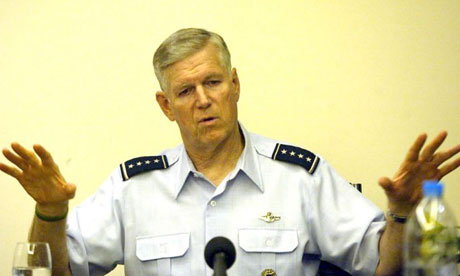
US military chief General Richard Myers

US military chief General Richard Myers. Photographer: Khalil Mazraawi/AFP

America's most senior general was "hoodwinked" by top Bush administration officials determined to push through aggressive interrogation techniques of terror suspects held at Guantánamo Bay, leading to the US military abandoning its age-old ban on the cruel and inhumane treatment of prisoners, the Guardian reveals today.

General Richard Myers, chairman of the US joint chiefs of staff from 2001 to 2005, wrongly believed that inmates at Guantánamo and other prisons were protected by the Geneva conventions and from abuse tantamount to torture.

The way he was duped by senior officials in Washington, who believed the Geneva conventions and other traditional safeguards were out of date, is disclosed in a devastating account of their role, extracts of which appear in today's Guardian.

In his new book, Torture Team, Philippe Sands QC, professor of law at University College London, reveals that:

· Senior Bush administration figures pushed through previously outlawed measures with the aid of inexperienced military officials at Guantánamo.

· Myers believes he was a victim of "intrigue" by top lawyers at the department of justice, the office of vice-president Dick Cheney, and at Donald Rumsfeld's defence department.

· The Guantánamo lawyers charged with devising interrogation techniques were inspired by the exploits of Jack Bauer in the American TV series 24.

· Myers wrongly believed interrogation techniques had been taken from the army's field manual.

The lawyers, all political appointees, who pushed through the interrogation techniques were Alberto Gonzales, David Addington and William Haynes. Also involved were Doug Feith, Rumsfeld's under-secretary for policy, and Jay Bybee and John Yoo, two assistant attorney generals.

Mark these names carefully, compatriots! There time is coming.

The revelations have sparked a fierce response in the US from those familiar with the contents of the book, and who are determined to establish accountability for the way the Bush administration violated international and domestic law by sanctioning prisoner abuse and torture.

The Bush administration has tried to explain away the ill-treatment of detainees at Guantánamo Bay and Abu Ghraib prison in Iraq by blaming junior officials. Sands' book establishes that pressure for aggressive and cruel treatment of detainees came from the top and was sanctioned by the most senior lawyers.

Myers was one top official who did not understand the implications of what was being done. Sands, who spent three hours with the former general, says he was "confused" about the decisions that were taken.

Myers mistakenly believed that new techniques recommended by Haynes and authorised by Rumsfeld in December 2002 for use by the military at Guantánamo had been taken from the US army field manual. They included hooding, sensory deprivation, and physical and mental abuse.

Does anyone wonder what kind of physical and mental abuse we are talking about here? Given that we have all heard or read about some detainees who were completely out of their minds by the time they were interviewed by a defense lawyer, I would like to know what is being done to human minds in our names.

"As we worked through the list of techniques, Myers became increasingly hesitant and troubled," writes Sands. "Haynes and Rumsfeld had been able to run rings around him."

Myers and his closest advisers were cut out of the decision-making process. He did not know that Bush administration officials were changing the rules allowing interrogation techniques, including the use of dogs, amounting to torture.

"We never authorised torture, we just didn't, not what we would do," Myers said. Sands comments: "He really had taken his eye off the ball ... he didn't ask too many questions ... and kept his distance from the decision-making process."

Larry Wilkerson, a former army officer and chief of staff to Colin Powell, US secretary of state at the time, told the Guardian: "I do know that Rumsfeld had neutralised the chairman [Myers] in many significant ways.

"The secretary did this by cutting [Myers] out of important communications, meetings, deliberations and plans.

"At the end of the day, however, Dick Myers was not a very powerful chairman in the first place, one reason Rumsfeld recommended him for the job".

He added: "Haynes, Feith, Yoo, Bybee, Gonzalez and - at the apex - Addington, should never travel outside the US, except perhaps to Saudi Arabia and Israel. They broke the law; they violated their professional ethical code. In future, some government may build the case necessary to prosecute them in a foreign court, or in an international court."

Out of the country? What? Making our country a safe place for international criminals.? Giving torturers safe haven? Making every American complicit in giving shelter to terrorists, essentially? Are you serious?

(Someone should warn Saudi Arabia and Israel that there are those who would not take kindly to them giving safe haven to terrorists either.)

It is our country these men have harmed greatly, in ways it will take years to fully comprehend, with their unconscionable behavior. They have tortured and murdered other human beings in our name, while making use of our money to pull it off.

Did we not learn a damn thing from what happened in Germany, a very young Democracy compared to ours, when they followed a deranged madman and his cabal of evil-doers off a cliff?

If "We, the people" care about human decency, human rights, meaning ours as well as those of our planetary family, the golden rule, the Nuremberg accords, the Geneva conventions, the U.N. Charter, our own constitution and/or our own souls, we had better be prepared to do what our government will not. The Hague is still there. It is up to us to see that our war criminals get the same treatment as others who have gone before them.

For those who don't give a damn about any of the above, allow me to assure you that karma will take care of you in ways your fellow citizens, nor the prosecutors and judges at Hague, could ever imagine. Count on it.

This war crimes/torture issue is the single biggest one for our nation's well-being (which is already in peril) and for our own souls' sake. We are not only losing an ill-conceived, criminal war in Iraq, which is only right and proper, given the way in which it was conceived, we are losing our identity as a nation. (Perhaps that is not an altogether bad thing, since our self-identity was a bit overblown anyway. Nevertheless, we are losing it in such a way that it is dangerous for all of us and our progeny, in ways we cannot yet imagine.)


(In accordance with Title 17 U.S.C. Section 107, this material is distributed without profit to those who have expressed a prior interest in receiving the included information for research and educational purposes. I.U. has no affiliation whatsoever with the originator of this article nor is I.U endorsed or sponsored by the originator.)


The Nazis, Fascists and Communists were political parties before they became enemies of liberty and mass murderers.

Saturday, December 29, 2007

Like Saddam, Junior Likes Torture Tapes

Did Bush Watch the Torture Tapes?
By Scott Horton

12/27/07 "Harpers" -- -- The Times (London)

Washington correspondent, Sarah Baxter, reporting with a summary of the developments in the case involving the CIA’s destruction of recordings of the treatment of Abu Zabaydah, points to the growing belief in Washington that President Bush viewed the torture tapes. Baxter reports:

It emerged yesterday that the CIA had misled members of the 9-11 Commission by not disclosing the existence of the tapes, in potential violation of the law. President George W Bush said last week he could not recall learning about the tapes before being briefed about them on December 6 by Michael Hayden, the CIA director. “It looks increasingly as though the decision was made by the White House,” said Johnson. He believes it is “highly likely” that Bush saw one of the videos, as he was interested in Zubaydah’s case and received frequent updates on his interrogation from George Tenet, the CIA director at the time.

It has emerged that the CIA did preserve two videotapes and an audiotape of detainee interrogations conducted by a foreign government, which may have been relevant to the trial of Zacarias Moussaoui, the Al-Qaeda conspirator. The CIA told a federal judge in 2003 that no such recordings existed but has now retracted that testimony. One of the tapes could show the interrogation of Ramzi Binalshibh, a September 11 conspirator, who was allegedly handed to Jordan for questioning.

In this regards, the sequence of statements out of the White House is extremely revealing. It started with firm denials, then went silent and then pulled back rather sharply to a “President Bush has no present recollection of having seen the tapes.” This is a formulation frequently used to avoid perjury charges, a sort of way of saying “no” without really saying “no.” In between these statements, two more things unfolded that have a bearing on the question.

The New York Times squarely placed four White House lawyers in the middle of the decision about whether to destroy the tapes—Alberto Gonzales, David Addington, John Bellinger and Harriet Miers. It also reported that at least one of them was strongly advocating destruction. Suspicion immediately fell on the principle mover in support of torture, David Addington.

May they all rot in hell!

Second, John Kiriakou clarified his statements about the purpose for which the tapes were made. It was to brief higher ups about the process of the interrogation. Reports persist that one “higher-up” in particular had a special strong interest in knowing the details of the Abu Zubaydah case. His name is George W. Bush.

Mr. Frog Exploder, himself.


Are Bush’s denials that he has seen the torture tapes really credible? I don’t think so. And having seen them, the interest in their destruction would be equally fierce, which helps account for the involvement of the White House’s four most senior lawyers in the process. No doubt about it. The White House desperately wants to scapegoat some CIA people over this. (Laura Rozen’s article

“Operation Stop Talking” is the best treatment so far of this phenomenon, which finds its best current expression in the effort to “get” John Kiriakou). But the trail leads to the White House, and that is clearly where the decision was taken. It will be interesting to see the techniques used by the Justice Department to obscure all of this. At this point, no one who’s tracked Justice Department antics over the past six years is anticipating anything but a crude cover-up.

Torture Lawyer’s Appointment Blocked.

In 1946, the United States prosecuted two Justice Department lawyers for a peculiar crime. They had written memoranda which, in disregard of international law, facilitated the torture and abuse of prisoners. They were sentenced to ten years in prison, less time served. That was in the days when the Justice Department lived up to its name. The case is called United States v. Altstoetter. It would be a good case for Michael Mukasey to read; his underlings could benefit from a reading, too, since the time is approaching when it’s going to have some direct impact in their own lives.

In George Bush’s America, however, lawyers who specialize in making torture and abuse possible are promoted. Indeed, they become attorney general and get appointed to Court of Appeals judgeships. And one of the key figures in this disgraceful saga is Steven Bradbury, the “acting” head of the Office of Legal Counsel. Many senators demanded that Michael B. Mukasey withdraw his nomination to head the office after it was learned that he had issued memoranda enabling waterboarding and other torture practices. In fact, it was later learned that Bradbury was brought into the job in a rush when his predecessor, Daniel Levin, started exploring the need to impose limits on waterboarding. Levin was fired so that Bradbury could come in and confirm that under Bush torutre knows no limits.

However, Mukasey’s decision to wink at the process of torture and abuse is nowhere more evident than in his decision to proceed with the promotion of one of the prime torture lawyers, Bradbury. President Bush was prepared to use his recess appointment power to reward Bradbury with an order which would take away the word “acting” and make his position permanent—within the time limits of the recess appointment.
But the Senate figured this out, and by convening every day, it has blocked the appointment. As the Associated Press’s
Laurie Kellman reports:

A nine-second session gaveled in and out by Sen. Jim Webb, D-Va., prevented Bush from appointing as an assistant attorney general a nominee roundly rejected by majority Democrats. Without the pro forma session, the Senate would be technically adjourned, allowing the president to install officials without Senate confirmation.

Bravo for the Senate.

Remembering those in Need On Christmas Day, the superscript in the New York Times read, just as it has read for a century: “It’s Christmas Day. Remember the Neediest!” And on St. Stephen’s Day, as Christmas continued, the editors of the Times did exactly that. They authored an editorial addressing the rotting cesspool of a Justice Department that the Bush Administration has created, and all the unfinished business which Congress must pick up in the coming year. And right at the top of the list was this:

There is evidence of impropriety in several recent prosecutions, including that of Don Siegelman, a former governor of Alabama who is serving a lengthy prison sentence. Mr. Mukasey needs to investigate Mr. Siegelman’s case and others that have been called into question to ensure that no one was wrongly put in jail by his department, and that anyone who acted improperly is held accountable.

The integrity of the Justice Department is precious. The fair application of the law is the cornerstone of American justice and American democracy. A halfway resolution of this scandal is not enough. It needs to be investigated vigorously and completely.

The fact is, since coming to office six weeks ago, Michael Mukasey has not lifted a finger to address the egregious abuses that led to the false charges brought against Governor Siegelman and the corrupt process by which he was convicted.

This continues to stain the Department of Justice. And, as we will soon be exploring in greater detail, the Justice Department continues to cover up, make apologies for the gross misconduct of those involved in the Siegelman case and to obstruct a proper investigation of prosecutorial misconduct by Congress. This scandal continues to fester, and the New Year must bring a renewed effort to secure justice and to punish those who perpetrated this abuse.

10 Myths About Iraq

American mainstream media coverage from Iraq remains pathetic. It’s heavily skewed by politics, which is to say, it doesn’t cover things in Iraq as they are. Rather it presents the vision of Iraq emanating from political leaders in the United States—from the White House and from Congress. In both cases, this vision reflects 90% political aspirations and interests and 10% reality. Shouldn’t the media be reporting on the facts on the ground rather than the politics in Washington?
Also those facts on the ground consist not just of the U.S. forces performing their mission, they include the complex political situation in the country as well. That’s the vastly more important story that regularly gets swept under the carpet because it’s “too complicated.” Complicated enough to warrant the expenditure of American lives and treasure, of course.
So what’s the remedy? I’d start with Juan Cole’s Informed Comment, still the indispensable supplement—and the best way to get a peek at the eyes and ears of the local and regional press, all within fifteen minutes. His posting yesterday is really superior—it’s
Ten Myths About Iraq. And here’s a snippet:

Myth: The US public no longer sees Iraq as a central issue in the 2008 presidential campaign.

Fact: In a recent ABC News/ Washington Post poll, Iraq and the economy were virtually tied among voters nationally, with nearly a quarter of voters in each case saying it was their number one issue. The economy had become more important to them than in previous months (in November only 14% said it was their most pressing concern), but Iraq still rivals it as an issue!

Myth: There have been steps toward religious and political reconciliation in Iraq in 2007.

Fact: The government of Prime Minister Nuri al-Maliki has for the moment lost the support of the Sunni Arabs in parliament. The Sunnis in his cabinet have resigned. Even some Shiite parties have abandoned the government. Sunni Arabs, who are aware that under his government Sunnis have largely been ethnically cleansed from Baghdad, see al-Maliki as a sectarian politician uninterested in the welfare of Sunnis.

Myth: The US troop surge stopped the civil war that had been raging between Sunni Arabs and Shiites in the Iraqi capital of Baghdad.

Fact: The civil war in Baghdad escalated during the US troop escalation. Between January, 2007, and July, 2007, Baghdad went from 65% Shiite to 75% Shiite. UN polling among Iraqi refugees in Syria suggests that 78% are from Baghdad and that nearly a million refugees relocated to Syria from Iraq in 2007 alone. This data suggests that over 700,000 residents of Baghdad have fled this city of 6 million during the US ’surge,’ or more than 10 percent of the capital’s population. Among the primary effects of the ’surge’ has been to turn Baghdad into an overwhelmingly Shiite city and to displace hundreds of thousands of Iraqis from the capital.


(In accordance with Title 17 U.S.C. Section 107, this material is distributed without profit to those who have expressed a prior interest in receiving the included information for research and educational purposes. I.U. has no affiliation whatsoever with the originator of this article nor is I.U endorsed or sponsored by the originator.)


The Nazis, Fascists and Communists were political parties before they became enemies of liberty and mass murderers.

Friday, September 14, 2007

Junior's American Tyranny

"We will push and push and push until some larger force makes us stop"
David Addington

Would that be the much larger force of an American rebellion, Mr. Addington? I don't think you really want that, do you? Imperial heads have been known to roll , especially when those heads become known as the heads of tyrants, the anti-thesis of The United States of America, her founding principles and everything her people hold dear.

You really are playing with fire.

The 9/11 tragedy did become a demarcation point for the United States, although not in the way many Americans understand. Before that date six years ago, there existed an American Republic – albeit one in decline – but afterwards a New Age authoritarian state quickly took shape.

Though some defenders of the old Republic rose up, nobody was strong enough to protect it.

How this historic calamity happened – one of the most under-reported events of modern times – is the centerpiece of our new book, Neck Deep: The Disastrous Presidency of George W. Bush, which looks at the roles of aggressive Republicans, accommodating Democrats, bullying pundits and careerist journalists.

But the fact that the eclipse of the Republic did happen has gained more corroboration from a new book by Jack Goldsmith, the former chief of the Justice Department’s Office of Legal Counsel (OLC) who clashed with senior White House lawyers over their expansive interpretation of presidential power.

“We’re going to push and push and push until some larger force makes us stop,” explained Vice President’s Dick Cheney’s legal counsel David Addington, according to Goldsmith’s new book, The Terror Presidency.

Goldsmith wrote that Addington “and, I presumed, his boss viewed power as the absence of constraint.”

However, “the absence of constraint” in the context of political leaders wielding the extraordinary authority of a powerful state is synonymous with tyranny, the antithesis of a democratic Republic with checks and balances, rule of law and respect for the will of an informed electorate.

This Bush tyranny combined its lust for unrestrained power with a parallel contempt for logic and objective information, becoming what might be called an imperial presidency in an anti-empirical world. Rationality and legality were brushed aside; action and toughness were all that mattered.

Even as President Bush stripped away the inalienable rights guaranteed by the Founders in the Constitution, he kept much of the population confused with misdirection, by asserting that he was taking these actions to defend "liberty" and "freedom."

In spring 2003, after becoming assistant attorney general at the influential Office of Legal Counsel, Goldsmith encountered the administration’s sophistry in the legal opinions that were the cornerstones of Bush’s claims of virtually unlimited presidential power in “wartime.”

“As I absorbed the opinions, I concluded that some were deeply flawed, sloppily reasoned, overbroad, and incautious in asserting extraordinary constitutional authorities on behalf of the President,” wrote Goldsmith, who regards himself as a conservative Republican though with a rational bent.

Goldsmith also was stunned to encounter the ideological extremism of Bush’s White House, which chafed at even the modest limits put on Bush’s spying power by the secret court created in 1978 by the Foreign Intelligence Surveillance Act (FISA).

In one February 2004 meeting, Addington remarked, “We’re one bomb away from getting rid of that obnoxious [FISA] court,” according to Goldsmith’s book.

The very idea that a senior government official would, even flippantly, welcome a terrorist attack as a way to panic the American people and further enhance Bush’s powers underscores how contemptuous the White House had become of the Founders’ vision of a constitutional Republic based on law and reason.

No Dissent

Bush’s White House also would brook no dissent from legal experts within the Justice Department. When Goldsmith questioned the legal reasoning behind Bush’s unilateral decision to waive the Geneva Conventions in regard to the “war on terror,” Addington lashed out angrily.

“The President has already decided that terrorists do not receive Geneva Convention protections,” Addington snapped. “You cannot question his decision.”

But Goldsmith proved to be a gutsy – if short-lived – bureaucratic infighter. When he suspended a legal opinion that permitted harsh interrogations of detainees, he did so without giving the White House advance warning.

On another occasion, when Goldsmith torpedoed a memo that permitted torture by narrowly defining it, he timed his move with the delivery of his resignation letter so the administration would find it tricky to reverse his opinion without drawing unwanted attention to the internal dispute.

Goldsmith left his influential position at the Office of Legal Counsel in July 2004 to return to academia.

Though the resistance from Goldsmith and a few others did complicate Bush’s consolidation of unlimited presidential power, the amassing of executive authority has continued to advance in the three years since Goldsmith left.

In September 2006, for instance, the Republican-controlled Congress pushed through the Military Commissions Act, which in effect creates an extra-constitutional legal system for handling a wide range of cases that Bush asserts involve “unlawful enemy combatants” and their accomplices, whether foreign or domestic.

Even after Democrats wrested control of Congress from the Republicans in November 2006, Bush continued to expand his powers. In May 2007, the Bush administration reversed long-standing legal policies and cleared the way for using powerful spy satellites against domestic targets.

Also in spring 2007, Congress acquiesced to giving Bush another blank check to fund the Iraq War. Then, just before the August recess, Democrats caved in to Bush’s demands for even more sweeping authority to spy on Americans who communicate or travel abroad.

So, the larger questions have yet to be resolved: Can Bush’s pursuit of what Goldsmith termed the “absence of constraint” be halted and reversed? Will some “larger force” finally materialize to stop the pushing from Addington and other Bush loyalists?

Can the great American Republic be salvaged and revived?

Robert Parry broke many of the Iran-Contra stories in the 1980s for the Associated Press and Newsweek. His latest book, Neck Deep: The Disastrous Presidency of George W. Bush, can be ordered at neckdeepbook.com. His two previous books, Secrecy & Privilege: The Rise of the Bush Dynasty from Watergate to Iraq and Lost History: Contras, Cocaine, the Press & 'Project Truth' are also available there.

(In accordance with Title 17 U.S.C. Section 107, this material is distributed without profit to those who have expressed a prior interest in receiving the included information for research and educational purposes. I.U. has no affiliation whatsoever with the originator of this article nor is I.U endorsed or sponsored by the originator.)


The Nazis, Fascists and Communists were political parties before they became enemies of liberty and mass murderers.

Wednesday, September 5, 2007

David Addington and the next terrorist attack.

Dick Cheney's top aide: "We're one bomb away" from our goal

In October of 2003, Jack Goldsmith -- a right-wing lawyer with radical views of executive power and long-time friend of John Yoo -- was named by the Bush administration to head the DOJ's Office of Legal Counsel, one of the most influential legal positions in the executive branch. During his tenure, he discovered numerous legal positions which the administration had adopted (many created by Yoo) that he found baseless and even unconscionable -- from torture to detention powers to illegal surveillance -- and he repudiated many of them, thereby repeatedly infuriating the most powerful White House officials, led by Cheney top aide David Addington. As a result, his tenure was extremely brief, and he was gone a mere 9 months after he began.

Goldsmith, now a Harvard Law Professor, has just written a book, to be released this month, criticizing and, in some cases, exposing for the first time, many of Bush's executive power abuses. He is donating all the proceeds from the book to charity to prevent the standard integrity attacks which Bush followers launch at any ex-officials who commit such blasphemy. In a lengthy profile in The New York Times Magazine, Jeffrey Rosen profiles Goldsmith and highlights some of the book's key revelations.

Two revelations in particular are extraordinary and deserve (but are unlikely to receive) intense media coverage. First, it was Goldsmith who first argued that the administration's secret, warrantless surveillance programs were illegal, and it was that conclusion which sparked the now famous refusal of Ashcroft/Comey in early 2004 to certify the program's legality. Goldsmith argued continuously about his conclusion with Addington, and during the course of those arguments, this is what happened:

[Goldsmith] shared the White House's concern that the Foreign Intelligence Surveillance Act might prevent wiretaps on international calls involving terrorists. But Goldsmith deplored the way the White House tried to fix the problem, which was highly contemptuous of Congress and the courts. "We're one bomb away from getting rid of that obnoxious [FISA] court," Goldsmith recalls Addington telling him in February 2004.
Their goal all along was to "get rid of the obnoxious FISA court" entirely, so that they could freely eavesdrop on whomever they wanted with no warrants or oversight of any kind. And here is Dick Cheney's top aide, drooling with anticipation at the prospect of another terrorist attack so that they could seize this power without challenge. Addington views the Next Terrorist Attack as the golden opportunity to seize yet more power. Sitting around the White House dreaming of all the great new powers they will have once the new terrorist attack occurs -- as Addington was doing -- is nothing short of deranged.

Contrary to the claims made by Bush and his followers ever since the NSA scandal arose, their real objective in secretly creating "The Terrorist Surveillance Program" was never to find a narrow means to circumvent FISA when, in those few cases, it impeded necessary eavesdropping. Rather, the goal was to get rid of FISA altogether and return the country to the days when our government could spy on us in total secrecy, with no oversight. Of course, until they could "get rid of" that law altogether -- through the only tactic they know: exploitation of Terrorism -- they simply decided to violate it at will.

More revealing still is Goldsmith's description of how the Bush administration systematically violated one law after the next -- employing tactics that are truly the hallmark of the most lawless third-world dictators:

In his book, Goldsmith claims that Addington and other top officials treated the Foreign Intelligence Surveillance Act the same way they handled other laws they objected to: "They blew through them in secret based on flimsy legal opinions that they guarded closely so no one could question the legal basis for the operations," he writes.

Goldsmith's first experienced this extraordinary concealment, or "strict compartmentalization," in late 2003 when, he recalls, Addington angrily denied a request by the N.S.A.'s inspector general to see a copy of the Office of Legal Counsel's legal analysis supporting the secret surveillance program. "Before I arrived in O.L.C., not even N.S.A. lawyers were allowed to see the Justice Department's legal analysis of what N.S.A. was doing," Goldsmith writes.

They literally decided they would break whatever laws they wanted -- one law after the next, in critical areas -- based on patently baseless memos issued by obedient followers like John Yoo. Not only did they do this in complete secrecy from Congress, they refused even to allow Executive Branch officials who were told to follow orders to see the legal basis for what they were told to do. Addington, whom Goldsmith described as "someone who spoke for and acted with the full backing of the powerful vice president," would simply demand compliance with what Cheney wanted. And anyone who objected was subjected to this (emphasis in original):
Months later, when Goldsmith tried to question another presidential decision, Addington expressed his views even more pointedly. "If you rule that way," Addington exclaimed in disgust, Goldsmith recalls, "the blood of the hundred thousand people who die in the next attack will be on your hands."
While our national media was glorifying the Great Commander-in-Chief and actively disseminating their most manipulative claims and mocking Democrats on the pettiest of grounds (The Serious National Security Grown-ups are in Charge; John Kerry windsurfs! John Edwards loves his hair!), the Bush administration was dismantling the rule of law, systematically violating long-standing statutes and treaties at will. We were ruled by a truly lawless government, while our media institutions and political elite sat by meek and respectful.

Perhaps most infuriating is the fact that, as it turns out, violating these laws in secret was not even necessary -- because Congress was, and still is, more than happy to legalize whatever they wanted to do. Almost immediately after the Supreme Court finally imposed some mild limitations on the President's detention and interrogation powers -- first in Hamdi, then in Hamdan -- Congress, as Goldsmith says, "promptly passed a law that gave him everything he asked for, authorizing many aspects of the military commissions that the Supreme Court had struck down."

And the terrorist bomb about which David Addington was fantasizing in order to get rid of FISA was equally unnecessary, since the Democratic Congress, in the face of the types of threats Goldsmith recounts Addington routinely made -- "the blood of the hundred thousand people who die in the next attack will be on your hands" -- just eviscerated the crux of FISA's protections by law. Hence, what began as the administration's illegal and secret abuses have become the legally sanctioned policies of the United States.

It is critical to emphasize that Goldsmith -- like James Comey and John Ashcroft -- is no hero. He is a hard-core right-wing ideologue who continues to support many of the administration's most radical positions, including his view that Common Article 3 of the Geneva Conventions does not apply to terrorist suspects (the position rejected by Hamdan). And it was Goldsmith who ultimately approved of the modified (and plainly illegal) NSA warrantless eavesdropping program.

Moreover, Goldsmith explains that he had not even intended to address the NSA surveillance program in his book, but changed his mind once he was served with subpoenas by the FBI in connection with the ongoing criminal investigation to find out who the whistleblower was who alerted the country to this illegality -- an investigation which Goldsmith supports. As Goldsmith says: "I'm not a civil libertarian, and what I did wasn't driven by concerns about civil liberties per se."

Goldsmith is commendable only by comparison to the truly extremist and reprehensible likes of Cheney, Addington, Gonzales and Yoo. He is, by and large, a True Believer in the Bush "War on Terror" and in theories designed to expand substantially executive power. That is what makes his revelations all the more credible, and all the more disturbing. What he is describing is a band of deranged and lawless radicals who, during his tenure, ran our government and who, after they forced him out, continue to do so.

But with little meaningful opposition to any of this -- either in the media or in the Congress -- little attention will be paid to these extraordinary revelations, and our government will continue to be shaped in the image of Dick Cheney and David Addington. Now that they have obtained most of their original wish list from a compliant Congress, just imagine what they are dreaming of, the still new unchecked powers which they believe are only "one bomb away."

-- Glenn Greenwald


(In accordance with Title 17 U.S.C. Section 107, this material is distributed without profit to those who have expressed a prior interest in receiving the included information for research and educational purposes. I.U. has no affiliation whatsoever with the originator of this article nor is I.U endorsed or sponsored by the originator.)

The Nazis, Fascists and Communists were political parties before they became enemies of liberty and mass murderers.

Saturday, February 3, 2007

Bush: Leaker-in-Chief


Cheney's Handwritten Notes Implicate Bush in Plame Affair

By Jason Leopold and Marc Ash

Copies of handwritten notes by Vice President Dick Cheney, introduced at trial by attorneys prosecuting former White House staffer I. Lewis "Scooter" Libby, would appear to implicate George W. Bush in the Plame CIA Leak case.

Bush has long maintained that he was unaware of attacks by any member of his administration against [former ambassador Joseph] Wilson. The ex-envoy's stinging rebukes of the administration's use of pre-war Iraq intelligence led Libby and other White House officials to leak Wilson's wife's covert CIA status to reporters in July 2003 in an act of retaliation.

But Cheney's notes, which were introduced into evidence Tuesday during Libby's perjury and obstruction-of-justice trial, call into question the truthfulness of President Bush's vehement denials about his prior knowledge of the attacks against Wilson. The revelation that Bush may have known all along that there was an effort by members of his office to discredit the former ambassador begs the question: Was the president also aware that senior members of his administration compromised Valerie Plame's undercover role with the CIA?

Further, the highly explicit nature of Cheney's comments not only hints at a rift between Cheney and Bush over what Cheney felt was the scapegoating of Libby, but also raises serious questions about potentially criminal actions by Bush. If Bush did indeed play an active role in encouraging Libby to take the fall to protect Karl Rove, as Libby's lawyers articulated in their opening statements, then that could be viewed as criminal involvement by Bush.

Last week, Libby's attorney Theodore Wells made a stunning pronouncement during opening statements of Libby's trial. He claimed that the White House had made Libby a scapegoat for the leak to protect Karl Rove - Bush's political adviser and "right-hand man."

"Mr. Libby, you will learn, went to the vice president of the United States and met with the vice president in private. Mr. Libby said to the vice president, 'I think the White House ... is trying to set me up. People in the White House want me to be a scapegoat,'" said Wells.

Cheney's notes seem to help bolster Wells's defense strategy. Libby's defense team first discussed the notes - written by Cheney in September 2003 for White House Press Secretary Scott McClellan - during opening statements last week. Wells said Cheney had written "not going to protect one staffer and sacrifice the guy that was asked to stick his head in the meat grinder because of incompetence of others": a reference to Libby being asked to deal with the media and vociferously rebut Wilson's allegations that the Bush administration knowingly "twisted" intelligence to win support for the war in Iraq.

However, when Cheney wrote the notes, he had originally written "this Pres." instead of "that was."

During cross-examination Tuesday morning, David Addington was asked specific questions about Cheney's notes and the reference to President Bush. Addington, former counsel to the vice president, was named Cheney's chief of staff - a position Libby had held before resigning."Can you make out what's crossed out, Mr. Addington?" Wells asked, according to a copy of the transcript of Tuesday's court proceedings.

"It says 'the guy' and then it says, 'this Pres.' and then that is scratched through," Addington said.

"OK," Wells said. "Let's start again. 'Not going to protect one staffer and sacrifice the guy ...' and then what's scratched through?" Wells asked Addington again, attempting to establish that Cheney had originally written that President Bush personally asked Libby to beat back Wilson's criticisms.

"T-h-i-s space P-r-e-s," Addington said, spelling out the words. "And then it's got a scratch-through."

"So it looks like 'this Pres.?'" Wells asked again.

"Yes sir," Addington said.

Thus, Cheney's notes would have read "not going to protect one staffer and sacrifice the guy this Pres. asked to stick his head in the meat grinder because of the incompetence of others." The words "this Pres." were crossed out and replaced with "that was," but are still clearly legible in the document.

The reference to "the meat grinder" was understood to be the Washington press corps, Wells said. The "protect one staffer" reference, Wells said, was White House Political Adviser Karl Rove, whose own role in the leak and the attacks on Wilson are well documented.

Furthermore, Cheney, in his directive to McClellan that day in September 2003, wrote that the White House spokesman needed to immediately "call out to key press saying the same thing about Scooter as Karl."

McClellan had publicly stated in September 2003 that Rove was not culpable in the leak of Valerie Plame's covert CIA identity, nor was he involved in a campaign to discredit her husband, but McClellan did not say anything to the media that exonerated Libby, which led Cheney to write the note. A couple of weeks later, in October 2003, McClellan told members of the media that it was "ridiculous" for them to suggest Libby and Rove were involved in the leak, because he received personal assurances from both men that they had nothing to do with it.

Moreover, Wells insinuated Tuesday that Cheney's note [seemingly] implicating President Bush in the discrediting of Wilson was one of the 250 pages of emails and documents the White House failed to turn over to investigators who had been probing the leak for more than two years.

Wells insinuated that Cheney's note, because it contained a reference to "this Pres." may have been an explosive piece of evidence that Attorney General Alberto Gonzales, who at the time of the leak was White House counsel, withheld from investigators, citing executive privilege. Addington told Wells that when subpoenas were first issued by the Justice Department in the fall of 2003, demanding documents and emails relating to Wilson and Plame be preserved, he was given Cheney's notes and immediately recognized the importance of what the vice president had written. Addington said he immediately entered into a "discussion" with Gonzales and Terry O'Donnell, Cheney's counsel, about the note, but Addington did not say whether it was turned over to investigators in the early days of the probe.

Wells's line of questioning is an attempt to shift the blame for the leak squarely onto the shoulders of the White House - a tactic aimed at confusing the jury - and will likely unravel because it has nothing to do with the perjury and obstruction-of-justice charges at the heart of the case against Libby. Still, Tuesday's testimony implicating President Bush may be the most important revelation that has emerged from the trial thus far.

Addington revealed during his testimony Monday that in June 2003 there were internal discussions - involving President Bush and Vice President Cheney - about declassifying for specific reporters a portion of the highly classified October 2002 National Intelligence Estimate as a way to counter Wilson's criticisms against the administration. That portion purportedly showed that Iraq was attempting to purchase uranium from Niger to use for building an atomic bomb - a claim that Wilson had debunked when he personally traveled to Niger to investigate it a year earlier.

In late June or early July 2003, "a question was asked of me - by Scooter Libby: Does the president have authority to declassify information?" Addington told jurors Monday, in response to a question by defense attorney William Jeffress. "And the answer I gave was, 'Of course, yes. It's clear the president has the authority to determine what constitutes a national security secret and who can have access to it.'"

President Bush signed an executive order in 2003 authorizing Cheney to declassify certain intelligence documents. The order was signed on March 23, four days after the start of the Iraq War and two weeks after Wilson first appeared on the administration's radar.
-------
http://Truthout.org will publish a follow-up to this story, with opinions from legal experts on possible implications of these latest developments for the White House.

The Nazis, Fascists and Communists were political parties before they became enemies of liberty and mass murderers.

Tuesday, January 30, 2007

Fleischer and Addigton Testify at Libby Trial

By Laurie Asseo

Jan. 29 (Bloomberg) -- Former White House Press Secretary Ari Fleischer told a jury that ex-vice presidential aide Lewis ``Scooter'' Libby disclosed a CIA operative's identity to him three days before Libby has testified he learned it.

Fleischer, testifying in the second week of Libby's perjury trial in Washington, said Libby told him during lunch on July 7, 2003, that Iraq war critic Joseph Wilson was sent to Africa by the Central Intelligence Agency the previous year at the instigation of his wife. Wilson's wife worked for the CIA in its counter-proliferation division, Fleischer said Libby told him.

`I think that he told me her name,' which is Valerie Plame, Fleischer told the jury today. Libby also said `something on the lines of `This is hush-hush. This is on the QT. Not very many people know about this,''' he told the jury. Fleischer testified for prosecutors under a grant of immunity from prosecution.

Libby, 56, is accused of lying to investigators probing whether U.S. officials deliberately leaked Plame's identity to retaliate against Wilson for attacking the administration's Iraq war claims. Libby told investigators he learned about Plame for the first time from NBC journalist Tim Russert on July 10, 2003, three days after his lunch with Fleischer.

Libby's lawyers say he was so focused on national security in 2003 that he confused the facts surrounding the Wilson episode. It is a federal crime to knowingly reveal the identity of a covert CIA agent. No one has been charged with the leak.

`New to Me'

Fleischer said Libby's disclosure about Wilson's wife was ``new to me.'' Fleischer said he thought the point of bringing up Wilson's wife was ``nepotism at the CIA.''

Fleischer said he left later that day with President George W. Bush on a trip to Africa. Several days later on Air Force One he overheard White House communications director Dan Bartlett say he couldn't believe someone was saying Vice President Dick Cheney ``sent Ambassador Wilson to Niger; his wife sent him, she works at the CIA.''

While in Uganda, Fleischer said, he told NBC reporter David Gregory and Time magazine reporter John Dickerson that Wilson had been sent to Africa by his wife at the CIA, not by Cheney's office.

"I never in my wildest dreams would have thought this information was classified,'' he said under questioning from prosecutor Peter Zeidenberg. Fleischer said he wanted to show that Cheney had no reason to know about Wilson's report on his trip to Niger because he hadn't requested the trip. (no, he just lived at Langely, riding the CIA to support his nutty ideas.)

State of the Union

Wilson has said that during his trip he found no evidence that Iraq sought to buy uranium from Niger, as Bush said during his State of the Union message in January 2003. Wilson wrote in a New York Times column on July 6, 2003, that the administration distorted intelligence to justify the Iraq invasion. Eight days later, syndicated columnist Robert Novak revealed that Wilson's wife was a CIA operative.

Fleischer said he was "horrified'' when he learned in September 2003 that the CIA was seeking a criminal investigation into the leak of Plame's identity. He said that although he didn't think he had done anything wrong, he got an attorney and refused to testify before a grand jury until after he was granted immunity, he said.

Libby is charged with perjury, obstruction of justice and making false statements. He faces up to 10 years in prison if convicted of obstruction, the most serious charge. Libby resigned after he was indicted in October 2005.

David Addington

Later today, David Addington, who succeeded Libby as Cheney's chief of staff, testified that Libby asked him after Wilson's July 6 New York Times article whether the president had the authority to declassify information.

Addington was Cheney's counsel at the time. He said Libby also asked whether the CIA would have records to show if it sent a CIA official's spouse on an assignment. The two were alone in Addington's office in the White House, he said, and Libby motioned with his hands for Addington to keep his voice down.

Addington said he wondered if the questions were related to Wilson, though he didn't know about Plame at the time.

U.S. District Judge Reggie Walton said Judith Miller, a former New York Times reporter, will be the next witness called after Addington completes his testimony tomorrow.

The trial is expected to last four to six weeks. Walton said today that one juror had been removed "so everybody else has to stay healthy.'' He didn't explain why the juror was removed. That leaves a panel of 12 jurors and three alternates.

The case is U.S. vs. Libby, 05-394, U.S. District Court, the District of Columbia.

To contact the reporter on this story: Laurie Asseo in Washington at lasseo1@bloomberg.net Last Updated: January 29, 2007 17:03 EST


The Nazis, Fascists and Communists were political parties before they became enemies of liberty and mass murderers.