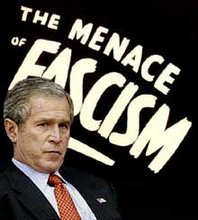
Showing posts with label Bush GOP. Show all posts

Friday, December 19, 2008

Gooper Pergatory: How Long Will It Last?

Until quite a few of them are in hell, we hope or, at least, in orange jump suits in a federal prison.

This is not just any transition from a GOP White House and Congressional majority to a Democratic White House and majority. The departing Republicans, quite a few of them, must not be allowed to ride off into the sunset, trying their very best to re-write history as they go. These people have ordered and facilitated horrendous crimes against people from all over the world, including the American people.

If there is to be no accountability, I can no longer consider myself an American. What these people have done goes against everything in which I believe, their actions and their arrogance about their actions (crimes) offend my spirit deeply.


From the editorial pages of the Wall Street Journal to the National Review Online, Republicans are working furiously to develop a comeback strategy.

The range of proposals and tactics runs the gamut from abandoning the religious right, to staying the course, to purging traitorous big-government conservatives lured by pork and power.

"Republicans walked away from the principles that minted our governing majority in 1980 and 1994," declared Mike Pence, the newly elected chair of the House Republican Conference. "There is a way out of the wilderness. But it will require humility, vision, positive alternatives and a willingness to fight for what makes America great."

That's not enough, counsels the American Enterprise Institute's David Frum: "College-educated Americans have come to believe that their money is safe with Democrats--but that their values are under threat from Republicans. And there are more and more of these college-educated Americans all the time. So the question for the GOP is: will it pursue them? To do so will involve painful change, on issues ranging from the environment to abortion. And it will potentially involve even more painful changes of style and tone: toward a future that is less overtly religious, less negligent with policy, and less polarizing on social issues. That is a future that leaves little room for [Sarah] Palin--but it is the only hope for a Republican recovery."

Evidence available now suggests, however, that whatever advice the GOP takes, it better not hold its breath. In all likelihood, Republicans can look forward to a considerable period on the sidelines. Barack Obama, Harry Reid and Nancy Pelosi could stumble badly in the face of a disastrous economy and under the constant threat of terrorist assault, but without such an opening, the Republican Party is not yet in a position to engineer its way back to dominance.

Why? First, party strength moves in cycles and the Democratic Party's turn has only just begun. Thus far, the Obama administration-to-be has demonstrated a commitment to avoiding the pitfalls of its Democratic predecessors, Jimmy Carter and Bill Clinton, giving the GOP little, or no, negative material to work with.

Second, memories of the Bush years, of the war in Iraq, congressional corruption, and above all, the trillion-dollar meltdown will require years to fade.

That does not mean the Democrats are secure. Sixteen years ago, in the wake of the 1992 election, support for Bill Clinton and the Democratic Party nosedived. But in 1994, the GOP had not been as tainted as it has been today.


"This is a very bad point in the cycle for Republicans, in terms of demographic trends in voter support, the timing of the cycle, and the overall image of the party," said the AEI's Norman Ornstein. "Republicans can hope that Obama and congressional Dems screw up, or that voters are less patient about economic recovery than they were in the 1930s. But that is a thin reed on which to base long-term hopes when neither geographical bases nor emerging voter groups are moving in your direction."

Democratic consultant Bill Carrick noted that in 1993-94, his party's setbacks followed the 1992 election in which Bill Clinton won only a plurality in a three-way contest, and in 1994, "the Ross Perot voters went for Republican Congressional candidates. Right now, there is no similar large group of alienated and unaligned voters capable of changing the partisan balance."

Carrick argues that "we are likely at the beginning of a Democratic-dominant period. Republicans are confronted with multiple problems--regional, demographic, and ideological. So far, the GOP leadership barely acknowledges most of these problems. The first part of building a healthy Republican Party would be to recognize the seriousness of your problems. The political climate could be very hostile to the GOP for several more years. The severity of the current economic crises is much better suited to Democratic solutions like stimulating the economy with government spending or dealing with government help on mortgage foreclosures."

Republican pollster Whit Ayres was more optimistic about GOP prospects, noting not only the brevity of the 1992 Democratic surge, but also the quick collapse of Democrats' Watergate-driven gains in 1974 and 1976, quickly followed by major Republican congressional pickups in 1978, and the GOP take-over of the White House and Senate in the 1980 election. "The electorate can switch gears very fast," he said.

Ayres shares the widely-held view that "what really matters now is how Obama governs." But he believes that "Republican failings will seem like ancient history compared to Obama's struggles to deal with the economy and looming terrorist threats."

Looking at these questions from a long-term historical perspective, Yale political scientist David Mayhew contends that "perceived management success or failure by an in-party, involving the economy or national security, has been more important in motoring parties in or out of office. On the economic front, governing parties as well as their entire doctrines of political economy have been discredited by bad economic troubles that the in-parties didn't deal with well. Consider the Grover Cleveland Democrats (small state; free trade) in 1894-96, the Hoover GOP in 1930-32, the Carter Democrats (the great inflation; stagflation; the demise of Keynesianism, etc.) in 1980."

This suggests, according to Mayhew, that "on occasions like these, a new in-party has a priceless opportunity to enact policies its activists would have wanted to enact anyway by wrapping them in a package of relief, recovery, and needed structural reform. That window is opening up for the Obama Democrats."

In the meantime, Obama and his advisors are going out of their way to demonstrate that their decisions will not be designed to accommodate ideological interest groups, but rather to secure a centrist footing, a strategy demonstrated most explicitly by Obama's top Cabinet-level appointments and by the choice - some say centrist, some say too far to the right - of Saddleback Church's Rick Warren to give the invocation at the January 20 inauguration.


(In accordance with Title 17 U.S.C. Section 107, this material is distributed without profit to those who have expressed a prior interest in receiving the included information for research and educational purposes. I.U. has no affiliation whatsoever with the originator of this article nor is I.U endorsed or sponsored by the originator.)


The Nazis, Fascists and Communists were political parties before they became enemies of liberty and mass murderers.



Monday, August 20, 2007

What A Stiking Rovian Mess!

If we are headed back to Colonial America, and it appears we are, it is high time we re-employed stockades, especially for public officials and religious hypocrites who do harm to us all.


The President’s Brain is Missing

by Harold Meyerson

Karl Rove, who announced his resignation last week as President George Bush’s political and domestic policy consigliere, was always a man on a mission: he wanted to be the man who engineered a Republican realignment of American politics.

By their very nature, genuine realignments - the process by which political parties win and maintain a dominant majority of voters over several decades - are rare in the US. The classic example is that of 1932-36, when the combination of the Great Depression and Franklin D Roosevelt dispatched the previously ascendant laissez-faire Republicans to the political hinterlands and established a period of Democratic dominance that lasted until 1968, when the New Deal coalition was sundered by issues of race, the Vietnam War, and cultural upheaval.

When Republicans think realignment, though, they hark back to 1896 when, confronted by the populist challenge of Democrat William Jennings Bryan, the Republicans assembled a coalition of nouveau riche industrialists and North-eastern and mid-Western Protestant workers and farmers that was to keep them in power until the Depression.

As early as the beginning stages of Bush’s first run for the White House in 1999, Rove had realignment on the brain, and saw himself as Hanna’s second coming. He was, in fact, the fourth prominent right-wing Republican who saw realignment lurking just around the corner. The first, William Kristol, editor of the neoconservative Weekly Standard warned Republicans against cutting any deal with President Clinton that would set up national healthcare, for to do so would cement voters ties to government and the Democrats, as had happened in the 1930s.

Kristol’s analysis served as a springboard for the theories, if they may be called such, of the Republican House Speaker Newt Gingrich and the conservative activist Grover Norquist, who has been convening weekly meetings of right-wing lobbyists and leaders in Washington for the past 15 years. From the mid-Nineties, Gingrich and Norquist argued that the passage of the United States to an information-age superpower, from a nation of employees to a nation of entrepreneurs, meant that the market would supplant the government as the source of Americans’ security, and that if the Republicans championed that cause - privatising social security and Medicare, for instance - they would bring about a realignment as fundamental, and as rooted in economic realities, as Hanna’s or FDR’s.

These were the ideas that fired the imaginations of Bush and Rove. Privatising social security was a theme on which Bush campaigned unsuccessfully for a seat in Congress a quarter-century ago - a campaign on which Rove, then a young Republican operative, offered his advice. By the time Bush reached the White House, rolling back the New Deal was at the centre of their mental tapestry. The Republican Party had taken a quantum leap rightward during the 1990s, a period when the Democrats held the White House and when, for the first time, the Republican’s congressional leaders all came from anti-statist South.

The goals of Rove the realigner and Rove the campaign strategist didn’t always mesh, however, although the campaign strategist had to succeed for there to be any prospect of realignment.

As a campaign strategist, Rove embraced the idea, shortly after Bush’s 2000 victory, that America had an all-but-unbridgeable partisan rift, and that he would try to win votes at election time and in Congress by building support among right-wing Republicans and eking out 51 per cent victories. The 9/11 attacks created the possibility that Bush could govern with a broad, bipartisan coalition. But instead, Bush, Rove and Vice-President Dick Cheney concluded that they could wage an aggressive foreign policy and depict Democrats as dissidents whose loyalty to their country was questionable. They began by forcing a congressional vote on authorising war in Iraq shortly before the 2002 election. This line of attack, which informed countless campaigns the Republicans waged against Democratic members of the House and Senate, poisoned national politics, and helped the Republicans win narrow victories in 2002 and 2004.

So, too, did the politicization of the government bureaucracy. Since the Democrats retook Congress in 2006 and began investigating the Bush administration, they have turned up numerous instances of the subordination of governmental agencies to narrow political ends. The Senate Judiciary Committee has been trying to compel Rove’s testimony in the matter of nine discharged federal prosecutors, whose sin seems to have been their unwillingness to file spurious voter fraud cases that the administration hoped would lead the curtailment of various Democratic voter registration campaigns, particularly in minority communities. The paper and email trail in the case leads to Rove, but he has thus far avoided testifying.

After Bush’s 2004 re-election, Rove’s formal portfolio grew from politics to all domestic policy. Bush and he had two great priorities for their second term: privatising social security and reforming immigration law to enable undocumented immigrants, chiefly from Mexico and Central America, to attain legal status. The imperative for these changes were purely political; there was no popular clamour for either.

Yet, both were essential if realignment were to be achieved from on high. The former would end Americans’ reliance on a successful government programme; the latter would endear Republicans to Hispanics, the fastest-growing part of the body politic. Both were exquisitely mistimed. Bush and Rove did not realise that the economic changes they had celebrated actually produced widespread insecurity among the American people.

The realisation of the neo-liberal vision - the outsourcing of jobs, the end of stable employment relationships, the abandonment by employers of healthcare coverage and pensions for their workers, the prolonged stagnation of wages - made this the worst possible time to dismantle the government’s retirement programme. The openness of the US economy to the downsides of globalisation helped engender a nativism, particularly in Republican ranks, that made this a terrible time to reform immigration as well.

Both initiatives were stillborn. And such abject failures in domestic policy, when compounded by such other dĂ©bĂącles as the government’s failure to deal with Hurricane Katrina and the war of the president’s choosing in Iraq, led to a decisive Democratic victory in 2006. Americans who call themselves Democrats now exceed those who call themselves Republicans by roughly 15 per cent; young people are rejecting Rove’s party by huge margins; and Republican prospects in the 2008 elections look dire.

So Rove will not be remembered as the man who brought a Republican realignment. The only question is whether he will have hastened a Democratic one.

Harold Meyerson is executive editor of ‘The American Prospect’ and a columnist on ‘The Washington Post’

© 2007 Independent News and Media Limited


(In accordance with Title 17 U.S.C. Section 107, this material is distributed without profit to those who have expressed a prior interest in receiving the included information for research and educational purposes. I.U. has no affiliation whatsoever with the originator of this article nor is I.U endorsed or sponsored by the originator.)


The Nazis, Fascists and Communists were political parties before they became enemies of liberty and mass murderers.


Thursday, July 12, 2007

Goopers Still Standing my The Cretin Idiot

WTF is it gonna take?

A Nuclear device set off in a large city?


Millions of dead Americans and others?

Financial losses that will make the Crash of '29 look like a picnic at the beach?

How much more until America wakes the hell up?

GOP still stand by Bush, blocking war plan

Wednesday, July 11, 2007

(07-11) 14:27 PDT Washington -- Republican congressional support for President Bush's Iraq war policy may be splintering, but enough GOP senators remained united with the president today to sidetrack legislation that would have made it harder to return military units to the war zone.

Republican leaders succeeded in blocking the proposal from coming up for a final vote, but seven of their members joined 48 Democrats and one independent in trying to require the Senate to consider the proposal of Democratic Sen. Jim Webb of Virginia and Republican Sen. Chuck Hagel of Nebraska. Still, the 56-41 vote left frustrated anti-war senators short of the 60 votes required to break the procedural filibuster.

But the focus was on the growing numbers of Republicans who turned away from the war now in its fifth year. With anti-war Democrats convinced that the public is on their side -- and the 2008 elections already looming

-- Democratic leaders are only too glad to force vote after vote in both houses of Congress requiring Republicans to support Bush or break with their president and support a U.S. troop withdrawal from Iraq.

Democratic leaders also hope the repeated votes make the case to their party's base that they're carrying through on their 2006 campaign promise to try to end the war, but Republicans are blocking the effort.

The president wants Congress to hold off on any policy changes until Gen. David Petraeus, the U.S. commander in Iraq, reports in September about how Bush's decision to increase combat troops has worked. But Sen. Olympia Snowe of Maine became the latest Republican to break with the president when she and Hagel said they would co-sponsor a bill that calls for most American forces to leave Iraq by next April.

One other Republican, Sen. Gordon Smith of Oregon, had already endorsed the plan of Democratic Sens. Carl Levin of Michigan and Jack Reed of Rhode Island. The Senate began debating the measure Wednesday as it continued its consideration of the fiscal 2008 military authorization bill.

The pressure on Republicans also will intensify in the House on Thursday when Democrats, bolstered by a new Gallup Poll showing that more than 70 percent of Americans support withdrawing almost all U.S. forces by next April, are scheduled to debate and vote on a measure calling for just that.

"If Republicans vote their constituencies, we are going to get over half of them,'' forecast House Majority Leader Steny Hoyer, D-Md.

After the Senate vote, Sen. Barbara Boxer, D-Calif., said anti-war forces in Congress have momentum, but she blasted the Republican Senate minority for blocking action on Webb's proposal to give military units longer rests in this country before being redeployed to Iraq.

"Except for a handful of Republicans, Republicans in the Senate are desperately clinging to the status quo. And this time, they have gone too far,'' Boxer said.

Of the seven Republicans who sided with the Democrats, six are up for re-election next year, if they choose to run again, and all of them are prime Democratic targets. They are Collins, Hagel, Smith, Norm Coleman of Minnesota, John Sununu of New Hampshire and John Warner of Virginia. Snowe also voted for the redeployment measure.

But three senior Republican members, Richard Lugar of Indiana, George Voinovich of Ohio and Pete Domenici of New Mexico, opposed the measure despite saying the past few weeks that they think it's time to start withdrawing from Iraq.

A group of Republican senators met Wednesday with administration officials at the White House to warn that support for the war is ebbing and the president must change policy soon.

Republican Senate leader Mitch McConnell of Kentucky, who also faces re-election next year ,was asked repeatedly if Wednesday's defections were a harbinger of future wider splits in his party ranks.

But he deflected the question.

"We're pleased to have succeeded'' in blocking the Webb-Hagel plan, McConnell said. "Many of us feel Gen. Petraeus should be given the opportunity to operate without our advice on this bill. Another assessment will come in September.''

In the House, leaders plan to vote before the August recess other anti-war steps, including a ban on permanent U.S. bases in Iraq, offered by Rep. Barbara Lee, D-Oakland, and a House version of the de-authorization of the war proposed by Rep. Ellen Tauscher, D-Walnut Creek.

But Senate Majority Leader Harry Reid, D-Nev., belittled a possible bipartisan proposal calling for implementation of last year's Iraq Study Group proposals. He said the time has past for such an idea.

"It doesn't have the teeth of a toothless tiger. It won't change one thing the president does,'' Reid said.

E-mail Edward Epstein at eepstein@sfchronicle.com

http://sfgate.com/cgi-bin/article.cgi?f=/c/a/2007/07/11/BAGDBQUMGU7.DTL


(In accordance with Title 17 U.S.C. Section 107, this material is distributed without profit to those who have expressed a prior interest in receiving the included information for research and educational purposes. I.U. has no affiliation whatsoever with the originator of this article nor is I.U endorsed or sponsored by the originator.)

The Nazis, Fascists and Communists were political parties before they became enemies of liberty and mass murderers.


Tuesday, July 10, 2007

Gooper Meltdown, As Forecast


Republicans are Approaching Impeachment Mentality

by rob kall

Republicans in the senate are taking itty bitty baby steps down the road towards impeachment.

They're not talking about or thinking about impeachment yet, but the recent steps leading GOP senators are taking, speaking out agains the Iraq war are the beginning steps necessary to break the Bush loyalty mindset.

For the past seven years, Republican senators have been marching in lockstep with the idiots in the Whitehouse. Finally, facing an angry, dissatisfied electorate, these GOP senators are also facing reality. Supporting Bush and his policies is bad for their job futures.

This is creating a new mentality-- an "I can disagree with Dubya mentality"-- an "I better disagree if I'm going to keep my job" mentality.

It's a bit like getting into the pool the first time in a new season. You have to get wet, have to brace yourself for the chill. But once you're in, you get used to it and it's easy to get out and get back in a second and third time.

It's a bit like losing your virginity. Once you've done the nasty, you don't have the old barrier, the worry about doing what you've never done before, as a concern anymore.

Don't get me wrong. I'm not saying that Republicans are ready to impeach. But the process of accepting the reality that they can publicly disagree with Bush, reject his policy and stand against him is a good thing for the impeachment movement, and really a good thing for America, which sorely needs the patriotic assistance of the GOP in re-asserting the rule of law, the constitution and ethical political engagement.

It is inevitable that more GOP senators will join the get out of Iraq fast already bandwagon. Even seeing their colleagues doing it is having a mental effect upon them-- particularly the incumbents up for election next year. The wall is being eroded.

Note that impeachment is not something that is necessary in the senate. Dave Lindorff has eloquently argued that the whole idea of impeachment was conceived as something the house of representatives does. He writes in his article Forget a Senate Trial, Impeachment is its own Punishment

Under the Constitution, there is no obligation for the Senate to even hold a trial after someone is impeached. It is an option, which is up to the will of the Senate.

When the Founding Fathers drew up the impeachment clause, they envisioned it as its own punishment. Trial and removal were seen as a wholly separate process, in addition to impeachment.

Under the Constitution, after investigating the high crimes and misdemeanors of a president or other federal officer in an impeachment panel composed of the members of the House Judiciary Committee, which would then approve articles of impeachment, the House would vote on whether to impeach the executive.

If they concluded that Bush or Cheney, in this case, had abused their power, or had damaged the nation, or committed treason or bribery, they could then vote to impeach.

At that point the president and/or vice president would stand impeached.

For all time, they would be known as defilers of the Constitution--or perhaps as traitors, depending upon the nature of the articles approved by a House majority.

Their nefarious actions—the lying to Congress and American people, the violation of international laws, the violation of the First, Fourth, Fifth, Sixth, Seventh and Eighth Amendments, the subversion of elections, the obstruction of justice, the criminal negligence, the war crimes, the usurping of the power of the Congress and the Courts—would all stand publicly condemned by the People’s Body.

That said, it is nice to know that there are many hearings going on that are cooking the impeachment soup hotter and hotter and that the Iraq war is forcing the members of congress in both houses to re-adjust their Bush loyalty mentality. Things are moving in the right direction.


(In accordance with Title 17 U.S.C. Section 107, this material is distributed without profit to those who have expressed a prior interest in receiving the included information for research and educational purposes. I.U. has no affiliation whatsoever with the originator of this article nor is I.U endorsed or sponsored by the originator.)

The Nazis, Fascists and Communists were political parties before they became enemies of liberty and mass murderers.

Saturday, June 30, 2007

The Democratic Party and the Infantile Omnipotence of The Ruling Class.
By PhilRockstroh 06/26/2007 10:16:46 PM EST

This may help to better understand the Washington establishment and its courtesan punditry who serve to reinforce their ceaseless narrative of exceptionalism. This is why they've disingenuously covered up the infantilism of George W. Bush for so long: Little Dubya is the id of the ruling class made manifest -- he's their troubled child, who, by his destructive actions, cracks the deceptively normal veneer of a miserable family and reveals the rot within. At a certain level, it's damned entertaining: his instability so shakes the foundation of the house that it causes the skeletons in its closets to dance.

Why did the Democratic Congress betray the voting public?

Betrayal is often a consequence of wishful thinking. It's the world's way of delivering the life lesson that it's time to shed the vanity of one's innocence and grow-the-hell-up. Apropos, here's lesson number one for political innocents:

Power serves the perpetuation of power. In an era of runaway corporate capitalism, the political elite exist to serve the corporate elite. It's that simple.

Why do the elites lie so brazenly? Ironically, because they believe they're entitled to, by virtue of their superior sense of morality. How did they come to this arrogant conclusion? Because they think they're better than us. If they believe in anything at all, it is this: They view us as a reeking collection of wretched, baseborn rabble, who are, on an individual level, a few billion neurons short of being governable by honest means.

Yes, you read that correctly: They believe they're better than you. When they lie and flout the rules and assert that the rule of law doesn't apply to them or refuse to impeach fellow members of their political and social class who break the law -- it is because they have convinced themselves it is best for society as a whole.

How did they come by such self-serving convictions? The massive extent of their privilege has convinced them that they're the quintessence of human virtue, that they're the most gifted of all golden children ever kissed by the radiant light of the sun. In other words, they're the worst sort of emotionally arrested brats -- spoiled children inhabiting adult bodies who mistake their feelings of infantile omnipotence for the benediction of superior ability: "I'm so special that what's good for me is good for the world," amounts to the sum total of their childish creed. In the case of narcissists such as these, over time, self-interest and systems of belief grow intertwined. Hence, within their warped, self-justifying belief systems, their actions, however mercenary, become acts of altruism.

The elites don't exactly believe their own lies; rather, they proceed from the neo-con guru, Leo Strauss' dictum (the modus operandi of the ruling classes) that it is necessary to promulgate "noble lies" to society's lower orders. This sort of virtuous mendacity must be practiced, because those varieties of upright apes (you and I) must be spared the complexities of the truth; otherwise, it will cause us to grow dangerously agitated -- will cause us to rattle the bars of our cages and fling poop at our betters. They believe it's better to ply us with lies because it's less trouble then having to hose us down in our filthy cages. In this way, they believe, all naked apes will have a more agreeable existence within the hierarchy-bound monkeyhouse of capitalism.

This may help to better understand the Washington establishment and its courtesan punditry who serve to reinforce their ceaseless narrative of exceptionalism. This is why they've disingenuously covered up the infantilism of George W. Bush for so long: Little Dubya is the id of the ruling class made manifest -- he's their troubled child, who, by his destructive actions, cracks the deceptively normal veneer of a miserable family and reveals the rot within. At a certain level, it's damn entertaining: his instability so shakes the foundation of the house that it causes the skeletons in its closets to dance.

By engaging in a mode of being so careless it amounts to public immolation, these corrupt elitists are bringing the empire down. There is nothing new in this: Such recklessness is the method by which cunning strivers commit suicide.

Those who take the trouble to look will apprehend the disastrous results of the ruling elites' pathology: wars of choice sold to a credulous citizenry by public relations confidence artists; a predatory economy that benefits one percent of the population; a demoralized, deeply ignorant populace who are either unaware of or indifferent to the difference between the virtues and vicissitudes of the electoral processes of a democratic republic, in contrast to the schlock circus, financed by big money corporatist, being inflicted upon us, at present.

Moreover, the elitist's barriers of isolation and exclusion play out among the classes below as an idiot's mimicry of soulless gated "communities" and the pernicious craving for a vast border wall -- all an imitation of the ruling classes' paranoia-driven compulsion for isolation and their narcissistic obsession with exclusivity.

Perhaps, we should cover the country in an enormous sheet of cellophane and place a zip-lock seal at its southern border, or, better yet -- in the interest of being more metaphorically accurate -- let's simply zip the entire land mass of the U.S. into a body bag and be done with it.

What will be at the root of the empire's demise?

It seems the elite of the nation will succumb to "Small World Syndrome" -- that malady borne of incurable careerism, a form of self-induced cretinism that reduces the vast and intricate world to only those things that advance the goals of its egoist sufferers. It is an degenerative disease that winnows down the consciousness of those afflicted to a banal nub of awareness, engendering the shallowness of character on display in the corporate media and the arrogance and cluelessness of the empire's business and political classes. It possesses a love of little but mammon; it is the myth of Midas, manifested in the hoarding of hedge funds; it is the tale of an idiot gibbering over his collection of used string.

What can be done? In these dangerous times, credulousness to party dogma is as dangerous as a fundamentalist Christian's literal interpretation of The Bible: There is no need to squander the hours searching for an "intelligent design" within the architecture of denial and duplicity built into this claptrap system -- a system that we have collaborated in constructing by our loyalty to political parties that are, in return, neither loyal to us nor any idea, policy nor principle that doesn't maintain the corporate status quo.

Accordingly, we must make the elites of the Democratic Party accountable for their betrayal -- or we ourselves will become complicit. The faith of Democratic partisans in their degraded party is analogous to Bush and his loyalist still believing they can achieve victory in Iraq and the delusion-based wing of the Republican Party who, a few years ago, clung to the belief, regardless of facts, that Terri Schiavo's brain was not irreparably damaged and she would someday rise from her hospital bed and bless the heavens for them and their unwavering devotion to her cause.

Faith-based Democrats are equally as delusional. Only their fantasies don't flow from the belief in a mythical father figure, existing somewhere in the boundless sky, who scripture proclaims has a deep concern for the fate of all things, from fallen sparrows to medically manipulated stem cells; rather, their beliefs are based on the bughouse crazy notion that the elites of the Democratic Party could give a fallen sparrow's ass about the circumstances of their lives.

In the same manner, I could never reconcile myself with the Judea/Christian/Islamic conception of god -- some strange, invisible, "who's-your-daddy-in-the-sk y," sadist -- who wants me on my knees (as if I'm a performer in some kind of cosmic porno movie) to show my belief in and devotion to him -- I can't delude myself into feeling any sense of devotion to the present day Democratic Party.

Long ago, reason and common sense caused me to renounce the toxic tenets of organized religion. At present, I feel compelled to apply the same principles to the Democratic Party, leading me to conclude, as did Voltaire regarding the unchecked power of The Church in his day, that we must, "crush the infamous thing."

Freedom begins when we free ourselves from as many illusions as possible -- including dogma, clichés, cant, magical thinking, as well as blind devotion to a corrupt political class.

I wrote the following, before the 2006 mid-term election: "[...] I believe, at this late hour, the second best thing that could come to pass in our crumbling republic is for the total destruction of the Democratic Party -- and then from its ashes to rise a party of true progressives.
"[...] I believe the best thing that could happen for our country would be for the leaders of The Republican Party -- out of a deep sense of shame (as if they even possessed the capacity for such a thing) regarding the manner they have disgrace their country and themselves -- to commit seppuku (the act of ritual suicide practiced by disgraced leaders in feudalist Japan) on national television.

"Because there's no chance of that event coming to pass, I believe the dismantling of the Democratic Party, as we know it, is in order. It is our moribund republic's last, best hope -- if any is still possible."

I received quite a bit of flack from party loyalist and netroots activists that my pronouncement was premature and we should wait and see.

We've waited and we've seen. Consequently, since the Republican leadership have not taken ceremonial swords in hand and disemboweled themselves on nationwide TV, it's time we pulled the plug on the Democratic Party, an entity that has only been kept alive by a corporately inserted food-tube. In my opinion, this remains the last, best hope for the living ideals of progressive governance to become part of the body politic.

Phil Rockstroh, a self-described, auto-didactic, gasbag monologist, is a poet, lyricist and philosopher bard living in New York City. He may be contacted at: philangie2000@yahoo.com

(In accordance with Title 17 U.S.C. Section 107, this material is distributed without profit to those who have expressed a prior interest in receiving the included information for research and educational purposes. I.U. has no affiliation whatsoever with the originator of this article nor is I.U endorsed or sponsored by the originator.)

The Nazis, Fascists and Communists were political parties before they became enemies of liberty and mass murderers.

Tuesday, June 12, 2007

Goopers Block No-Confidence Vote....


.....causing us to have no confidence in them or the Department of Justice.

Guess they don't mind living in a lawless land, where the DOJ is nothing but a tool of the White House political team.

May the Republican burn in hell!

GOP blocks Gonzales no-confidence vote
By LAURIE KELLMAN,

Associated Press Writer

Republicans blocked a Senate no-confidence vote on Attorney General Alberto Gonzales Monday, rejecting a symbolic Democratic effort to force him from office amid blistering criticism from lawmakers in both parties.

The 53-38 vote to move the resolution to full debate fell seven short of the 60 required. In bringing the matter up, Democrats dared Republicans to vote their true feelings about an attorney general who has alienated even the White House's strongest defenders by bungling the firings of federal prosecutors and claiming not to recall the details.

Republicans did not defend him, but most voted against moving the resolution ahead.
Monday's vote was not the end of scrutiny for Gonzales and his management of the Justice Department — more congressional hearings are scheduled and an internal department investigation continues.

Short of impeachment, Congress has no authority to oust a Cabinet member, but Democrats were trying anew to give him a push. Gonzales dismissed the rhetorical ruckus on Capitol Hill, and President Bush continued to stand by his longtime friend and legal adviser.

"They can have their votes of no confidence, but it's not going to make the determination about who serves in my government," Bush said in Sofia, Bulgaria, the last stop on a weeklong visit to Europe.

"This process has been drug out a long time," Bush added. "It's political."

The attorney general said he was paying no attention to the rhetoric on Capitol Hill and didn't plan on leaving anytime soon.

"I am focused on the next 18 months and sprinting to the finish line," Gonzales said ad he met Monday with child advocates in an impoverished Mobile, Ala., neighborhood.

In the Senate, seven Republicans voted with Democrats to advance the no confidence resolution.
Even before the controversy over fired prosecutors, lawmakers of both parties complained that Gonzales allowed Justice to violate civil liberties on a host of other issues — such as implementing Bush's warrantless wiretapping program.

One veteran Republican said Gonzales had used up all his political capital in the Senate.
"There is no confidence in the attorney general on this side of the aisle," said Arlen Specter of Pennsylvania, the senior Republican on the Senate Judiciary Committee. Specter voted to move the resolution forward, but he said many of his GOP colleagues would not because they feared political retribution.

Democrats said it was only fair to put senators on record for or against Gonzales, particularly since five GOP senators have called for the attorney general's resignation and many more have said they have lost confidence in him.

The mere debate shook loose another Republican call for a new attorney general.

Sen. Susan Collins (news, bio, voting record), R-Maine, for the first time publicly declared she had lost confidence in Gonzales.

"I think his continued tenure does not benefit the department or our country," she said.
Chief sponsor Charles Schumer (news, bio, voting record), D-N.Y., urged more like her to vote their true feelings.

"If senators cast their vote with their conscience, they would speak with near unanimity that there is no confidence in the attorney general," said Schumer. "Their united voice would undoubtedly dislodge the attorney general from the post that he should no longer hold."

"He deserves to be fired," said Senate Majority leader Harry Reid (news, bio, voting record), D-Nev.

Whatever Gonzales may or may not deserve, some Republicans said, it's not the Senate's job to hold forth on a member of the president's Cabinet.

"This is a nonbinding, irrelevant resolution proving what? Nothing," said Sen. Trent Lott (news, bio, voting record), R-Miss. "Maybe we should be considering a vote of no confidence on the Senate or on the Congress for malfunction and an inability to produce anything."

The vote cut across party lines.

Seven Republicans voted for the no-confidence resolution, including four senators who had called for a new attorney general: Sens. John Sununu (news, bio, voting record) of New Hampshire, Gordon Smith (news, bio, voting record) of Oregon, Chuck Hagel (news, bio, voting record) of Nebraska and Norm Coleman (news, bio, voting record) of Minnesota. Joining them were Specter and Maine Republicans Olympia Snowe (news, bio, voting record) and Collins.

Sen. Joe Lieberman of Connecticut, an independent who often votes with the Democrats, voted no. And Sen. Ted Stevens (news, bio, voting record), R-Alaska, voted present.

Those not voting included Sen. John McCain, R-Ariz., a presidential candidate who had called for Gonzales' resignation.

House Democrats announced that Gonzales' deputy, Paul McNulty, who has announced his resignation, would testify June 19 about his role in the U.S. attorney firings. Gonzales last month said he relied on McNulty more than any other aide to decide which U.S. attorneys should be fired last year. But internal Justice Department documents showed that McNulty was not closely involved in picking all of those fired.

And the Justice Department's internal inspector general is investigating whether department officials improperly considered the party affiliation of candidates for career jobs there.
Majority Democrats toned down the language in their one-sentence resolution to attract more support from Republicans. The measure read: "It is the sense of the Senate that Attorney General Alberto Gonzales no longer holds the confidence of the Senate and of the American people."

Associated Press Writer Melissa Nelson contributed to this report from Mobile, Ala.


(In accordance with Title 17 U.S.C. Section 107, this material is distributed without profit to those who have expressed a prior interest in receiving the included information for research and educational purposes. I.U. has no affiliation whatsoever with the originator of this article nor is I.U endorsed or sponsored by the originator.)


The Nazis, Fascists and Communists were political parties before they became enemies of liberty and mass murderers.

Wednesday, May 30, 2007

It Takes The Non-aligned Grassroots!

In the 60s and early 70s, independents were re-born by the bus-loads.

Why?

Because a Democratic president lied us into an escalation of the war in Vitenam, after which casualty rates soared. Then A Republican president, promising to end the war with honor, broadened the damn thing, causing near revolution in this country. Neither party held any moral high-ground on Civil Rights. It did seem, however, that the Dems moved forward and the Rethugs moved backward, where civil rights were concerned in the decades that followed.

They were the party of FDR and JFK, after all. (of course, neither of these guys were perfect, but we do not expect perfection. St. Francis of Assisi is not likely to throw his cowl into the political ring anytime soon.

Still, we remained independent.

We saw the writing on the wall. We witnessed enough corruption to last a life time and we saw political courage that has inspired us 'til this day. Good thing, too. It has rarely been dupilicated since.

But it is about to be.... the universe and the human spirit willing.....and the 60s generation of independents will walfk the path of the American Political Tao.

-----------------------------------------------------

After several months of empty posturing against the war in Iraq, politicians in Washington have made what Democratic congressman James P. Moran called a "concession to reality" by agreeing to give President Bush virtually everything he wanted in funding and unrestricted license to continue waging the increasingly detested war that has made Bush the most unpopular president since Richard Nixon.

This is the outcome that we warned against two months ago when we wrote "Why Won't MoveOn Move Forward?" In it, we criticized MoveOn for backpedaling on its previously claimed objective of ending the war in Iraq immediately. Anti-war sentiment was the main factor behind last year's elections that brought Democrats to power in both houses of Congress. Once in power, however, House Speaker Nancy Pelosi pushed through a "compromise" bill, supported by MoveOn, that offered $124 billion in supplemental funding for the war. To make it sound like they were voting for peace, the Democrats threw in a few non-binding benchmarks asking Bush to certify progress in Iraq, coupled with language that talked about withdrawing troops next year.

Understanding how legislative processes work, we expected then that even those few nods to anti-war sentiment would be eliminated in due course. Bush had already said he would veto the Pelosi bill and pledged to hold out for funding without restrictions of any kind. Moreover, there was little doubt that the Democratic leadership would eventually cave to his demands.

Notwithstanding their stage-managed photo ops and rhetorical flourishes for peace, prominent Democrats signaled early that they would give Bush the funding he wanted. Barack Obama even went so far as to state publicly that once Bush vetoed the original bill, Congress would approve the money because "nobody wants to play chicken with our troops on the ground." (Two weeks later, MoveOn announced that it had polled its members, and Obama was their "top choice to lead the country out of Iraq.") In effect, the confrontation between Bush and the Democrats was a high-stakes game of poker in which the Democrats went out of their way to make it clear that they would fold once Bush called their bluff.

Not everyone saw this coming, of course. Back in March, Salon.com called MoveOn's Eli Pariser "shrewdly pragmatic" for backing Pelosi's original supplemental war funding bill. It quoted Pariser predicting that after Bush was "forced to veto" Pelosi's bill, "That forces the Republicans to choose between an increasingly isolated president and the majority of the Congress and the majority of the American people."

Similar "shrewd pragmatism" came from blogger and Democratic campaign consultant Matt Stoller at MyDD.com, praising MoveOn's "dedication to practical results" and calling the Pelosi bill "a major step forward ... Moveon was true to its members in helping this happen." Stoller criticized us by name for our naiveté in thinking otherwise:

John Stauber, who is an ardent critic of Moveon, comes from a different generation of liberal activism. ...

Stauber isn't used to a non-Southern Democratic Party. It's nothing he's ever known, and it's frankly nothing that any of us have ever known. None of us know how to wield power in this new political world, where the public is liberal, the military industrial state is cannibalizing itself, and the political system is (slowly) reorienting itself around this shocking new paradigm.

Stauber is also not used to the idea that activist liberals actually like the Democratic Party. He believes that Moveon members would not support Democratic leaders if presented with a different set of choices, without acknowledging that Moveon members have traditionally supported Democratic leaders when the questions are tactical in nature.

A "tactic," as the dictionary explains, is "an expedient for achieving a goal." If the goal is to end the war in Iraq, the Pelosi bill was never a tactic that had any chance of succeeding. Its provisions had no teeth and it was clear that too many Democrats never intended to see the fight through. As this week's betrayal by the Democratic leadership demonstrates, ending the war is simply not their goal. Their goal is to continue the war for the time being, while giving themselves just enough distance from it that they can run as the anti-war party in next year's presidential and congressional elections. Stoller seems to have belatedly arrived at this realization himself.

Responding to this week's news, he writes:
We're in Iraq because the political system, the public, and all of us became unable to distinguish between truth and falsehood. We're still in Iraq, and will be there until the public is genuinely convinced to leave. Right now, we're not there. I know what the polls say, but I also am watching Clinton, Edwards, Obama, Giuliani, Romney, etc running for President, and not one of them is calling for a full withdrawal. Not one. Clinton, the leading nominee in a supposedly antiwar party, is a hawk and doesn't even think that voting to authorize the war was a mistake.

Amazingly, the conclusion that Stoller draws from these facts is the following non sequitur:
So do not tell me that Pelosi, Reid, and Moveon are doing a bad job. They are not. They are persuading a country and a politics that is used to lazy bullshit that kills a lot of people to think twice about it, and resist.

Here's the point that Stoller seems to have missed: There is a difference between what the public wants and what politicians do. Just because the high and mighty politicians don't get it yet, don't assume that the average American doesn't. It is not "the public" that needs to be persuaded. The politicians, their marketing campaigns, and the bloggers who join them may be "unable to distinguish between truth and falsehood," but the public at large fully understands that we need to get out of Iraq. The question is simply how to translate that public awareness into effective pressure that will force the politicians to change course. As we wrote in March, "When politicians and advocacy groups like MoveOn play anti-war games of political theater while effectively collaborating with the war's continuation, they merely add one more deception to the layers of lies in which this war has been wrapped."

Since 2003 we've co-authored two books on Iraq, and we have been reporting on the war for over five years now, since we began to dissect the Bush administration's propaganda push almost immediately after 9/11. We've been reporting on MoveOn for almost as long. And by the way, we are not "ardent critics" of MoveOn, as Stoller claimed. We are trying to constructively criticize an organization whose leaders mean well, even though they have been selling a flawed strategy. MoveOn has emerged as a powerful political player with a massive email list of more than three million names and the ability to raise millions of dollars for Democrats while waging innovative PR campaigns around the environmental, political and social issues they promote.

The bottom line, however, is that MoveOn until now has always been a big "D" Democratic Party organization. It began as an online campaign to oppose the impeachment of President Clinton, and its tactical alliances with Democratic politicians have made it part of the party's current power base, which melds together millionaire funders such as George Soros and the Democracy Alliance, liberal unions like SEIU, and the ballyhooed Netroots bloggers like Matt Stoller, Jerome Armstrong and Markos Moulitsas ZĂșniga of the Daily Kos. At a personal level, we presume the members of this coalition genuinely want the war to end, but their true and primary priority is winning Democratic Party control of both houses of Congress and the White House. Now that the war in Iraq hangs like a rotting albatross around the neck of the Bush administration, it has become the Democrats' best weapon to successfully campaign against Republicans. From a "shrewdly pragmatic" point of view, therefore, they have no reason to want the war to end soon.

Some Democrats (not the top politicians, of course) are saying this openly. Here, for example, is how one blogger at the Daily Kos sees things:
I know, that means more American casualties, more Iraqi casualties, more treasure and lives wasted.

But I think you've got to keep in mind the big picture here. ... [B]y the end of September, people will be beginning to pay real attention to the next election...

I think this does give the Democratic party a tremendous opportunity to crush the Republicans for perhaps a couple of decades to come. Iraq, and the Republican support of it, may well do for the Republicans what Vietnam did for Democrats — make the public suspicious for decades about the party's bona fides on foreign policy.

In this analysis, "more treasure and lives wasted" are the "little picture," while winning elections is "the big picture." Democrats like Russ Feingold who oppose the Iraq supplemental do not share this strategy, and it is never explicitly stated even by the Democratic politicians who are signing on this week to fund the war, but it is implicit in their actions.

If you visit the MoveOn website today as we write, the top item on the page is a request for people to sign a petition against price gouging by oil companies. They're focused on the "big picture" of using the current spike in gasoline prices as an opportunity to build their email list, while the little picture of ending the war has fallen from the top of the page. Yesterday MoveOn began a campaign calling on Democrats to vote no on the Iraq supplemental. MoveOn is also talking for the first time about supporting primary challengers to Democrats who "ran on ending the war but vote for more chaos and more troops in Iraq." This belated spark of independence, however, is too little and too late to stop a deal that has already been struck, in which politicians that MoveOn has been supporting have just surrendered ground from a position of strength to a president and party that is weakened, on an issue of utmost importance to their country.

MoveOn is expert at marketing, PR and advertising. Their emails to members convey a friendly, informal style and a sense that "they" are just like "us." But there are important differences between the organization and many of the people who sign their petitions and give them money. MoveOn has not been primarily a movement against the war. It has been a movement of Democrats to get the party back into power.

We do not doubt that MoveOn's leadership sincerely believes they are pursuing the most practical and effective course to improve America's political problems by vanquishing the Republicans and getting Democrats elected. However, when given a choice between building a powerful grassroots movement to end the war, versus exploiting the war for the benefit of getting Democrats elected, MoveOn has repeatedly chosen the latter while probably believing there is no difference.

There is an organized anti-war movement in America that is not an adjunct of the Democratic Party. Up until now, it has been weak and divided and unable to organize itself into an effective national movement in its own right. In its place, therefore, MoveOn and its Netroots allies have become identified as the leadership of the anti-war movement. It is vitally important, however, that a genuinely independent anti-war movement organize itself with the ability to speak on its own behalf.

In the 1950s and the 1960s, the civil rights movement was most definitely not an adjunct of the Democratic or Republican Parties. Far from it, it was a grassroots movement that eventually forced both parties to respond to its agenda. Likewise, the movement against the Vietnam War was not aligned with either the Democratic or Republican parties, both of which claimed to have plans for peace while actually pursuing policies that expanded the war.

That's the sort of movement we need again, if we wish to see peace in our lifetime.

(In accordance with Title 17 U.S.C. Section 107, this material is distributed without profit to those who have expressed a prior interest in receiving the included information for research and educational purposes. I.U. has no affiliation whatsoever with the originator of this article nor is I.U endorsed or sponsored by the originator.)

The Nazis, Fascists and Communists were political parties before they became enemies of liberty and mass murderers.

Monday, May 14, 2007

Goopers Begin Eating Each Other.....


Let the feeding frenzy begin!

The Raw Story Bill Kristol: 'Stupid, dishonorable' Republicans wavering on Iraq:

Conservative pundit Bill Kristol on Fox News Sunday this morning criticized the wavering on support for the Iraq war by some Republicans as 'extremely stupid.'

'The idea that they will get credit for deserting the war at this point, they voted for the war, they voted to fund the war, now they're going to what? Vote for withdrawal, for surrender,' he mocked. 'Then they're going to go to voters, Republican congressmen, in 2008 and say, 'Hey, re-elect us!''

'It's a ridiculous political calculation, as well as dishonorable one,' he continued. 'The Democrats are behaving terribly, but the Republicans are behaving foolishly.'

Monday, May 7, 2007

The GOP and Rampant Hypocrisy

Published on Friday, May 4, 2007 by The Seattle Post-Intelligencer

‘Family-Values’ Cloak Lifted From GOP
by Bonnie Erbe

President Bush’s budget-busting, spendthrift tactics have robbed the GOP of its claim to the title, “Party of Fiscal Conservancy.”

Now the perverse antics of some high-level Bush appointees and his party’s power elite are lifting the cloak of “family values” from the GOP, too.

The “D.C. Madam” scandal is the latest in a string of stories revealed during Bush’s second term showing that the private lives of some of his most powerful appointees bear little resemblance to the Ozzie-and-Harriet-like ideal the party tries to mimic.

Deborah Jeane Palfrey is in court battling charges of running a high-class prostitution ring from California. She maintained a 46-pound Rolodex that has caused the resignation of one State Department potentate and reportedly contains the names of more elite administration officials and Republican Party donors. The first resignation was that of Randall Tobias, who last week fled a top State Department perch. While there, he not only managed foreign-assistance programs but also, according to The New York Times, “ran agencies that required foreign recipients of AIDS assistance to explicitly condemn prostitution, a policy that drew protests from some nations and relief organizations.”

As “AIDS czar,” Tobias alienated many AIDS-plagued, developing nations by requiring recipients of U.S. foreign aid to sign a pledge against prostitution. Donee nations complained the pledge effectively prevented organizations from befriending sex workers so as to teach them HIV/AIDS prevention. Tobias also promoted faithfulness and abstinence over condom use to prevent AIDS transmission.

Now the joke’s on Tobias, who has the gall to claim his patronage of the D.C. Madam’s women involved “no sex” and that he paid a reported $300 per session for “the gals” (as he put it) to give him massages. Yeah, right.

Even in pricy Washington, in my humble opinion, $300 seems like an awful lot for a garden-variety massage. And Bush is a uniter, not a divider.

Would that the D.C. Madam scandal were the only example of family-unfriendly behavior by powerful GOP Washingtonians. Let’s ignore, for the moment, the congressional page scandal in which disgraced former Rep. Mark Foley traded lewd e-mails with young male pages. Let’s ignore, too, the resignation of former Food and Drug Administration appointee — and evangelical Christian gynecologist (whatever that is) — Dr. W. David Hager.

Hager urged his female patients to pray for relief from medical conditions. Worse yet, The Nation Magazine reported that Hager’s ex-wife said that while he publicly sermonized and moralized on sexual matters, he repeatedly sodomized her without her consent over a seven-year period.

Let’s focus, instead, on the post-resignation antics of the man Bush appointed to lead the Office of Population Affairs. This office is in charge of doling out almost $300 million worth of contraceptives to low-income women. Yet appointee Eric Keroack once described contraceptives as “demeaning to women.” And he came to the administration’s attention due to his management of an affiliation with a string of crisis-pregnancy centers. These are the “centers” that lure pregnant women in by masquerading as women’s health service providers. Instead, they proselytize and show women ultrasound images of fetuses to dissuade them from having abortions.

Keroack resigned abruptly about a month ago, after less than five months in the job, because (as The Boston Globe reported) he was “notified that the state’s Medicaid office had launched an investigation into his private practice.”

Don’t get me wrong. Democrats have their famous foibles, too. I still say former President Clinton should have resigned for having oral sex with Monica Lewinsky in the Oval Office, rather than drag the nation through the trauma of impeachment proceedings. But the lesson of Bush’s GOP and its agglomeration of perverse appointed and elected officials is that neither party should ever lay claim to that mantle again.

Bonnie Erbe is a TV host and writes this column for Scripps Howard News Service. E-mail bonnieerbe@CompuServe.com.

© 2007 The Seattle Post-Intelligencer


(In accordance with Title 17 U.S.C. Section 107, this material is distributed without profit to those who have expressed a prior interest in receiving the included information for research and educational purposes. I.U. has no affiliation whatsoever with the originator of this article nor is I.U endorsed or sponsored by the originator.)

The Nazis, Fascists and Communists were political parties before they became enemies of liberty and mass murderers.

Friday, May 4, 2007

GOP and Democracy Theft (Using The DOJ)

Having been born and raised in the South, I have no problem with voter registration drives, as a matter of fact, I am all for them!.

Democracy is not a spectator sport, though it certainly seems like it at times. The more eligible voters we have voting the better for Democracy, whatever is left of it.

But for gawdsake, DO NOT register people who are not eligible to vote in the first place.

Having said that, I read before the 2006 elections, that the GOP planned to use voter fraud against the Democrats everywhere they possibly could, but especially in battleground states. This was not a well kept secret, except from the MSM, and they are easy

The kind of voter fraud described here is not likely to effect most elections, one way or the other.

But wholesale voter disenfranchisement, through voter roll scrubbing, as in Florida in 2000, voter intimidation, like the threats of arrest at the polls, if a voter has outstanding traffic tickets and electronic manipulation of vote tallies have proven themselves very effective at, literally, stealing Democracy, right out from under us.


By Bill Boyarsky


Since Attorney General Alberto Gonzales’ inept stonewalling before the Senate Judiciary Committee shed no light on the firing of eight U.S. attorneys, let’s dig into one of the real reasons—the Republican effort to stop voter registration campaigns in poor neighborhoods.


The assault is an early battle of the 2008 presidential campaign. Republicans are trying to limit registration of African-Americans and Latinos in a number of states that Democrats have a chance of carrying. It’s not the only reason that attorneys were fired, but it is the most reprehensible.

U.S. attorneys are political appointees. When a new president and his party take power, the old are swept out for the new. But once in office, the attorneys usually work with local law enforcement and lawyers and are not often micro-managed from Washington. There have been exceptions to this. The power of local segregationists sent Kennedy administration lawyers into action to take over some law enforcement in the South during the civil rights movement.

This operation is different.

The Kennedys wanted to give African-Americans rights guaranteed by the Constitution.

The Bush crowd is trying to exclude African-Americans and Latinos.


One of the fired attorneys is David Iglesias of New Mexico, who was dismissed after state Republican officials complained that he wouldn’t prosecute registration fraud allegations.
(The state produced another, unrelated, example of Republicans using the Justice Department to win elections. Republican Sen. Peter Domenici complained that Iglesias was too slow in prosecuting a political corruption case that would have helped the campaign of Rep. Heather Wilson, a Republican who eventually won a tight race.)

In 2004, President Bush beat Sen. John Kerry in New Mexico by just a single percentage point, 50 percent to 49 percent.

In 2008, the state’s five electoral votes are within Democratic grasp. Although that’s not a lot of votes, the Democrats’ near success in 2004 reflects the party’s hopes of big gains throughout the Southwest and Rockies next year.


Another U.S. attorney firing was linked to efforts to stop a Democratic registration drive in Washington state. Kerry carried it in 2004, but a Republican came within 129 votes of the Democratic winner in last year’s election for governor. U.S. Attorney John McKay, who was appointed by Bush, was dumped by Gonzales after Republican officials complained he would not investigate supposed registration fraud.

The Republicans’ main target in New Mexico, Washington and other states is a progressive grass-roots group, the Association of Community Organizations for Reform Now, ACORN. It has chapters in more than 100 cities engaged in organizing the poor for a living wage, improved housing, jobs, healthcare, better schools and child care.


What angers the Republicans are ACORN’s voter registration efforts, mostly in poor African-American and Latino neighborhoods. In the last few years, it has registered about 500,000 voters in poor communities.

ACORN members tend to be tough and focused. They organize poor families ignored by the politicians, the big contributors and the reporters and pundits who dominate today’s political dialogue. While political writers report on the so-called money primary—the contribution competition among the top contenders—ACORN is signing up voters in neighborhoods where the major candidates and journalists seldom venture.


It’s the hardest kind of political organizing. The organizers—invariably low paid—must convince the overworked and poor to give up a portion of their limited time to activities such as staging marches, visiting city halls and state capitols and organizing registration drives.

Professor Peter Dreier, director of the Urban and Environmental Policy Program at Occidental College in Los Angeles, told me that “of all the organizations in the country that represent the poor, except for the labor unions, ACORN is the most effective.” With a good political research operation and a grasp of local, state and national politics, ACORN targets its work in swing districts, “registering voters who are likely to be Democrats,” Dreier said.


ACORN’s success woke up New Mexico State Republican Chairman Allen Weh and other state party officials. They accused ACORN of fraud in the 2004 drive that registered 35,000 potential voters, according to The Albuquerque Tribune.

U.S. Attorney Iglesias investigated the complaints. He formed a task force that took a close look at more than 300 of them. In fact, some ACORN workers, who were paid for each person they registered, weren’t too fussy about whom they signed up. ACORN fired a worker for registering a 13-year-old boy.


But in January 2005, The Albuquerque Tribune reported that the U.S. attorney’s office had said most of the complaints were “not criminally prosecutable.”

Unhappy about this, Weh met with Iglesias over coffee. “I told him there were well-known instances of voter fraud and people expect them to be prosecuted,” Weh told the Tribune. Weh said he then took his complaint to an aide to Karl Rove, President Bush’s political brain. “The next time I saw that [Rove] staffer, I said, ‘Man, you guys need to get a new U.S. attorney. This guy is hopeless,’ ” Weh said.


When he saw Rove at a White House function a few months later, Weh asked him about Iglesias. Rove replied that Iglesias was “gone,” Weh told the Tribune.

The Senate Judiciary Committee hearings revealed what had happened. A firing list was assembled in the White House and the Justice Department, and Iglesias and McKay were on it.


The accusations were phony.

On April 12, The New York Times reported that the Bush administration campaign had turned up virtually no evidence of an organized operation to fix elections. In the last five years, only 120 people, most of them Democrats, have been charged. Only 86 were convicted. Most of the offenses involved mistakes in filling out registration forms or misunderstood eligibility rules.


Iglesias and McKay refused to use the tremendous power at their disposal to bring indictments on the basis of flimsy evidence. Unlike the attorney general, and the president, they would not abuse their authority. Of course they had to be fired.

(In accordance with Title 17 U.S.C. Section 107, this material is distributed without profit to those who have expressed a prior interest in receiving the included information for research and educational purposes. I.U. has no affiliation whatsoever with the originator of this article nor is I.U endorsed or sponsored by the originator.)

The Nazis, Fascists and Communists were political parties before they became enemies of liberty and mass murderers.

Sunday, February 11, 2007

Kerry Rips Bush, GOP

By ANDREW MIGA,
Associated Press Writer
Sat Feb 10, 3:32 PM ET

Sen. John Kerry on Saturday blamed Republicans for squelching Senate debate on the Iraq war and warned that President Bush's plan for more troops in Iraq is a mistake.

"Another 21,000 troops sent into Iraq, with no visible end or strategy, ignores the best advice from our own generals and isn't the best way to keep faith with the courage and commitment of our soldiers," the Massachusetts Democrat said in his party's weekly radio address.

Kerry branded Bush's proposal for additional forces as "nothing more than the escalation of a misguided war."

The Pentagon is in the midst of implementing Bush's order to raise troop levels by 21,500, part of a plan to help quell sectarian violence in Baghdad.

The 2004 Democratic presidential nominee, who has said he will not run for the White House in 2008, criticized Republicans for blocking Senate debate on Iraq.

The GOP stalled a Senate resolution backed by Democrats and several Republicans that expresses dissatisfaction with Bush's call for additional troops and sets benchmarks for the Iraq government.

The measure fell 11 votes short of the 60 required to move the debate forward.

"If there was a straight up-or-down, yes-or-no vote this week on whether the United States should keep up an indefinite presence in Iraq, it would be voted down," Kerry said.

The senator called on Congress to take stronger action to end the war.

"The Congress should tell President Bush to end this open-ended commitment of American troops," Kerry said. "The United States must get tough with Iraqi politicians — pressure them to meet tough benchmarks. ... Congress must push this administration to find not just a new way forward in Iraq, but the right way forward."


(In accordance with Title 17 U.S.C. Section 107, this material is distributed without profit to those who have expressed a prior interest in receiving the included information for research and educational purposes. I.U. has no affiliation whatsoever with the originator of this article nor is I.U endorsed or sponsored by the originator.)


The Nazis, Fascists and Communists were political parties before they became enemies of liberty and mass murderers.