Saturday, September 29, 2007

Giuliani "Untouchable" on 9/11

Goopers are afraid to touch the subject. We can only hope that the Dems are not.

Giuliani is a freakin' madman.


2007-09-28-911blog.jpg

Rudy Giuliani has made his performance on Sept. 11 the dominant pillar of his campaign, a strategy that has proved at once effective and controversial. While the former New York City mayor finds himself atop national polls and well-positioned to capture the Republican nomination, he has also exposed himself to criticism that he is overstating his terrorism credentials and crassly politicizing the issue.

Yet just three months before the first primary vote is cast, none of Giuliani's top-tier primary opponents have taken the bait.

Despite privately acknowledging that there is ample ammunition to attack Giuliani for his handling of and work after 9/11, the GOP presidential frontrunners have been either too cautious or afraid to speak out. Their silence underscores a strategic calculation that Giuliani's 9/11 record will be picked apart by Democrats, and other foes of Rudy; but also a fear that bringing up the terrorism issue could backfire.

"I'm not going to get into it at all because we are not willing to use 9/11 for political purposes," Jeff Sadosky, a spokesman for former senator Fred Thompson, R-TN, told the Huffington Post.

"I could go on all day about that," said Alice Stewart, a spokesperson for former governor Mike Huckabee, R-AK, before asking for time to organize her thoughts and never calling back.

To be sure, there have been multiple opportunities to go after Giuliani on his perceived strong suit. The International Association of Fire Fighters lashed the former mayor for failing to outfit first responders with modern radio equipment and prematurely ending the search for firefighters buried under the 9/11 rubble. Jerry Hauer, who once ran Mayor Giuliani's Office of Emergency Management, called the perception of Giuliani as a terrorism expert a "fabrication" and "lie."

"In the time I worked for Rudy," Hauer told the Huffington Post. "I never heard him talk about Jihadists or Jihadism or Islamic fundamentalists or Hamas, Hezbollah, or al Qaeda... The words al Qaeda never even came out of Rudy's mouth."

Privately, Giuliani's Republican opponents say criticisms like these could impact the primary race. But one official from a rival campaign told the Huffington Post that the idea of going after Giuliani on these grounds hadn't even come up during a strategy session.

If they went after him, Stephen Wayne, Professor of American Government at Georgetown University, told the Huffington Post, "He would shout back about the need for strong leadership during crises, and that he was there and they weren't. Given the audience - the Republican constituency - any attempt to do that would backfire. It doesn't mean they can't attack him on 9/11, but they are going to have to do it in a way that won't trace back to them."

Not all of Giuliani's opponents have kept their silence. Rep. Ron Paul, R-TX, has repeatedly sparred with Giuliani over the root causes of terrorism during GOP presidential debates.

"I think it's interesting that [Rudy] continues to bring this up as a central point to his campaign when he doesn't really understand what happened on 9/11," Jesse Benton, a spokesperson for Paul, told the Huffington Post. "He doesn't understand the motivating factors and he doesn't understand what to do to prevent another attack." Giuliani's campaign did not return a request for comment.

And during Wednesday night's Democratic debate at Dartmouth College, Senator Joe Biden, D-DE, called Giuliani the "the most uninformed person in American foreign policy now running for president."

"It becomes obvious at a point where you are using the event rather than respecting it," Larry Rasky, Biden's communications director, told the Huffington Post. "[Giuliani] seems to have this campaign that says, because I was mayor of NYC on 9/11, I know everything there is to know about terrorism and everything in the world is related to terrorism. It is a view of the world we reject."

This past week presented another instance in which the Giuliani camp's invocation of 9/11 stirred the political pot. A fundraiser, on the mayor's behalf, put forward the suggested donation of $9.11. Democrats were quick to howl. "Unconscionable, Shameless And Sickening," declared Senator Chris Dodd, D-CT.

Yet Republicans, once again, stayed on the sidelines.

"I think about [Senator] John Edwards' comment - the war on terrorism is a bumper sticker slogan - and I think that having a fundraiser like that certainly doesn't help fight that statement," said one Republican Giuliani opponent.

Would you say that on record?

"No," he replied. "9/11 is too touchy subject, especially to attack someone on."


(In accordance with Title 17 U.S.C. Section 107, this material is distributed without profit to those who have expressed a prior interest in receiving the included information for research and educational purposes. I.U. has no affiliation whatsoever with the originator of this article nor is I.U endorsed or sponsored by the originator.)


The Nazis, Fascists and Communists were political parties before they became enemies of liberty and mass murderers.

Rethugs Lose on California Electoral Vote Splitting Scheme

They lost because the voters cannot change the rules. It takes action on the part of the California legislature. In California, Dems. Hold the majority...a real one.

Tom Hiltachk, a California Republican political legal hack, apparently can't even throw a spit ball with a straight arm. He wanted to put a measure on the California ballot that would have taken twenty or more Electoral College votes away from the Democrats by changing the way we allocate those electors from winner take all to proportional by Congressional district.

So much for the sucker punch from the right hook of the Republican Party. After tens of thousands of people joined together in the netroots and grassroots to just say no, the initiative seems to have fallen apart. Courage Campaign worked with civilian leaders such as Brad Whitford (see his video here) and joined with the leading bloggers in California and across the country to make sure that if this got on the ballot, it would fail and that the conspirators would know that the more they cheated, the more they helped us to organize.

As Howie Klein says," It ('s defeat) has more to do with the grassroots action against it, the organizing efforts of the Courage Campaign and the fact that the shady Republicans behind it, Californians For Equal Representation are a bunch of cronies of David Dreier's from Missouri." Paul Kumar , Vice President of SEIU'S United Healthcare Workers West, one of the online community's best friends in labor, said, "Your work made it too hot for Schwarzenegger and other leading Republicans to handle and dried up our opponents' access to money. The netroots was way out in front of the party regulars and big institutional players on this one and you deserve the credit for it."

Courage Campaign and our online colleagues had support from a huge cross section of prominent leaders ranging from members of congress such as California Congressional delegation chair Zoe Lofgren, Hilda Solis and Jane Harman, members of the state legislature such as Karen Bass and Mark Leno, labor leaders such as Sal Roselli at SEIU and bloggers ranging from Arianna Huffington to John Amato and Jane Hamsher. We had folks from Hollywood such as Brad Whitford, Sherry Lansing and Judith Light as well as literally over ten thousand others.

It's not polite to toot one's own horn, but there's a lesson here. As Jane Hamsher noted here on HuffPost, the House and Senate took the time over the past week to attack MoveOn.org, the largest progressive on line organization in the country, for pushing them to end the war in Iraq. It's obvious that this attack, too eagerly joined by many supposed progressives, was meant to diminish the online communities. My guess is that those presidential candidates who joined in the condemnation on television or in votes or both were only too happy to feel that MoveOn was knocked down a peg or two in advance of what they hope will be their ascension to power. That way, when those who claim to be progressives act otherwise, they'll be able to say, "See? Those guys out there in the "blogosphere" are just not to be taken seriously. Both houses of Congress said so."

Not so fast. Had this initiative gotten on the ballot and passed, a Democratic White House victory would have been almost impossible. That explains why so many of Hillary Clinton's expectant operatives were hard at work on this (and they were very effective). And it explains why so many in the online community got on board so quickly. So let's note now that the online community is an ally to most Democrats in times of need. That's all good. Keep in mind what we do when you need us and keep in mind that we'll not be taken for granted.

We beat the right wingnuts on this one. As the Los Angeles Times reports this morning, we demonstrated that with discipline, organization and speed we can defeat the bad stuff. As we build power, we'll be there to support other progressives and remind those who claim to be what it really means to make progress.


(In accordance with Title 17 U.S.C. Section 107, this material is distributed without profit to those who have expressed a prior interest in receiving the included information for research and educational purposes. I.U. has no affiliation whatsoever with the originator of this article nor is I.U endorsed or sponsored by the originator.)


The Nazis, Fascists and Communists were political parties before they became enemies of liberty and mass murderers.

Putin To Tehran: They're Going To Bomb You

Beware the Ides of October

An attack on Iran has been the goal of this neocon administration since before 9-11. Now they are ready to act, and without much opposition from the rest of the U.S. government, press, or American people. It is why Hillary and Bush have recently refused to answer questions on the topic. We'll deserve what we get, because our silence is acquiescence. The consequences of war with Iran will be catastrophic:
In a sign that U.N. Security Council-based diplomacy is losing steam, a number of sources are reporting that a military strike against Iran's nuclear facilities may be imminent. France and America also are pushing for tighter economic sanctions against Tehran, without U.N. approval.

Yesterday's edition of Le Canard Enchaîné, a French weekly known for its investigative journalism, reported details of an alleged Israeli-American plan to attack Iran's nuclear facilities. The frontpage headline read: "A report sent to the Elysée — Putin tells Tehran: They're going to bomb you!"

The Saudi foreign minister, Prince Saud al-Faisal, also expressed concerns to reporters in New York that an attack on Iran might be imminent.

Like most stories in the French paper, the article was based on unnamed sources who said that in order to reduce casualties, the attack against Iran is planned for October 15, the end of the Muslim holy month of Ramadan. Israel would bomb the first targets while America would orchestrate a second wave of strikes, the report said.


(In accordance with Title 17 U.S.C. Section 107, this material is distributed without profit to those who have expressed a prior interest in receiving the included information for research and educational purposes. I.U. has no affiliation whatsoever with the originator of this article nor is I.U endorsed or sponsored by the originator.)


The Nazis, Fascists and Communists were political parties before they became enemies of liberty and mass murderers.

Friday, September 28, 2007

Ahmadinejad and Chavez Meet To Plan The Death of the Dollar

among other economic horrors.

Chavez and Ahmadinejad Pow-wow Amid Fears of US 'Economic Armageddon'

One is tempted to conclude that Chavez and Ahmadinejad are meeting to plan the death of the US dollar. Certainly, an oil bourse trading in Euros, might do the trick. Both men at the head of countries that still produce significant amounts of oil may have this power.

It is no coincidence that most recent dollar falls have occurred during the regime of George W. Bush, who walks a tight rope by keeping the dollar low but not collapsed. That, instead of building up a real economy, is how Bush floats his bubble upon the backs of US poor, US elderly and people in developing nations all over the world

Otherwise, the jobless rate would be even worse and Bush's failed regime would be seen for what it is: a house of cards. Chavez and Ahmadinejad have the power to collapse the house or break the bank. They have the power to expose the fraud Bush perpetrates at home and abroad.

Bush must surely be haunted by Iranian threats --not nuclear but monetary. I will leave it to economists to predict what might happen to the US economy if Iran should follow through with plans to establish an oil bourse trading in Euros, not dollars.

Ahmadinejad has Bush by the cajones. Unless Bush is prepared to utterly wipe out Iran, there is really very little Bush can do about it. Just this morning Ahmadinejad is in Venezuela for talks with Hugo Chavez. Both men have defied US imperialism. Both men lead oil producing countries. Both men detest Bush. Both men have a common interest --trading oil in currency other than the US dollar. If Bush were a responsible and legitimate President, the prospects might keep him awake at night.

It was about a year ago, as you may recall, that Hugo Chavez stirred the UN General Assembly and the world, calling Bush "the Devil". Bush had been there, Chavez said at the time. You could still smell the sulphur. These days its not sulphur but dollars going up in smoke as US currency continues its long slide into oblivion.

Current geopolitical tensions between the United States and Iran extend beyond the publicly stated concerns regarding Iran's nuclear intentions, and likely include a proposed Iranian "petroEuro " system for oil trade. Similar to the Iraq war, military operations against Iran relate to the macroeconomics of 'petrodollar recycling' and the un-publicized but real challenge to US dollar supremacy from the Euro as an alternative oil transaction currency.

It is now obvious the invasion of Iraq had less to do with any threat from Saddam's long-gone WMD program and certainly less to do to do with fighting International terrorism than it has to do with gaining strategic control over Iraq's hydrocarbon reserves and in doing so maintain the US dollar as the monopoly currency for the critical international oil market. Throughout 2004 information provided by former administration insiders revealed the Bush/Cheney administration entered into office with the intention of toppling Saddam.[1][2] Candidly stated, 'Operation Iraqi Freedom' was a war designed to install a pro-US government in Iraq, establish multiple US military bases before the onset of global Peak Oil, and to reconvert Iraq back to petrodollars while hoping to thwart further OPEC momentum towards the Euro as an alternative oil transaction currency

--Petrodollar Warfare & The Euro

Coppes is no crank. He's chief economicst for Morgan-Stanley and predicted a 90% chance of a US "economic armageddon".

It's been a slow but steady decline over decades. Gore Vidal puts a specific date on it, wrapping up our fiscal weakness with the passage of the National Security Act of 1947 [NSC-68]; then implemented in January 1950. The National Security Council was created by Public Law 80-253, approved July 26, 1947, as part of a general reorganization of the US. national security apparatus. The function of the NSC as outlined in the 1947 act was to advise the President on integration of domestic, foreign, and military policies relating to national security and to facilitate interagency cooperation. At the President's direction, the NSC could also assess and appraise risks to US national security, consider policies, and then report or make recommendations to the President.

In his retirement President Truman denied any responsibility for "cloak and dagger operations" but it was during his Presidency that covert intelligence operations in support of foreign policy objectives was undertaken on an ever broadening scale. The NSC's first action (NSC 1/1) authorized covert action in the Italian elections. The formal institutionalization of covert actions was established as NSC 4 in December 1947, and NSC 10/2 of June 1948.
I was asked to speak tonight about the National Security Act of 1947, which was enacted sixty years ago to the day. On a personal and professional level, it’s extremely significant to me—it created the two organizations I currently represent: the Air Force and CIA. Today is a double anniversary, so I’ve been invited to a lot more celebrations than usual.

--CIA Director's Remarks at the INSA Dinner

It was with the passage of this act, Vidal says, that the US began a regime of strict "governmental control of our economy coupled with the gradual erosion of our liberties" and all in the interest of "national security". Truman, in Vidal's view, thus sold us out upon the urging of GOP Senator Arthur Vandenburg, GOP, who "...told Truman that if he really wanted all those weapons and all those high taxes to pay for them, he had better 'scare the hell out of the American people."

Thus began three trends that have sealed our fate --our eventual bankruptcy as a result of empire, perpetual war ala Orwell, and --the unkindest cut of all --Democratic sell outs to the GOP! The result is the "auctioning off" of the office of President of the United States, an eventuality embodied in Mussolini's term: corporatism.

Something similar occurred on March 28th, 193 AD, when the Praetorian guards, literally, sold the Roman empire to the wealthy senator Didius Julianus for the bargain price of 6250 drachmas. I haven't tried to buy drachmas (lately) but it sounds like a bargain compared to the absurdly high prices that are paid by US corporations for control of the US Presidency, indeed, the US government. Our modern day "Didius" has fared better than Julianus.
A magnificent feast was prepared by his order, and he amused himself until a very late hour, with dice, and the performances of Pylades, a celebrated dancer. Yet it was observed that after the crowd of flatterers dispersed, and left him to darkness, solitude, and terrible reflection, he passed a sleepless night; revolving most probably in his mind his own rash folly, the fate of his virtuous predecessor, and the doubtful and dangerous tenure of an empire, which had not been acquired by merit, but purchased by money.

- Gibbon, The Decline and Fall of the Roman Empire; See also: Edward Gibbon: General Observations on the Fall of the Roman Empire in the West

An important point must be made here. Gibbon reports that Julianus paid for the Roman Empire in "drachmas". "Drachmas" denotes Greek currency. At that time, the basic unit of currency in Ancient Rome was a bronze coin called an as or aes. A sestertius, another bronze coin, was worth four asses. A silver coin, the denarius, was worth 16 asses. [I will not go there!]

If Gibbon is correct, it is an indication that Rome, by that time in decline, had suffered a catastrophic devaluation of its coinage. Even now "real" money is considered by some to be "gold" if anything at all has intrinsic value. That Didius Julianus would pay in Greek currency, not Roman, indicates to me that the smart money had already dumped the as, the asses, and the sestertius for drachmas. At last, bronze would seem to have little intrinsic value as "real" money unless you had enough of it to melt down for public statuary. I would wager that only very wealthy Roman aristocracy possessed denarius, which they might have held against the complete collapse of bronze coins.

Here's where everything begins to hit us where we live. Gibbon is remembered not only because he wrote a comprehensive nine volume history of the Roman Empire, he ventured a thesis: the Roman Empire, he claims, fell to barbarian invasions because of "a loss of civic virtue". The citizenry had become lazy. The empire had taken up the habit of "outsourcing" to barbarian mercenaries the more odious jobs, primarily the defense of the empire itself. By the time the Emperor Valens faced the "barbarians" at Adrianople, it is probably true that none of his some 40,000 legionaries were, properly, citizens of Rome. They were, perhaps, the 379 AD version of Blackwater, composed largely of Syrians and "barbarian" troops from Gaul. [I can't resist a trivia diversion. Gibbon, who devoted his life to his history of Rome, left London to complete his work in a less hectic environment: Lausanne on Lac Leman, otherwise known as Lake Geneva.]

As St. Thomas More said, our "business" now lies in escaping. He actually felt it his duty. But, alas, More was beheaded for his efforts. I still have hopes that we fare better but the road ahead is daunting. More understood how, in his own time, a privileged elite exploited the economic misfortunes of others.
The rich men not only by private fraud, but also by common laws, do every day pluck and snatch away from the poor some part of their daily living. So whereas it seemed before unjust to recompense with unkindness their pains that have been beneficial to the public weal, now they have to this their wrong and unjust dealing given the name of justice, yea, and that by force of law. Therefore when I consider and weigh in my mind all these commonwealths, which nowadays anywhere do flourish, so God help me, I can perceive nothing but a certain conspiracy of rich men procuring their own commodities under the name and title of the commonwealth.

--Sir Thomas More, Utopia

Bush having screwed the world, the "world" seems conspicuously less inclined to come to America's aid.

The rest of the world may come to our aid when Bush is securely out of office but mere regime change will mean little. I see no stomach in either party for the reforms that might stay the hand of economic fate. As long as Bush is President, there is little upside for Europe, China, or Japan to continue shoring up a collapsing dollar.

France bailed out our failing "Revolution" --not because they loved us, but because the separation of American colonies from the British Empire was in their interests. The arrogance of American regimes and this one in particular does not help our case today. In revolutionary times, Benjamin Franklin charmed the French who adopted the "coonskin" hat and made of it the fashion statement du jour. Bush is no Franklin. In Europe, he is a cockroach, une blatte.

Bush misrule has taken its toll. Recently, in Europe, I watched a BBC documentary about happiness and the nature of governments in those nations whose people are most happy. The conclusion: happy people are more numerous in Democratic countries which respect privacy, civil liberties, and individual rights --freedom of speech and religion. People also tend to be happier in wealthier nations though wealth, in and of itself, does not correlate precisely with individual happiness.

The war on terrorism was lost when Bush became a terrorist. Bush has, thus, attacked the very source of our "happiness" --our nation's wealth, our privacy, our civil liberties and rights, our sense of security. It is difficult to be happy with the knowledge that one's own government has made of itself your enemy, militating openly against your interests and those of your neighbors.

Still, I urge everyone to make an existentialist choice. Choose to be happy in spite of Bush. It will drive him even nuttier than he already is. I suggest Victor Frankl's "Man Search for Meaning". Frankl knows what he writes about, having survived a Nazi death camp. The least we can do is survive George W. Bush.

(In accordance with Title 17 U.S.C. Section 107, this material is distributed without profit to those who have expressed a prior interest in receiving the included information for research and educational purposes. I.U. has no affiliation whatsoever with the originator of this article nor is I.U endorsed or sponsored by the originator.)


The Nazis, Fascists and Communists were political parties before they became enemies of liberty and mass murderers.

A Scary Time In Our History, Indeed......

Following up on Monday night’s Nexus of Terror & Politics report, Keith Olbermann talks with Rep. Jane Harman (D-CA) to get more details on the revelation that the Bush Administration used bogus intelligence in order to frighten lawmakers into voting for last August’s expanded FISA bill. Harman says that after much digging she found the classified intelligence document in question and the document clearly stated that the intelligence community did not deem the source to be reliable.

video_wmv Download (3071) | Play (3026) video_mov Download (1346) | Play (1316)

Olbermann: “Nobody doubts the existence of terrorism or terrorists or the need to act on their existence, but at this point, is our freedom beginning to be or even now already at greater risk from terrorism, or from people who are exploiting the fact of terrorism to gain unprecedented and perhaps irreversible rights to spy and detain and rendition and everything else?”

Harman: “Well, I think this is a-a quite a scary period in our history and there are right answers. We can get surveillance right. I think most of us, maybe all of us in the House and in the Senate support surveilling people who are trying to harm us, but we can do that within the careful framework of FISA. FISA is not broken. What’s broken is the view of executive power that some hold in the administration. They claim it trumps all laws and our constitution.”


(In accordance with Title 17 U.S.C. Section 107, this material is distributed without profit to those who have expressed a prior interest in receiving the included information for research and educational purposes. I.U. has no affiliation whatsoever with the originator of this article nor is I.U endorsed or sponsored by the originator.)


The Nazis, Fascists and Communists were political parties before they became enemies of liberty and mass murderers.


WiFi, Cell Phones: Are They making us sick?

Germany Warns Citizens to Avoid Using Wi-Fi
By Geoffrey Lean
The Independent UK

Sunday 09 September 2007

People should avoid using Wi-Fi wherever possible because of the risks it may pose to health, the German government has said.

Its surprise ruling - the most damning made by any government on the fast-growing technology - will shake the industry and British ministers, and vindicates the questions that The Independent on Sunday has been raising over the past four months.

And Germany's official radiation protection body also advises its citizens to use landlines instead of mobile phones, and warns of "electrosmog" from a wide range of other everyday products, from baby monitors to electric blankets.

The German government's ruling - which contrasts sharply with the unquestioning promotion of the technology by British officials - was made in response to a series of questions by Green members of the Bundestag, Germany's parliament.

The Environment Ministry recommended that people should keep their exposure to radiation from Wi-Fi "as low as possible" by choosing "conventional wired connections". It added that it is "actively informing people about possibilities for reducing personal exposure".

Its actions will provide vital support for Sir William Stewart, Britain's official health protection watchdog, who has produced two reports calling for caution in using mobile phones and who has also called for a review of the use of Wi-Fi in schools. His warnings have so far been ignored by ministers and even played down by the Health Protection Agency, which he chairs.

By contrast the agency's German equivalent - the Federal Office for Radiation Protection - is leading the calls for caution.

Florian Emrich, for the office, says Wi-Fi should be avoided "because people receive exposures from many sources and because it is a new technology and all the research into its health effects has not yet been carried out".


Go to Original

Are Your Cell Phone and Laptop Bad for Your Health?
By Stan Cox
AlterNet

Tuesday 31 July 2007

In the wee hours of July 14, a 45-year-old Australian named John Patterson climbed into a tank and drove it through the streets of Sydney, knocking down six cell-phone towers and an electrical substation along the way. Patterson, a former telecommunications worker, reportedly had mapped out the locations of the towers, which he claimed were harming his health.

In recent years, protesters in England and Northern Ireland have brought down cell towers by sawing, removing bolts, and pulling with tow trucks and ropes. In one such case, locals bought the structure and sold off pieces of it as souvenirs to help with funding of future protests. In attempts to fend off objections to towers in Germany, some churches have taken to disguising them as giant crucifixes.

Opposition to towers usually finds more socially acceptable outlets, and protests are being heard more often than ever in meetings of city councils, planning commissions, and other government bodies. This summer alone, citizen efforts to block cell towers have sprouted in, among a host of other places, including California, New Jersey, Maryland, Illinois, North Dakota and north of the border in Ontario and British Columbia. Transmitters are already banned from the roofs of schools in many districts.

For years, towers have been even less welcome in the United Kingdom, where this summer has seen disputes across the country.

Most opponents cite not only aesthetics but also concerns over potential health effects of electromagnetic (EM) fields generated by the towers. Once ridiculed as crackpots and Luddites, they're starting to get backup from the scientific community.

It's not just cell phones they're worried about. The Tottenham area of London is considering the suspension of all wireless technology in its schools. Last year, Fred Gilbert, a respected scientist and president of Lakehead University in Ontario, banned wireless internet on his campus. And resident groups in San Francisco are currently battling Earthlink and Google over a proposed city-wide Wi-Fi system.

Picking Up Some Interference?

For decades, concerns have been raised about the health effects of "extremely low frequency" fields that are produced by electrical equipment or power lines. People living close to large power lines or working next to heavy electrical equipment are spending a lot of time in electromagnetic fields generated by those sources. Others of us can be exposed briefly to very strong fields each day.

But in the past decade, suspicion has spread to cell phones and other wireless technologies, which operate at frequencies that are millions to tens of millions higher but at low power and "pulsed."

Then there's your cell phone, laptop, or other wireless device, which not only receives but also sends pulsed signals at high frequencies. Because it's usually very close to your head (or lap) when in use, the fields experienced by your body are stronger than those from a cell tower down the street.

A growing number of scientists, along with a diverse collection of technology critics, are pointing out that our bodies constantly generate electrical pulses as part of their normal functioning. They maintain that incoming radiation from modern technology may be fouling those signals.

But with hundreds of billions in sales at stake, the communications industry (and more than a few scientists) insist that radio-frequency radiation can't have biological effects unless it's intense enough to heat your flesh or organs, in the way a microwave oven cooks meat.

It's also turning out that when scientific studies are funded by industry, the results a lot less likely to show that EM fields are a health hazard.

Low Frequency, More Frequent Disease?

Before the digital revolution, a long line of epidemiological studies compared people who were exposed to strong low-frequency fields - people living in the shadow of power lines, for example, or long-time military radar operators - to similar but unexposed groups.

One solid outcome of that research was to show that rates of childhood leukemia are associated with low-frequency EM exposure; as a result, the International Agency for Research on Cancer has labeled that type of energy as a possible carcinogen, just as they might label a chemical compound.

Other studies have found increased incidence of amyotrophic lateral sclerosis (commonly called ALS or Lou Gehrig's disease), higher rates of breast cancer among both men and women, and immune-system dysfunction in occupations with high exposure.

Five years ago, the California Public Utilities Commission asked three epidemiologists in the state Department of Health Services to review and evaluate the scientific literature on health effects of low-frequency EM fields.

The epidemiologists, who had expertise in physics, medicine, and genetics, agreed in their report that they were "inclined to believe that EMFs can cause some degree of increased risk of childhood leukemia, adult brain cancer, Lou Gehrig's disease, and miscarriage" and were open to the possibility that they raise the risks of adult leukemia and suicide. They did not see associations with other cancer types, heart disease, or Alzheimer's disease.

Epidemiological and animal studies have not been unanimous in finding negative health effects from low-frequency EM fields, so the electric-utility industry continues to emphasize that no cause-and-effect link has been proven.

High Resistance

Now the most intense debate is focused on radio-frequency fields. As soon as cell phones came into common usage, there was widespread concern that holding an electronic device against the side of your head many hours a month for the rest of your life might be harmful, and researchers went to work looking for links to health problems, often zeroing in on the possibility of brain tumors.

Until recently, cell phones had not been widely used over enough years to evaluate effects on cancers that take a long time to develop. A number of researchers failed to find an effect during those years, but now that the phones have been widely available for more than a decade, some studies are relating brain-tumor rates to long-term phone use.

Some lab studies have found short-term harm as well. Treatment with cell-phone frequencies has disrupted thyroid-gland functioning in lab rats, for example. And at Lund University in Sweden, rats were exposed to cell-phone EM fields of varying strengths for two hours; 50 days later, exposed rats showed significant brain damage relative to non-exposed controls.

The authors were blunt in their assessment: "We chose 12-26-week-old rats because they are comparable with human teenagers - notably frequent users of mobile phones - with respect to age. The situation of the growing brain might deserve special concern from society because biologic and maturational processes are particularly vulnerable during the growth process."

Even more recently, health concerns have been raised about the antenna masts that serve cell phones and other wireless devices. EM fields at, say, a couple of blocks from a tower are not as strong as those from a wireless device held close to the body; nevertheless many city-dwellers are now continuously bathed in emissions that will only grow in their coverage and intensity.

Last year, the RMIT University in Melbourne, Australia closed off the top two floors of its 17-story business school for a time because five employees working on its upper floors had been diagnosed with brain tumors in a single month, and seven since 1999. Cell phone towers had been placed on the building's roof a decade earlier and, although there was no proven link between them and the tumors, university officials were taking no chances.

Data on the health effects of cell or W-Fi towers are still sparse and inconsistent. Their opponents point to statistically rigorous studies like one in Austria finding that headaches and difficulty with concentration were more common among people exposed to stronger fields from cell towers. All sides seem to agree on the need for more research with solid data and robust statistical design.

San Francisco, one of the world's most technology-happy cities, is home to more than 2400 cell-phone antennas, and many of those transmitters are due to be replaced with more powerful models that can better handle text messaging and photographs, and possibly a new generation of even higher-frequency phones.

Now there's hot-and-heavy debate over plans to add 2200 more towers for a city-wide Earthlink/Google Wi-Fi network. On July 31, the city's Board of Supervisors considered an appeal by the San Francisco Neighborhood Antenna-Free Union (SNAFU) that the network proposal be put through an environmental review - a step that up to now has not been required for such telecommunications projects.

In support of the appeal, Magda Havas, professor of environmental and resource studies at Trent University in Ontario submitted an analysis of radio-frequency effects found in more than 50 human, animal, and cellular-level studies published in scientific journals.

Havas has specialized in investigating the effects of both low- and high-frequency EM radiation. She says most of the research in the field is properly done, but that alone won't guarantee that all studies will give similar results. "Natural variability in biological populations is the norm," she said.

And, she says, informative research takes time and focus: "For example, studies that consider all kinds of brain tumors in people who've only used cell phones for, say, five years don't show an association. But those studies that consider only tumors on the same side of the head where the phone is held and include only people who've used a phone for ten years or more give the same answer very consistently: there's an increased risk of tumors." In other research, wireless frequencies have been associated with higher rates of miscarriage, testicular cancer, and low sperm counts.

Direct current from a battery can be used to encourage healing of broken bones. EM fields of various frequencies have also been shown to reduce tissue damage from heart attacks, help heal wounds, reduce pain, improve sleep, and relieve depression and anxiety. If they are biologically active enough to promote health, are they also active enough to degrade it?

At the 2006 meeting of the International Commission for Electromagnetic Safety in Benevento, Italy, 42 scientists from 16 countries signed a resolution arguing for much stricter regulation of EM fields from wireless communication.

Four years earlier, in Freiburger, Germany, a group of physicians had signed a statement also calling for tighter regulation of wireless communication and a prohibition on use of wireless devices by children. In the years since, more than 3000 doctors have signed the so-called "Freiburger Appeal" and documents modeled on it.

But in this country, industry has pushed for and gotten exemption from strict regulation, most notably through the Telecommunications Act of 1996. Libby Kelley, director of the Council on Wireless Technology Impacts in Novato, California says, "The technology always comes first, the scientific and environmental questions later. EM trails chemicals by about 10 years, but I hope we'll catch up."

Kelley says a major problem is that the Telecommunications Act does not permit state or local governments to block the siting of towers based on health concerns: "We'll go to hearings and try to bring up health issues, and officials will tell us, 'We can't talk about that. We could get sued in federal court!'"

High-Voltage Influence?

Industry officials are correct when they say the scientific literature contains many studies that did not find power lines or telecommunication devices to have significant health effects. But when, as often happens, a range of studies give some positive and some negative results, industry people usually make statements like, "Technology A has not been proven to cause disease B."

Michael Kundi, professor at the Medical University of Vienna, Austria and an EM researcher, has issued a warning about distortions of the concept of cause-and-effect, particularly when a scientific study concludes that "there is no evidence for a causal relationship" between environmental factors and human health. Noting that science is rarely able to prove that A did or did not "cause" B, he wrote that such statements can be "readily misused by interested parties to claim that exposure is not associated with adverse health effects."

Scientists and groups concerned about current standards for EM fields have criticized the World Health Organization (WHO) and other for downplaying the risks. And some emphasize the risk of financial influence when such intense interest is being shown by huge utilities and a global communications industry that's expected to sell $250 billion worth of wireless handsets per year by 2011 (that's just for the instruments, not counting monthly bills). Microwave News cited Belgian reports in late 2006 that two industry groups - the GSM Association and Mobile Manufacturers Forum - accounted for more than 40 percent of the budget for WHO's EM fields project in 2005-06.

When a US National Academy of Sciences committee was formed earlier this year to look into health effects of wireless communication devices, the Center for Science in the Public Interest and Sage Associates wrote a letter to the Academy charging that the appointment of two of the committee's six members was improper under federal conflict-of-interest laws.

One of the committee members, Leeka Kheifets, a professor of epidemiology in UCLA's School of Public Health, has, says the letter, "spent the majority of the past 20 years working in various capacities with the Electric Power Research Institute, the research arm of the electric power industry."

The other, Bernard Veyret, senior scientist at the University of Bordeaux in France, "is on the consulting board of Bouygues Telecom (one of 3 French mobile phone providers), has contracts with Alcatel and other providers, and has received research funding from Electricite de France, the operator of the French electricity grid." The NAS committee will be holding a workshop this month and will issue a report sometime after that.

A paper published in January in the journal Environmental Health Perspectives found that when studies of cell phone use and health problems were funded by industry, they were much less likely to find a statistically significant relationship than were publicly funded studies.

The authors categorized the titles of the papers they surveyed as either negative (as in "Cellular phones have no effect on sleep patterns"), or neutral (e.g., "Sleep patterns of adolescents using cellular phones"), or positive, (e.g., "Cellular phones disrupt sleep"). Fully 42 percent of the privately funded studies had negative titles and none had positive ones. In public or nonprofit studies, titles were 18 percent negative and 46 percent positive.

Alluding to previous studies in the pharmaceutical and tobacco industries, the authors concluded, "Our findings add to the existing evidence that single-source sponsorship is associated with outcomes that favor the sponsors' products."

By email, I asked Dr. John Moulder, a senior editor of the journal Radiation Research, for his reaction to the study. Moulder, who is Professor and Director of Radiation Biology in the Department of Radiation Oncology at the University of Wisconsin, did not think the analysis was adequate to conclusively demonstrate industry influence and told me that in his capacity as an editor, "I have not noted such an effect, but I have not systematically looked for one either. I am certainly aware that an industry bias exists in other areas of medicine, such as reporting of clinical trails."

Moulder was lead author on a 2005 paper concluding that the scientific literature to that point showed "a lack of convincing evidence for a causal association between cancer and exposure to the RF [radio-frequency] energy used for mobile telecommunications."

The Center for Science in the Public Interest has questioned Moulder's objectivity because he has served as a consultant to electric-power and telecommunications firms and groups. Moulder told me, "I have not done any consulting for the electric power and telecommunications industry in years, and when I was doing consulting for these industries, the journals for which I served as an editor or reviewer were made aware of it."

A year ago, Microwave News also reported that approximately one-half of all studies looking into possible damage to DNA by communication-frequency EM fields found no effect. But three-fourths of those negative studies were industry- or military-funded; indeed, only 3 of 35 industry or military papers found an effect, whereas 32 of 37 publicly funded studies found effects.

Magda Havas sees a shortage of public money in the US for research on EM health effects as one of the chief factors leading to lack of a rigorous public policy, telling me, "Much of the research here ends up being funded directly or indirectly by industry. That affects both the design and the interpretation of studies." As for research done directly by company scientists, "It's the same as in any industry. They can decide what information to make public. They are free to downplay harmful effects and release information that's beneficial to their product."

Meanwhile, at Trent University where Havas works, students using laptops are exposed to radio-frequency levels that exceed international guidelines. Of that, she says, "For people who've been fully informed and decide to take the risk, that's their choice. But what about those who have no choice, who have a cell-phone tower outside their bedroom window?

"It's the equivalent of secondhand smoke. We took a long time to get the political will to establish smoke-free environments, and we now know we should have done it sooner. How long will it take to react to secondhand radiation?"


(In accordance with Title 17 U.S.C. Section 107, this material is distributed without profit to those who have expressed a prior interest in receiving the included information for research and educational purposes. I.U. has no affiliation whatsoever with the originator of this article nor is I.U endorsed or sponsored by the originator.)


The Nazis, Fascists and Communists were political parties before they became enemies of liberty and mass murderers.
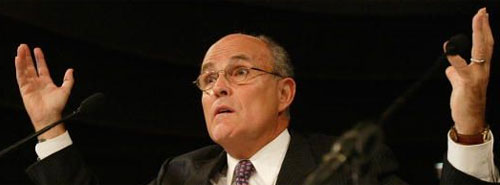
Commander-in-thief: Why should anyone obey this man?

Soldiers With Picket Signs
By Amber Healy
The Fairfax Connection

Thursday 13 September 2007

More than five years after war began in Iraq, veterans speak out against the occupation.

Being a good soldier means following the orders given by higher ranking officers, out of a sense of duty and loyalty to protect his country. But what happens when a soldier feels his commanding officers, even the Commander in Chief, has betrayed and abandoned the Constitution? Tony Teolis of Fairfax wrestled with that question for years before joining Veterans for Peace, one of many organizations that help veterans find the courage and the voice to speak out against the current occupation of Iraq. "As veterans, we believe in the Constitution as the law of the land, and we took an oath to preserve, protect and defend it," Teolis said. It is the same oath congressmen, senators and the president also take when they step into office, and Teolis and other like-minded veterans believe those elected officials have abandoned the Constitution by going into Iraq under false pretenses. "A declaration of war without a direct order from Congress, combined with the abuse of human rights, the abuse and threat of invasion to other nations are all signs that Congress and the president are not fulfilling their duties," Teolis said.

A veteran of the first Gulf War in the early 1990s, Teolis spent several years in Japan following his combat duty. With a long family history of military service, he was proud to serve his country and for the work he had done in helping to liberate Kuwait from Iraqi control. "The Army let me travel and gave me training because they thought I had a skill with languages," he said. That sense of pride changed for him shortly after Sept. 11, 2001. "When I heard Bush essentially say you're either with us or you're against us, that didn't sit well with me," Teolis said. "The world is too complex to speak in absolutisms." Steve Hayes of Herndon has a similar story. A soldier in the Army from 1978 to 1982, Hayes was stationed in Germany during peacetime, continuing a family tradition. "What is going on in the military, especially what might be waiting for the younger generation, is important to my family and for people of my generation to pay attention," he said. "We need to make sure these soldiers get treated well so the military remains honorable and we don't have to go back to a draft system." For Hayes, concerns about the current military began in 2003 and 2004, early in the Iraq occupation, when news started trickling out that the reasons for the U.S. invasion were not factually correct. Hayes, joined by other members of Veterans for Peace and the Prince William County Peacemakers, began visiting Walter Reed and another military hospital in Bethesda to talk with veterans returning from Iraq to be treated for injuries. The two hospitals had different methods in place to help veterans recover. Walter Reed provided homes for veterans' families to stay in while visiting their loved one; the hospital in Bethesda provided a Marine Corps officer to make sure injured vets had whatever resources needed for a full recovery.

As the veterans Hayes worked with began to speak out about the conditions of Walter Reed, another group began to stage counter-protests each Friday, accusing the group of betraying their country. "We just wanted to make sure these guys got a fair shake from their government," Hayes said. Tina Richards fought with the Department of Defense for nine months to prevent her son, who had already served two tours in Iraq, from returning to battle after the Veterans Administration determined he was 80 percent disabled from post-traumatic stress disorder. "We were in the middle of getting the VA paperwork filed with the Marines when they tried calling him back for a third tour," said Richards, now an activist on behalf of veterans who return home from Iraq with mental health issues that directly result from their duty overseas. "When my son first came home, he was telling me about how the occupation was destroying people's lives and I knew I had to do what I could to stop it," she said. Despite a serious medical problem, Richards said her son was in danger of losing his honorable discharge for refusing to return for duty, which could have cost him the medical benefits he needed. "When he first came back, he tried to speak out, but now the Marine Corps has taken that away from him too," she said. "For every person we kill, we're making 10 more people angry," Richards said of the tension in Iraq. "Who knows how many of those people will become extremists in the future?" Like Hayes and Teolis, Richards said many men on both sides of her family have proudly served in the military. Like so many other mothers and family members, she felt guilty every time her son called her after soldiers had died, knowing some other mother would be getting the call that her son or daughter wouldn't be coming home. "By the end of his second tour, he knew it wasn't right," Richards said. "In the beginning, with all the rhetoric going around, he was already a Marine and was going to do what his commander said." Adam Kokesh joined the Marines when he was 17 in 1999, fresh out of high school and eager to serve. Kokesh and his division were among the first on the ground in Iraq, eyewitness to the raids on Fallujah in 2004. "It was a very interesting time," he said. "We were there for the battle in April, we were there when Saddam [Hussein] was taken out of power and we held our position through the alleged transfer of power to the Iraqi parliament."

From that vantage point, Kokesh said he saw the rise in the number of insurgent attacks against American soldiers who were stationed in the city to protect Iraqi homes and streets. Early on, he said, he believed the mission in Fallujah was "a failure." "We waited until August to disband and until November to try to get into the city from the outer perimeter because [President] Bush couldn't get elected with 20 Marines dead in Fallujah," he said. "We saw two or three guys die each day patrolling the city." Kokesh gained a measure of national notoriety earlier this year when he was stripped of his honorable discharge from the Marines for wearing parts of his uniform during protests in Washington in March. He's also become a leader of Iraq Veterans Against the War, a national organization of veterans and currently enlisted members of the military who want troops to begin coming home soon. All these groups and other will be converging on Washington on Saturday, Sept. 15 and staying for nearly a week, with marches, rallies and days set aside for lobbying members of Congress to demand a withdrawal of troops and the restoration of Constitutional law. "The first casualty of war is the truth," Teolis said. The American people were told what they needed to hear to support the invasion of Iraq, he believes. "When we took the oath to join the military, we made a promise to defend the law of our land," Teolis said. That promise has been forgotten or betrayed by leaders who continue to support the war, he said. "The way I see it, we have two options for going forward," he said. "We can either throw out the Constitution as our laws and start all over again, or we have to act like we mean what we say, and that goes for the president, for Congress, for soldiers and veterans and citizens." Which brings up the question of what it means to support the troops still serving overseas. "It's a vague statement," Hayes said. "I'm concerned about people from the Navy being used in combat when they weren't necessarily trained for that. There's the stop-loss program which allows a soldier's tour of duty to be extended after he's been deployed. I'm not one to say that recruiting is bad, but people need to read and understand what it really means to join the military before they enlist."


This is the first in series of articles about local sentiment to the war in Iraq.

(In accordance with Title 17 U.S.C. Section 107, this material is distributed without profit to those who have expressed a prior interest in receiving the included information for research and educational purposes. I.U. has no affiliation whatsoever with the originator of this article nor is I.U endorsed or sponsored by the originator.)


The Nazis, Fascists and Communists were political parties before they became enemies of liberty and mass murderers.

The Unholy Trinity: U.S. Israel, Iran

September 28, 2007
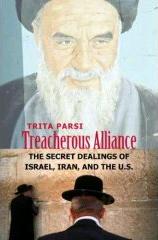
Treacherous Alliance
Readings in the Age of Empire
Doug Bandow

Trita Parsi, Treacherous Alliance: The Secret Dealings of Israel, Iran, and the U.S. (New Haven: Yale University Press, 2007), 361 pp.

by Doug Bandow

Communist dictators and apparatchiks have routinely visited the U.S., with nary an eyebrow raised in polite society. Third World dictators have traipsed through Washington with only an occasional protest.

But the recent visit by Iranian Mahmoud Ahmadinejad to New York City caused endless caterwauling. He's a nasty piece of work, of course, but the U.S. has worked with worse – such as Saddam Hussein, when, two decades ago, the U.S. backed Iraq in its aggressive war against Iran.

The refusal to deal with Tehran represents the triumph of hope over experience, the idea that refusing to acknowledge an adversary will make him go away. This strategy didn't work with the Bolsheviks in Russia. It didn't work with Maoist China. It didn't work with the people's paradise in North Korea. It didn't work with Gadhafi's Libya. It hasn't worked with the Iranian mullocracy.

Particularly disturbing is the enthusiasm for war evident in some precincts of the Bush administration, among the neoconservative faux warriors, and in the Israeli government. Indeed, enthusiasm is an understatement for many members of the war lobby. Notes Parsi, "prominent neoconservatives, who for years had urged the Bush administration to take on Iran, were ecstatic" over Israel's attack on Lebanon, and Iran's ally, Hezbollah. Michael Ledeen of the American Enterprise Institute even "called for the United States to expand the fighting into a regional war." It seems that everyone who was so wrong about Iraq wants to go double or nothing – attack a nation which is larger, more populous, possesses a more serious military, and has far more ability to retaliate against the U.S. (particularly in Iraq) and American allies. The operation codename should be Cakewalk II.

The criminal irresponsibility of this position is evident after reading Trita Parsi's excellent Treacherous Alliance, which details the complex relationship among America, Iran, and Israel. Parsi, president of the National Iranian American Council and adjunct professor at the School of Advanced International Studies (Johns Hopkins University), has woven a fascinating history filled with policy complications.

Today Iran and Israel are perceived as blood enemies. But their relationship actually is far more complex. Indeed, there's good reason to doubt that Ahmadinejad's anti-Israel rhetoric is intended for practical application. Explains Parsi: "Blinded by the condemnatory rhetoric, most observers have failed to notice a critical common interest shared by these two non-Arab powerhouses in the Middle East: the need to portray their fundamentally strategic conflict as an ideological clash."

Although Iran is an Islamic state, it is not an Arab country. As such, Tehran has more in common with Israel than commonly supposed. The relationship between the two was always complicated, often strained, and rarely public, but the two nations cooperated until the fall of the Shah in 1979.

The Iranian revolution disrupted relations, but did not end contact. Radical was the rhetoric of the Ayatollah Khomeini, but practical were his policies. Notes Parsi: "In early 1980s, only months after the eruption of the hostage crisis, Ahmed Kashani, the youngest son of Grand Ayatollah Abol Qassem Kashani, who had played a key role in the nationalization of the Iranian oil industry in 1951, visited Israel – most likely the first Iranian to do so after the revolution – to discuss arms sales and military cooperation against Iraq's nuclear program at Osirak."

Tehran was particularly interested in using Israel as a go-between with the U.S. in an attempt to get spare parts for its military arsenal during the lengthy and bloody war with Iraq. Iran's relations with the Palestinian Liberation Organization, a secular movement, were always tense. Throughout everything, including the Iran-Contra scandal, writes Parsi, "Iran's anti-Israel rhetoric remained intact though Tehran took no practical steps to act on it."

Unfortunately, Washington lost no opportunity to miss an opportunity to open a dialogue with Tehran. The U.S. refused to invite Iran to the Madrid summit on Israel's relations with Arab states and the Palestinians. This act of hubris, by which, in Parsi's words, "Washington failed to appreciate Iran's pragmatism, in particular Tehran's new position on Israel, in which [Iranian President Hashemi] Rafsanjani had declared that Iran would agree to any solution acceptable to the Palestinians," cost America greatly. It "strengthened the hands of Iranian rejectionists" and led Tehran "to seriously reach out to rejectionist Palestinian groups, in spite of the Shia-Sunni divide and their enmity dating back to the Iraq-Iran war."

As Israeli policy shifted, so did Israel's view of U.S.-Iranian relations. It's an astonishing tale, and one that raises as many questions about Washington's relations with Israel as with Iran. Explains Parsi: "The Israeli-U.S.-Iranian triangle had shifted remarkably in just a few years. In the 1980s, Israel was the unlikely defender of and apologist for Iran in Washington, taking great risks to pressure the Reagan administration to open up channels of communication with Iran. Now, Israel did the opposite. Israel wanted the United States to put Iran under economic and political siege."

Israel was particularly alarmed at the thought that the election of Seyyed Mohammad Khatami as Iran's president in 1997 would lead to détente between Washington and Tehran. Unfortunately for America, the moment passed. Although success from opening contact was never guaranteed, today's crisis might have been avoided.

Explains Parsi: "Ironically, the economic sanctions and the heightened rhetoric that the Clinton White House had put in place during its first term turned out to be the most difficult stumbling block to a rapprochement. While Tehran and Washington's failure lay primarily in miscommunication, missed signals, and Iranian overconfidence, at every step Israel and the pro-Israeli lobby continued to put political obstacles in the path of Iran and the United States."

This special pleading has left both America and Israel far worse off.

The Bush administration's lost opportunities have been even worse. After 9/11 Tehran was helpful, in part because it had long opposed Afghanistan's Taliban regime. President George W. Bush's illogical "Axis of Evil" linking Iraq, North Korea, and Iran killed any chance of rapprochement.

Washington had another chance after its easy ouster of Saddam Hussein. In a proposal that "stunned the Americans," reports Parsi:

"The Iranians offered to end their support to Hamas and Islamic Jihad – Iran's ideological brethren in the struggle against the Jewish State – and pressure them to cease attacks on Israel. On Hezbollah, Iran's own brainchild and its most reliable partner in the Arab world, the clerics offered to support the disarmament of the Lebanese militia and transform it into a purely political party. On the nuclear issue, intrusive international inspections in order to alleviate any fears of Iranian weaponization. The Iranians would sign the Additional Protocol to the Non-Proliferation Treaty, and they also offered extensive American involvement in the program as a further guarantee and goodwill gesture. On terrorism, Tehran offered full cooperation against all terrorist organizations – above all, al-Qaeda. On Iraq, Iran would work actively with the United states to support political stabilization and establishment of democratic institutions and – most importantly – a nonreligious government."

Tehran even accepted the 2002 Beirut Declaration. That is, the Saudi proposal advanced by the Arab League to recognize Israel in return for agreeing to a Palestinian state, withdrawal from the occupied territories, and a resolution of the problem of Palestinian refugees.

The Bush administration, enjoying a victory high and convinced regime change was but a finger flick away, said no. Washington even denounced the Swiss government for passing along the Iranian offer. The U.S. government didn't want to talk to Iran. And the Bush administration didn't want anyone to help Iran talk to America.

Four years have passed, and the administration's Mideast policy is in ruins. Iraq is racked by sectarian war. Israel blundered into a lost war against Hezbollah. Dreams of democracy across the Mideast have gone aglimmering. Iran's chief enemies, Saddam Hussein and the Taliban, have been defeated, and a friendly regime is in power in Baghdad. Iran, not the U.S., now is riding high. Iran's Deputy Oil Minister told Parsi: "Iraq couldn't have turned out better for us."

Heck'uva job, Georgie.

What to do now? Washington's options are limited. "One fantasy in which the Bush White House has invested much energy and hope is regime-change in Iran," writes Parsi. It would be great, of course, but Washington hopes do not create Iranian realities. And even democracy in Iran might not end Tehran's quest for nuclear weapons.

The worst option, of course, is military action. True, all of the analysts, politicians, pundits, and ivory tower analysts who were wrong about Iraq believe that this time war would be easy. But no serious person should take them seriously.

An attack "would be extremely risky, and even if it were to succeed the costs would be staggering," explains Parsi. The mind boggles at the potential consequences, especially since even successful airstrikes might only delay Iran's development of nuclear weapons.

Parsi advocates "regional integration and collective security." He is optimistic, though there's obviously no guarantee of success. But Parsi surely is correct that the only hope of resolving the variety of conflicts between Washington and Tehran is for the U.S. to accommodate "legitimate Iranian security objectives in return for Iranian concessions on various regional and international issues." We have moved well beyond the time when Washington could attempt to dictate an outcome. That dream died as the consequences of the administration's incompetent arrogance in Iraq became evident to all the world.

Trita Parsi's Treacherous Alliance is valuable as a historical reference, detailing a fascinating relationship between Iran and Israel that is not widely known. But his analysis is even more important as a tool to inform policymakers attempting to fashion Mideast policy. No where has the Bush administration failed more dramatically and disastrously. No where is sound thinking more desperately needed. We can only hope, and pray, that someone in Washington listens before it is too late.


(In accordance with Title 17 U.S.C. Section 107, this material is distributed without profit to those who have expressed a prior interest in receiving the included information for research and educational purposes. I.U. has no affiliation whatsoever with the originator of this article nor is I.U endorsed or sponsored by the originator.)


The Nazis, Fascists and Communists were political parties before they became enemies of liberty and mass murderers.

Shameful, Shameful, Shameful.....

....Criminal, humiliating for Americans as well as Iraqis and Afghans.


Bush, Oil – and Moral Bankruptcy
by Ray McGovern

It is an exceedingly dangerous time. Vice President Dick Cheney and his hard-core "neoconservative" protégés in the administration and Congress are pushing harder and harder for President George W. Bush, isolated from reality, to honor the promise he made to Israel to prevent Iran from developing a nuclear weapon.

On Sept. 23, former national security adviser Zbigniew Brzezinski warned pointedly:

"If we escalate tensions, if we succumb to hysteria, if we start making threats, we are likely to stampede ourselves into a war [with Iran], which most reasonable people agree would be a disaster for us...I think the administration, the president and the vice president particularly, are trying to hype the atmosphere, and that is reminiscent of what preceded the war in Iraq."

So why the pressure for a wider war in which any victory will be Pyrrhic – for Israel and for the U.S.? The short answer is arrogant stupidity; the longer answer – what the Chinese used to call "great power chauvinism" – and oil.

The truth can slip out when erstwhile functionaries write their memoirs (the dense pages of George Tenet's tome being the exception). Kudos to the still functioning reportorial side of the Washington Post, which on Sept. 15, was the first to ferret out the gem in former Fed chairman, Alan Greenspan's book that the Iraq war was "largely about oil."

But that's okay, said the Post's editorial side (which has done yeoman service as the White House's Pravda) the very next day. Dominating the op-ed page was a turgid piece by Henry Kissinger, serving chiefly as a reminder that there is an excellent case to be made for retiring when one reaches the age of statutory senility.

Dr. Kissinger described as a "truism" the notion that "the industrial nations cannot accept radical forces dominating a region on which their economies depend." (Curious. That same truism was considered a bad thing, when an integral part of the "Brezhnev Doctrine" applied to Eastern Europe.) What is important here is that Kissinger was speaking of Iran, which – in a classic example of pot calling kettle black – he accuses of "seeking regional hegemony."

What's going on here seems to be a concerted effort to get us accustomed to the prospect of a long, and possibly expanded war? Don't you remember? Those terrorists, or Iraqis, or Iranians, or jihadists...whoever...are trying to destroy our way of life. The White House spin machine is determined to justify the war in ways they think will draw popular support from folks like the well heeled man who asked me querulously before a large audience, "Don't you agree that several GIs killed each week is a small price to pay for the oil we need?"

Consistency in U.S. Policy?

The Bush policy toward the Middle East is at the same time consistent with, and a marked departure from, the U.S. approach since the end of World War II. Given ever-growing U.S. dependence on imported oil, priority has always been given to ensuring the uninterrupted supply of oil, as well as securing the state of Israel. The U.S. was by and large successful in achieving these goals through traditional diplomacy and commerce. Granted, it would overthrow duly elected governments, when it felt it necessary – as in Iran in 1953, after its president nationalized the oil. But the George W. Bush administration is the first to start a major war to implement U.S. policy in the region.

Just before the March 2003 attack, Chas Freeman, U.S. ambassador to Saudi Arabia for President George H.W. Bush, explained that the new policy was to maintain a lock on the world's energy lifeline and be able to deny access to global competitors. Freeman said the new Bush administration "believes you have to control resources in order to have access to them" and that, with the end of the Cold War, the U.S. is uniquely able to shape global events – and would be remiss if it did not do so.

This could not be attempted in a world of two superpowers, but has been a longstanding goal of the people closest to George W. Bush. In 1975 in Harpers, then-secretary of state Henry Kissinger authored under a pseudonym an article, "Seizing Arab Oil." Blissfully unaware that the author was his boss, the highly respected career ambassador to Saudi Arabia, James Akins, committed the mother of all faux pas when he told a TV audience that whoever wrote that article had to be a "madman." Akins was right; he was also fired.

In those days, cooler heads prevailed, thanks largely to the deterrent effect of a then-powerful Soviet Union. Nevertheless, in proof of the axiom that bad ideas never die, 26 years later Kissinger rose Phoenix-like to urge a spanking new president to stoke and exploit the fears engendered by 9/11, associate Iraq with that catastrophe, and seize the moment to attack Iraq. It was well known that Iraq's armed forces were no match for ours, and the Soviet Union had imploded.

Some, I suppose, would call that Realpolitik. Akins saw it as folly; his handicap was that he was steeped in the history, politics, and culture of the Middle East after serving in Syria, Lebanon, Kuwait, Iraq, as well as Saudi Arabia – and knew better.

The renaissance of Kissinger's influence in 2001 on an impressionable young president, together with faith-based analysis by untutored ideologues cherry-picked by Cheney explain what happened next – an unnecessary, counterproductive war, in which over 3,800 U. S. troops have already been killed – leaving Iraq prostrate and exhausted.

A-plus in Chutzpah, F in Ethics

In an International Herald Tribune op-ed on Feb. 25, 2007, Kissinger focused on threats in the Middle East to "global oil supplies" and the need for a "diplomatic phase," since the war had long since turned sour. Acknowledging that he had supported the use of force against Iraq, he proceeded to boost chutzpah to unprecedented heights.

Kissinger referred piously to the Thirty Years' War (1618-48), which left the European continent "prostrate and exhausted." What he failed to point out is that the significance of that prolonged carnage lies precisely in how it finally brought Europeans to their senses; that is, in how it ended. The Treaty of Westphalia brought the mutual slaughter to an end, and for centuries prevented many a new attack by the strong on the weak – like the U.S. attack on Iraq in 2003.

It was, it is about oil – unabashedly and shamefully. Even to those lacking experience with U.S. policy in the Middle East, it should have been obvious early on, when every one of Bush's senior national security officials spoke verbatim from the talking-point sheet, "It's not about oil." Thanks to Greenspan and Kissinger, the truth is now "largely" available to those who do not seek refuge in denial.

The implications for the future are clear – for Iraq and Iran. As far as this administration is concerned (and as Kissinger himself has written), "Withdrawal [from Iraq] is not an option." Westphalia? U.N. Charter? Geneva Conventions? Hey, we're talking superpower!

Thus, Greenspan last Monday with Amy Goodman on Democracy Now:

"Getting him [Saddam Hussein] out of the control position...was essential. And whether that be done by one means or another was not as important. But it's clear to me that, were there not the oil resources in Iraq, the whole picture...would have been different."

Can We Handle the Truth?

"All truth passes through three stages.

First, it is ridiculed.

Second, it is violently opposed.

Third, it is accepted as being self-evident."

--Schopenhauer

As the truth about our country's policy becomes clearer and clearer, can we summon the courage to address it from a moral perspective? The Germans left it up to the churches; the churches collaborated.

"There is only us; there never has been any other."

--Annie Dillard

This article appeared first on Consortium News .


(In accordance with Title 17 U.S.C. Section 107, this material is distributed without profit to those who have expressed a prior interest in receiving the included information for research and educational purposes. I.U. has no affiliation whatsoever with the originator of this article nor is I.U endorsed or sponsored by the originator.)


The Nazis, Fascists and Communists were political parties before they became enemies of liberty and mass murderers.