

Tuesday, February 27, 2007
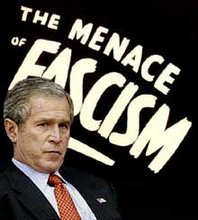
Junior is Already Making The Case, In Speech After Speech
Are they actually dragging 4 year old speeches and giving them a slighly new do?
Am I having a flashback?
Who put the DMT in my coffee?
What year is this? What decade is it?
Tomgram: Michael Klare, Talking Points for the Next War
At 10:16 PM on March 19, 2003, after copious military preparations in the Persian Gulf region and beyond, after months of diplomatic maneuvers at the United Nations, after a drumbeat of leaked intelligence warnings and hair-raising statements by top U.S. officials and the President about Iraqi weapons of mass destruction and how close Saddam Hussein might be to developing a nuclear weapon, after declaring Saddam's regime a major threat to Americans, after countless insinuations that it was somehow connected to the 9/11 attacks on our country, after endless denials that war with Iraq was necessarily on the administration's agenda, President George W. Bush addressed the nation from the Oval Office. "My fellow citizens," he began, "at this hour, American and coalition forces are in the early stages of military operations to disarm Iraq, to free its people and to defend the world from grave danger…"
Almost four years later, all the above elements are again in place, this time in relation to Iran -- with Iranian responsibility for the deaths of Americans in Iraq replacing Iraqi responsibility for the deaths of Americans in New York and Washington. On a careful reading of our President's latest speeches and statements, Michael Klare has noted that an actual list of charges against Iran, a case for war, has already essentially been drawn up, making it easy enough to imagine that at 10:16 PM on some night not so very distant from this one, from that same desk in the Oval Office, the President of the United States might again begin, "My fellow citizens, at this hour…" But read on for yourself. Tom
Bush's Future Iran War Speech: Three Charges in the Case for War
By Michael T. Klare
Sometime this spring or summer, barring an unexpected turnaround by Tehran, President Bush is likely to go on national television and announce that he has ordered American ships and aircraft to strike at military targets inside Iran. We must still sit through several months of soap opera at the United Nations in New York and assorted foreign capitals before this comes to pass, and it is always possible that a diplomatic breakthrough will occur -- let it be so! -- but I am convinced that Bush has already decided an attack is his only option and the rest is a charade he must go through to satisfy his European allies. The proof of this, I believe, lies half-hidden in recent public statements of his, which, if pieced together, provide a casus belli, or formal list of justifications, for going to war.
Three of his statements, in particular, contained the essence of this justification: his January 10 televised speech on his plan for a troop "surge" in Iraq, his State of the Union Address of January 23, and his first televised press conference of the year on February 14. None of these was primarily focused on Iran, but the President used each of them to warn of the extraordinary dangers that country poses to the United States and to hint at severe U.S. reprisals if the Iranians did not desist from "harming U.S. troops." In each, moreover, he laid out various parts of the overall argument he will certainly use to justify an attack on Iran. String these together in one place and you can almost anticipate what Bush's speechwriters will concoct before he addresses the American people from the Oval Office sometime later this year. Think of them as talking points for the next war.
The first of these revealing statements was Bush's January 10th televised address on Iraq. This speech was supposedly intended to rally public and Congressional support behind his plan to send 21,500 additional U.S. troops into the Iraqi capital and al-Anbar Province, the heartland of the Sunni insurgency. But his presentation that night was so uninspired, so lacking in conviction, that -- according to media commentary and polling data -- few, if any, Americans were persuaded by his arguments. Only once that evening did Bush visibly come alive: When he spoke about the threat to Iraq supposedly posed by Iran.
"Succeeding in Iraq also requires defending its territorial integrity and stabilizing the region in the face of extremist challenges," he declared, which meant, he assured his audience, addressing the problem of Iran. That country, he asserted, "is providing material support for attacks on American troops." (This support was later identified as advanced improvised explosive devices -- IEDs or roadside bombs -- given to anti-American Shiite militias.) Then followed an unambiguous warning: "We will disrupt the attacks on our forces... And we will seek out and destroy the networks providing advanced weaponry and training to our enemies in Iraq."
Consider this item one in his casus belli: Because Iran is aiding and abetting our enemies in Iraq, we are justified in attacking Iran as a matter of self-defense.
Bush put it this way in an interview with Juan Williams of National Public Radio on January 29:
"If Iran escalates its military action in Iraq to the detriment of our troops and/or innocent Iraqi people, we will respond firmly… It makes common sense for the commander-in-chief to say to our troops and the Iraqi people -- and the Iraqi government -- that we will help you defend yourself from people that want to sow discord and harm."
In his January 10 address, the President went on to fill in a second item in any future casus belli:
Iran is seeking nuclear weapons in order to dominate the Middle East to the detriment of our friends in the region -- a goal that it simply cannot be allowed to achieve.
In response to such a possibility, the President declared, "We're also taking other steps to bolster the security of Iraq and protect American interests in the Middle East." These included deploying a second U.S. aircraft carrier battle group to the Gulf region, consisting of the USS John C. Stennis and a flotilla of cruisers, destroyers, and submarines (presumably to provide additional air and missile assets for strikes on Iran), along with additional Patriot anti-missile batteries (presumably to shoot down any Iranian missiles that might be fired in retaliation for an air attack on the country and its nuclear facilities). "And," Bush added, "we will work with others to prevent Iran from gaining nuclear weapons and dominating the region."
Bush added a third item to the casus belli in his State of the Union Address on January 23.
After years of describing Saddam Hussein and al-Qaeda as the greatest threats to U.S. interests in the Middle East, he now introduced a new menace: the resurgent Shia branch of Islam led by Iran.
Aside from al-Qaeda and other Sunni extremists, he explained, "it has also become clear that we face an escalating danger from Shia extremists who are just as hostile to America, and are also determined to dominate the Middle East."
Many of these extremists, he noted, "are known to take direction from the regime in Iran," including the Hezbollah movement in Lebanon.
As if to nail down this point, he offered some hair-raising imagery right out of the Left Behind bestselling book series so beloved of Christian evangelicals and their neoconservative allies:
"If American forces step back [from Iraq] before Baghdad is secure, the Iraqi government would be overrun by extremists on all sides. We could expect an epic battle between Shia extremists backed by Iran, and Sunni extremists backed by Al Qaeda and supporters of the old regime. A contagion of violence could spill across the country, and in time the entire region could be drawn into the conflict. For America, this is a nightmare scenario. For the enemy, this is the objective."
As refined by Bush speechwriters, this, then, is the third item in his casus belli for attacking Iran: to prevent a "nightmare scenario" in which the Shia leaders of Iran might emerge as the grandmasters of regional instability, using proxies like Hezbollah to imperil Israel and pro-American regimes in Jordan, Bahrain, and Saudi Arabia -- with potentially catastrophic consequences for the safety of Middle Eastern oil supplies. You can be sure of what Bush will say to this in his future address: No American president would ever allow such a scenario to come to pass.
Many of these themes were reiterated in the president's White House Valentine's Day press conference. Once again, Iraq was meant to be the main story, but Iran captured all the headlines.
Bush's most widely cited comments on Iran focused on claims of Iranian involvement in the delivery of sophisticated versions of the roadside IEDs that have been responsible for many of the U.S. casualties in recent months. Just a few days earlier, unidentified American military officials in Baghdad had declared that elements of the Iranian military -- specifically, the Quds Force of the Iranian Revolutionary Guards -- were supplying the deadly devices to Shiite militias in Iraq, and that high-ranking Iranian government officials were aware of the deliveries.
These claims were contested by other U.S. officials and members of Congress who expressed doubt about the reliability of the evidence and the intelligence work behind it, but Bush evinced no such uncertainty:
"What we do know is that the Quds force was instrumental in providing these deadly IEDs to networks inside of Iraq. We know that. And we also know that the Quds force is a part of the Iranian government. That's a known."
What is not known, he continued, is just how high up in the Iranian government went the decision-making that led such IEDs to be delivered to the Shia militias in Iraq. But that doesn't matter, he explained. "What matters is, is that they're there... [W]e know they're there, and we're going to protect our troops." As Commander-in-Chief, he insisted, he would "do what is necessary to protect our soldiers in harm's way."
He then went on to indicate that "the biggest problem I see is the Iranians' desire to have a nuclear weapon." He expressed his wish that this problem can be "dealt with" in a peaceful way -- by the Iranians voluntarily agreeing to cease their program to enrich uranium to weapons-grade levels. But he also made it clear that the onus was purely on Tehran to take the necessary action to avoid unspecified harm: "I would like to be at the -- have been given a chance for us to explain that we have no desire to harm the Iranian people."
No reporters at the press conference asked him to explain this odd twist of phrase, delivered in the past tense, about his regret that he was unable to explain to the Iranian people why he had meant them no harm -- presumably after the fact.
However, if you view this as the Bush version of a Freudian slip, one obvious conclusion can be drawn: that the President has already made the decision to begin the countdown for an attack on Iran, and only total capitulation by the Iranians could possibly bring the process to a halt.
Further evidence for this conclusion is provided by Bush's repeated reference to Chapter 7 of the UN Charter. On three separate occasions during the press conference he praised Russia, China, and the "EU3" -- Britain, France, and Germany -- for framing the December 23 Security Council resolution condemning Iran's nuclear activities and imposing economic sanctions on Iran in the context of Chapter 7 -- that is, of "Action with Respect to Threats to the Peace, Breaches of the Peace, and Acts of Aggression."
This sets the stage for the international community, under UN leadership, to take such steps as may be deemed necessary "to maintain or restore international peace and stability," ranging from mild economic sanctions to full-scale war (steps that are described in Articles 39 to 51). But the December 23 resolution was specifically framed under Article 41, which entails "measures not involving the use of armed force," a stipulation demanded by China and Russia, which have categorically ruled out the use of military force to resolve the nuclear dispute with Iran.
One suspects that President Bush has Chapter 7 on the brain because he now intends to ask for a new resolution under Article 42, which allows the use of military force to restore international peace and stability. But it is nearly inconceivable that Russia and China would approve such a resolution. Such approval would also be tantamount to acknowledging American hegemony worldwide, and this is something they are simply unwilling to do.
So we can expect several months of fruitless diplomacy at the United Nations in which the United States may achieve slightly more severe economic sanctions under Chapter 41 but not approval for military action under Chapter 42. Bush knows that this is the inevitable outcome, and so I am convinced that, in his various speeches and meetings with reporters, he is already preparing the way for a future address to the nation.
In it, he will speak somberly of a tireless American effort to secure a meaningful resolution from the United Nations on Iran with real teeth in it and his deep disappointment that no such resolution has been not forthcoming. He will also point out that, despite the heroic efforts of American diplomats as well as military commanders in Iraq, Iran continues to pose a vital and unchecked threat to American security in Iraq, in the region, and even -- via its nuclear program -- in the wider world.
Further diplomacy, he will insist, appears futile and yet Iran must be stopped. Hence, he will say, "I have made the unavoidable decision to eliminate this vital threat through direct military action," and will announce -- in language eerily reminiscent of his address to the nation on March 19, 2003 -- that a massive air offensive against Iran has already been underway for several hours.
Michael T. Klare is a professor of peace and world security studies at Hampshire College and the defense correspondent of the Nation magazine. He is the author, most recently, of Blood and Oil: The Dangers and Consequences of America's Growing Dependence on Imported Petroleum (Owl Books).
Copyright 2007 Michael T. Klare
(In accordance with Title 17 U.S.C. Section 107, this material is distributed without profit to those who have expressed a prior interest in receiving the included information for research and educational purposes. I.U. has no affiliation whatsoever with the originator of this article nor is I.U endorsed or sponsored by the originator.)
The Nazis, Fascists and Communists were political parties before they became enemies of liberty and mass murderers.


Is Pakistan Falling Apart or Just Away From Bush?
Whatever, Bush is blaming the Democrats for any funding cuts that Pakistan may see.
Isn't that lovely?
Now, he's hiding behind Pelosi's skirts.
February 26, 2007
Bush to Warn Pakistan to Act on Terror
By DAVID E. SANGER and MARK MAZZETTI
WASHINGTON, Feb. 25 — President Bush has decided to send an unusually tough message to one of his most important allies, Gen. Pervez Musharraf, the president of Pakistan, warning him that the newly Democratic Congress could cut aid to his country unless his forces become far more aggressive in hunting down operatives with Al Qaeda, senior administration officials say.
The decision came after the White House concluded that General Musharraf is failing to live up to commitments he made to Mr. Bush during a visit here in September. General Musharraf insisted then, both in private and public, that a peace deal he struck with tribal leaders in one of the country’s most lawless border areas would not diminish the hunt for the leaders of Al Qaeda and the Taliban or their training camps.
Now, American intelligence officials have concluded that the terrorist infrastructure is being rebuilt, and that while Pakistan has attacked some camps, its overall effort has flagged.
“He’s made a number of assurances over the past few months, but the bottom line is that what they are doing now is not working,” one senior administration official who deals often with South Asian issues said late last week. “The message we’re sending to him now is that the only thing that matters is results.”
Democrats, who took control of Congress last month, have urged the White House to put greater pressure on Pakistan because of statements from American commanders that units based in Pakistan that are linked to the Taliban, Afghanistan’s ousted rulers, are increasing their attacks into Afghanistan.
For the time being, officials say, the White House has ruled out unilateral strikes against the training camps that American spy satellites are monitoring in North Waziristan, in Pakistan’s tribal areas on the border. The fear is that such strikes would result in what one administration official referred to as a “shock to the stability” of General Musharraf’s government.
General Musharraf, a savvy survivor in the brutal world of Pakistani politics, knows that the administration is hesitant to push him too far. If his government collapses, it is not clear who would succeed him or who would gain control over Pakistan’s arsenal of nuclear weapons.
But the spread of Al Qaeda in the tribal areas threatens to undermine a central element of Mr. Bush’s argument that he is succeeding in the administration’s effort to curb terrorism. The bomb plot disrupted in Britain last summer, involving plans to hijack airplanes, has been linked by British and American intelligence agencies to camps in the Pakistan-Afghan border areas.
General Musharraf has told American officials that Pakistani military operations in the tribal areas in recent years so alienated local residents that they no longer provide the central government with quality intelligence about the movements of senior Islamic militants.
Congressional Democrats have threatened to review military assistance and other aid to Pakistan unless they see evidence of aggressive attacks on Al Qaeda. The House last month passed a measure linking future military aid to White House certification that Pakistan “is making all possible efforts to prevent the Taliban from operating in areas under its sovereign control.”
Pakistan is now the fifth-largest recipient of American aid. Mr. Bush has proposed $785 million in aid to Pakistan in his new budget, including $300 million in military aid to help Pakistan combat Islamic radicalism in the country.
The rumblings from Congress give Mr. Bush and his top advisers a way of conveying the seriousness of the problem, officials said, without appearing to issue a direct threat to the proud Pakistani leader themselves.
“We think the Pakistani aid is at risk in Congress,” said the senior official, who declined to speak on the record because the subject involved intelligence matters.
The administration has sent a series of emissaries to see the Pakistani leader in recent weeks, including the new secretary of defense, Robert M. Gates. Mr. Gates was charged with prompting more action in a region in which American forces operate with great constraints, if they are allowed in at all.
“This is not the type of relationship where we can order action,” said an administration official involved in discussions over Pakistan policy. “We can strongly encourage.”
Relations between General Musharraf and Mr. Bush have always been tense, as the Pakistani leader veers between his need for American support and protection and his awareness that many Pakistani people — and the intelligence service — have strong sympathies for Al Qaeda and the resurgent Taliban. Officials involved with the issue describe the current moment between the leaders as especially fraught.
Mr. Bush was deeply skeptical of the deal General Musharraf struck with the tribal leaders last year, fearing that it would limit the government’s powers to intercede in what Mr. Bush has called the “wild west” of Waziristan, administration officials said at the time.
During his visit to Washington last fall, General Musharraf said the agreement he signed with tribal leaders, giving them greater sovereignty in the region, had “three bottom lines.” He said one was “no Al Qaeda activities in our tribal agencies or across the border in Afghanistan.” The second was “no Taliban activity” in the same areas. And the third was “no Talibanization,” which he described as “obscurantist thoughts or way of life.”
American intelligence officials have made an assessment that senior Qaeda leaders in Pakistan have re-established significant control over their global network and are training operatives in some of the camps for strikes on Western targets.
One American official familiar with intelligence reports about Pakistan said intelligence agencies had established “clear linkages” between the Qaeda camps and the plot to blow up trans-Atlantic flights that was thwarted last August. American analysts said the recent trials of terrorism suspects in Britain showed that some defendants had been trained in Pakistan.
American officials say one reason General Musharraf agreed to pull government troops back to their barracks in North Waziristan and allow tribal leaders greater control over security was to give him time to rebuild his intelligence network in the border region gradually.
(In accordance with Title 17 U.S.C. Section 107, this material is distributed without profit to those who have expressed a prior interest in receiving the included information for research and educational purposes. I.U. has no affiliation whatsoever with the originator of this article nor is I.U endorsed or sponsored by the originator.)
The Nazis, Fascists and Communists were political parties before they became enemies of liberty and mass murderers.
The Effing Crazies Are At It Again
Bill Berkowitz
February 26, 2007
American Enterprise Institute takes lead in agitating against Iran
Despite wrongheaded predictions about the war on Iraq, neocons are on the frontlines advocating military conflict with Iran
After doing such a bang up job with their advice and predictions about the outcome of the war on Iraq, would it surprise you to learn that America's neoconservatives are still in business? While at this time we are not yet seeing the same intense neocon invasion of our living rooms -- via cable television's news networks -- that we saw during the run-up to the invasion of Iraq, nevertheless, a host of policy analysts at conservative think tanks -- most notably the American Enterprise Institute -- are being heeded on Iran by those who count - folks inside the Bush Administration.
Long before the Bush Administration began escalating its rhetoric and upping the ante about the supposed "threat" posed to the US by Iran, well-paid inside-the-beltway think tankers were agitating for some kind of action against that country. Some have argued for ratcheting up sanctions and freezing bank accounts, others have advocated increasing financial aid to opposition groups, and still others have argued that a military strike at Iran's nuclear facilities is absolutely essential. For all, the desired end result is regime change in Iran.
If President Bush plunges the U.S. into some kind of military conflict with Iran, you can thank the Washington, D.C.-based American Enterprise Institute (AEI), a key player in the current debate over Iran.
President Bush acknowledged as much when he recently appeared at the AEI for a much-publicized speech on his War on Terror, which focused on the front in Afghanistan.
Established in 1943, the AEI is no Johnny-come-lately to think tank politicking. Ronald Reagan gave the Institute its props by declaring that "[no think tank] has been more influential than the American Enterprise Institute." And during his recent speech at AEI, Bush said that he "admire[d] AEI a lot.After all, I have been consistently borrowing some of your best people. More than 20 AEI scholars have worked in my administration."
Bush also relayed greetings from vice president Dick Cheney who served as an AEI Senior Fellow from 1993-1995. Cheney's wife Lynne currently serves as a Senior Fellow studying education and children.
All eyes on Iran
A section of AEI's website entitled "The Iranian Threat" lists a treasure trove of several hundred published articles on Iran, including more than 50 last year alone. Since the beginning of this year, Michael Ledeen the Freedom Scholar at AEI -- who is credited with nearly 20 pieces on Iran last year -- published a story in the National Review Online headlined "The War of the Persian Succession: Rafsanjani and Ahmadinejad Are Posturing to Succeed an Ailing Khamenei"; Anne Applebaum, an adjunct scholar at AEI, wrote an op-ed piece for the Washington Post titled "Wisdom in Exile"; and the prolific Michael Rubin, a resident scholar at AEI, wrote a story published by the New York Daily News titled "How to Make '07 Ahmadinejad's Last Year in Power."
Ledeen, writing about the power struggle taking place in the country, maintained that "The mullahs are living through difficult times. Their murderous activities in Iraq are now clear, save to those who are grimly determined to believe that the Bush administration cannot possibly tell the truth about terrorism. They have wrecked their national economy (like the Soviet Union, they do not need Western sanctions to ruin the country; they are quite capable of doing it all by themselves). The nuclear breakthrough is constantly promised but never delivered -- Ahmadinejad had promised a glorious announcement ... but then ... [decided to] postpone ... [it] for a couple of months, pending the action of the United Nations. They are scrambling to buy more time and fighting amongst themselves over how to deal with the West and the successor to the dying leader."
"To buy time, they are proposing everything and its opposite. They whisper to American diplomats -- who then promptly inform the Washington Post, afflicted with grave credibility problems of its own--that they are prepared to deliver al Qaeda terrorists into our hands, if only we will be kinder. I have lost count of the number of times this empty promise has been trotted out (this regime could no more abandon al Qaeda than it could abandon Shiism; terrorism is too deeply embedded in its DNA). For many days, Tehran approved, then canceled, then promised, then canceled, then finally approved the visit of the country's top nuclear negotiator, Ali Larijani, to a security conference in Munich, where, according to the wire services, he assured his audience that Israel had nothing to fear from Iran. But when the printed text was released, there were no such words in it, in either the Farsi or the English version. The manifest incoherence reflects the leadership vacuum, and the on again-off again behavior of Larijani shows the ebb and flow of the Succession War."
Ledeen concluded, as he has done numerous times over the years, that this "moment ... provides an opportunity for the West to encourage the best solution to the Iranian threat: support for democratic change. If we were to echo [85-year-old Ayatollah Hosseynali] Montazeri, denounce the mounting repression, support a peaceful transition to democracy, and demand an end to Iran's decisive support for the terror war, all the while clearly stating our desire for regime change in Tehran, the tens of millions of Iranians who hate this regime might seize the opportunity."
In discussing the role of the AEI, The Guardian pointed out that "Its influence on the White House appeared to be on the decline last year amid endless bad news from Iraq, for which it had been a cheerleader. But in the face of opposition from Congress, the Pentagon and state department, Bush opted last month for an AEI plan to send more troops to Iraq. Will he support calls from within the AEI for a strike on Iran?"
CNN reporter Suzanne Malveaux pointed out that the AEI is "One conservative policy group that has the president's ear and is influencing his thinking" on Iraq. (For more on the role of AEI-affiliated spokespersons during the run-up to the Iraq War, see here.)
Josh Muravchik, a Middle East specialist at the AEI, is a major supporter of some kind of action against Iran. He told The Guardian: "I do not think anyone in the US is talking about invasion. We have been chastened by the experience of Iraq, even a hawk like myself."
An air strike against Iran's burgeoning nuclear facilities is another matter all together, because not only might Iran "use [nuclear weapons program] out of the blue but [it could also be used] as a shield to do all sorts of mischief. I do not believe there will be any way to stop this happening other than physical force."
Muravchik pointed out rather colorfully that "The Bush administration ha[s] said they would not allow Iran nuclear weapons. That is either bullshit or they mean it as a clear code: we will do it if we have to. I would rather believe it is not hot air."
Not all neocons agree with the Muravchik prescription for Iran. According to The Guardian, some neocons who are "opposed to an air strike ... advocate a different form of military action, supporting Iranian armed groups, in particular the Mujahideen-e Khalq (MEK), even though the state department has branded it a terrorist organization."
Raymond Tanter, founder of the Iran Policy Committee, which includes former officials from the White House, state department and intelligence services, "is a leading advocate of support for the MEK. If it comes to an air strike, he favors bunker-busting bombs. 'I believe the only way to get at the deeply buried sites at Natanz and Arak is probably to use bunker-buster bombs, some of which are nuclear tipped. I do not believe the US would do that but it has sold them to Israel.'"
Meyrav Wurmser, the director of the Center for Middle East Policy at the Hudson Institute, "also favors supporting Iranian opposition groups," The Guardian pointed out. Wurmser "is disappointed with the response of the Bush administration so far to Iran and said that if the aim of US policy after 9/11 was to make the Middle East safer for the US, it was not working because the administration had stopped at Iraq. 'There is not enough political will for a strike. There seems to be various notions of what the policy should be.'"
AEI doesn't pay its so-called scholars with proceeds garnered from rummage or bake sales: A good chunk of its money comes directly from a coterie of right wing foundations. From 1985 through 2005, AEI received more than 330 grants totaling over $43 million. Generous donors include the John M. Olin Foundation, the Sarah Scaife Foundation, the Earhart Foundation, the Carthage Foundation, the Smith Richardson Foundation, and the Lynde and Harry Bradley Foundation.
In 2004, the Bradley Foundation, under the leadership of Michael Grebe, gave more than $700,000 to AEI's Foreign and Defense Policy Studies program, and the New Atlantic Initiative.
Manufacturing the Iran threat?
In recent weeks, as things have continued to deteriorate in Iraq, the Bush Administration has been laying the foundation for a possible military face-off with Iran. In addition to expressing its dismay over Iran's burgeoning nuclear program, and intensifying its military presence in the Persian Gulf, administration officials have taken to charging Iran with training insurgents and supplying weapons to forces responsible for killing American soldiers in Iraq.
At his February 14 news conference, President Bush "officially anointed a new enemy of the United States ...: the 'Quds Force,'" Newsweek recently reported. "After a week in which his administration contradicted itself repeatedly over the threat from Iran, Bush settled on what he said were the known facts. The sophisticated weapons being used against U.S. troops in Iraq 'were provided by the Quds [means 'Jerusalem' in Arabic] Force,' a paramilitary arm of the Iranian Revolutionary Guard Corps (IRGC)," the president said."
Appearing to be using former Secretary of Defense Donald Rumsfeld's "knowns and unknowns" linguistic formulation, the president added: "We know that. And we also know that the Quds Force is a part of the Iranian government. That's a known. What we don't know is whether or not head leaders of Iran ordered the Quds Force to do what they did."
"The truth about the Iranian threat is that the Bush Administration is not telling the real truth," wrote Larry Johnson in a mid-February column at the TPMCafe. "Like any effective propagandist President Bush is using a kernel of truth and, with the help of many in the media, laying the foundation for another war."
"The kernel of truth is that Iranian intelligence agents are active in Iraq and are working with a variety of Shia militia and groups," Johnson who worked with the Central Intelligence Agency from 1985 to 1989, and was the the Department of State's Office of the Coordinator for Counter Terrorsim from 1989 to 1993, and is currently a Managing Partner and founder of BERG Associates, LLC, an international business-consulting firm based in Washington, D.C., which specializes in counter terrorism and money laundering investigations, pointed out.
"What Bush cleverly omits in his litany is the fact that Iran has been present in Iraq since the early days of the U.S. invasion in March of 2003. Bush and his generals also are ignoring the fact that Sunni insurgents, not Iranian backed Shia militia, have been those responsible for the vast majority of U.S. casualties in Iraq."
Robert Gates, the new Secretary of Defense, recently insisted that he, the president and Secretary of State Condoleezza Rice have all said that they have "no intention of attacking Iran." However, Vincent Cannistraro, a Washington-based intelligence analyst who worked for the CIA and the National Security Council, told The Guardian that "Planning is going on, in spite of public disavowals by Gates."
Cannistraro added that the planning is "quite advanced" and "targets have been selected [f]or a bombing campaign against nuclear sites. ...The military assets to carry this out are being put in place."
The Guardian also reported that "Colonel Sam Gardiner, a former air force officer who has carried out war games with Iran as the target, supported the view that planning for an air strike was under way: 'Gates said there is no planning for war. We know this is not true. He possibly meant there is no plan for an immediate strike. It was sloppy wording.'"
Gardiner told The Guardian that "All the moves being made over the last few weeks are consistent with what you would do if you were going to do an air strike. We have to throw away the notion the US could not do it because it is too tied up in Iraq. It is an air operation."
In August of last year, Think Progress reported that Reuel Marc Gerecht, a resident fellow at the American Enterprise Institute who was "a member of a small group of analysts" that met with President Bush to "discuss their views on the Middle East" told ABC's "This Week" that "the mid- to long-term fallout from Israel-Hezbollah conflict could be a good thing because it may prompt Bush to take military action against Iran."
Gerecht said that the role the Iranians and Syrians played in the conflict had angered Bush. The program's host George Stephanopoulos asked: "How much harder line could he take? Are you talking about military action?"
Gerecht reponded: "Well yeah it is conceivable you go down the road 12 or 18 months that the president will say nuclear weapons in the hands of the mullahs is simply unacceptable -- as he said many times. And if in fact Lebanon contributes to the hardening of the American postion, then I would say that Hezbollah actions in Lebanon were a great mistake."
(In accordance with Title 17 U.S.C. Section 107, this material is distributed without profit to those who have expressed a prior interest in receiving the included information for research and educational purposes. I.U. has no affiliation whatsoever with the originator of this article nor is I.U endorsed or sponsored by the originator.)
The Nazis, Fascists and Communists were political parties before they became enemies of liberty and mass murderers.
Bush on The Couch, Again
New York Magazine Puts Bush on the Couch
Posted by Jon Ponder Feb. 26, 2007, 7:14 am
Earlier this month, New York Magazine published a series of essays under the collective title, “Bush’s Mind: Analyzing the President.”
In 17 essays by experts in politcs and psychology, the magazine offers what it calls a “psychopolitical survey” of the inner George W. Bush.
Here are a few particularly insightful highlights:
A Decadent Aristocrat, by By Andrew Solomon, author of The Noonday Demon: An Atlas of Depression: Bush, like his mother, has an almost inhuman ability to identify his own advantage without the slightest regard to its cost to others.
Bush, like his mother, has an almost inhuman ability to identify his own advantage without the slightest regard to its cost to others. One reads in Lincoln’s diaries of how his heart bled for every soldier who died in the war he felt obliged to wage; one reads in Bush’s face and in his speeches an inability to conceive of other people as fully human, including the soldiers who die at his behest, a quality that renders him less than fully human himself. This heartlessness, unlike his achievement of the presidency, is the very hallmark of decadent aristocracy.
It is worth noting, however, that most aristocracy is not so far decayed; the queen of England, despite her less cuddly manner, is clearly more compassionate than W.
Bush’s upbringing in wealth and privilege is key to understanding him, and yet the public is blind to it. They take his mangled hookum and NASCAR Dad persona at face value. Conversely, Traditional Media types tend to bow and scrape in front of their betters, and I believe Bush’s high station in life is a factor in the nearly hands-off coverage he’s gotten in the Capitol.
First and foremostly, George W. Bush is the spoiled and pampered scion of one of an American dynasty that goes back to Pres. Pierce. His position in life, and his attitude about it, explains everything about the ease with which he has failed upward, all the way to the top.
Simplicity Himself, by By Franklin Foer, editor of The New Republic:
Bush mocks us before we can mock him. He mocks us with his palpable disdain for the news media, the Congress and, most of all, our votes in November 2006.
Where Nixon was a barrel of laughs, the Bush presidency simply isn’t very funny. There are no masterful Bush impersonators. Nixon’s comedic appeal resided in his dark interior life. When he spoke in public, you knew that you weren’t getting the full Nixon. Back in the private quarters of the White House, he was famously brooding over his enemies, sipping scotch, and talking to the portraits on the wall. The fact that the leader of the Free World was neurotic, paranoid, and palpably creepy made him a genuinely excellent premise for jokes.
Bush has none of these qualities. Even as his entire presidency has tanked, he shows no signs of acquiring psychological complexities. He remains the “simple,” “resolute” man that his hagiographers once venerated.
Mockery and satire are safety valves as old as society itself that enable the people to humanize their leaders. But Bush mocks us before we can mock him. He mocks us with his palpable disdain for the news media, the Congress and, most of all, our votes in November 2006. As any eight-year-old can tell you, mocking mockery is rarely effective.
Dad, the Bottle, Vietnam, by By Jonathan Alter, Newsweek columnist:
I see Bush’s behavior as the result of three major forces: the dad, the bottle, and the Vietnam War. For most of his life, Bush tried and failed to follow in his absent father’s footsteps. His father was a war hero; Bush a no-show Guardsman dodging Vietnam. His father did well in the oil business; Bush struck dry holes. His father got elected to Congress; Bush was defeated in 1978. A collection of Bush Sr.’s letters contains far more to Jeb than George W. Finally, in 1994, Bush was elected governor of Texas, but George and Bar were so upset that their anointed son, Jeb, lost the election that night for the governorship of Florida that they barely seemed to notice. You don’t have to be Freud to see that Bush has snubbed his father’s closest advisers (who turned out to be right) and hired men who held his father in contempt, like Don Rumsfeld (who turned out to be wrong).
If Bush were a Democrat, the Liberal Media would not rest until they knew whether or not the “former” alcoholic president was drinking again.
His Smile, by By Deepak Chopra, president, Alliance for a New Humanity:
One of the most unnerving things about George Bush is his smile. As the situation in Iraq has grown more calamitous, the smile hasn’t disappeared. It’s become markedly patronizing, saying, “I’m right on this. The rest of you just don’t understand.” A pitying smile. On the night of the State of the Union, the president kept his smirking to a minimum — a surprise.
It’s been pointed out that until he became president, Bush didn’t smirk. It’s grown into a disturbing tic, expressing a mixture of contradictory traits: smugness, disdain, self-consciousness, doubt.
It’s not the easiest smirk to read. People who read contempt in it are rightfully offended. They think of Bush’s most unpleasant attribute: his sense of entitlement. Having accomplished little in his life, he nevertheless expected the highest rewards. He wanted victory to come easily, as his birthright.
When it did come in 2000 — to the astonishment even of his family — the smirk said, “I told you so.”
His smile turns into a go-to-hell smirk whenever Bush hears a hostile question. He’s shielding himself from impudence while reining in his own simmering anger. He’s smirking to put you on warning. In a moment he might blow his top. Bush’s smile also tells us, almost guilelessly, that he isn’t suffering inside.
This fact maddens his critics the most. Lincoln suffered terribly during the Civil War, as Churchill did in World War II. Bush has to remind himself to put on a sad face when he talks about his war. The black dog, as Churchill called his depression, doesn’t nip at this president’s heels. Have we seen a more inappropriate smile from any politician since Nixon? I doubt it.
There is no temperament more ill-suited to leadership than the simpleton autocrat, and yet this is precisely the personality type the Republican Party has forced on the United States, and the world — twice.
*
Nixon’s meglomania led him to blur the line of legality, for which he was forced to resign the preidency. For the good of the republic, and the assurance of a stable future for the democratic government Bush’s actions and policies have hobbled, he needs to be turned out and relegated to the sidelines from now on, as Nixon was.
(In accordance with Title 17 U.S.C. Section 107, this material is distributed without profit to those who have expressed a prior interest in receiving the included information for research and educational purposes. I.U. has no affiliation whatsoever with the originator of this article nor is I.U endorsed or sponsored by the originator.)
The Nazis, Fascists and Communists were political parties before they became enemies of liberty and mass murderers.
Posted by Jon Ponder Feb. 26, 2007, 7:14 am
Earlier this month, New York Magazine published a series of essays under the collective title, “Bush’s Mind: Analyzing the President.”
In 17 essays by experts in politcs and psychology, the magazine offers what it calls a “psychopolitical survey” of the inner George W. Bush.
Here are a few particularly insightful highlights:
A Decadent Aristocrat, by By Andrew Solomon, author of The Noonday Demon: An Atlas of Depression: Bush, like his mother, has an almost inhuman ability to identify his own advantage without the slightest regard to its cost to others.
Bush, like his mother, has an almost inhuman ability to identify his own advantage without the slightest regard to its cost to others. One reads in Lincoln’s diaries of how his heart bled for every soldier who died in the war he felt obliged to wage; one reads in Bush’s face and in his speeches an inability to conceive of other people as fully human, including the soldiers who die at his behest, a quality that renders him less than fully human himself. This heartlessness, unlike his achievement of the presidency, is the very hallmark of decadent aristocracy.
It is worth noting, however, that most aristocracy is not so far decayed; the queen of England, despite her less cuddly manner, is clearly more compassionate than W.
Bush’s upbringing in wealth and privilege is key to understanding him, and yet the public is blind to it. They take his mangled hookum and NASCAR Dad persona at face value. Conversely, Traditional Media types tend to bow and scrape in front of their betters, and I believe Bush’s high station in life is a factor in the nearly hands-off coverage he’s gotten in the Capitol.
First and foremostly, George W. Bush is the spoiled and pampered scion of one of an American dynasty that goes back to Pres. Pierce. His position in life, and his attitude about it, explains everything about the ease with which he has failed upward, all the way to the top.
Simplicity Himself, by By Franklin Foer, editor of The New Republic:
Bush mocks us before we can mock him. He mocks us with his palpable disdain for the news media, the Congress and, most of all, our votes in November 2006.
Where Nixon was a barrel of laughs, the Bush presidency simply isn’t very funny. There are no masterful Bush impersonators. Nixon’s comedic appeal resided in his dark interior life. When he spoke in public, you knew that you weren’t getting the full Nixon. Back in the private quarters of the White House, he was famously brooding over his enemies, sipping scotch, and talking to the portraits on the wall. The fact that the leader of the Free World was neurotic, paranoid, and palpably creepy made him a genuinely excellent premise for jokes.
Bush has none of these qualities. Even as his entire presidency has tanked, he shows no signs of acquiring psychological complexities. He remains the “simple,” “resolute” man that his hagiographers once venerated.
Mockery and satire are safety valves as old as society itself that enable the people to humanize their leaders. But Bush mocks us before we can mock him. He mocks us with his palpable disdain for the news media, the Congress and, most of all, our votes in November 2006. As any eight-year-old can tell you, mocking mockery is rarely effective.
Dad, the Bottle, Vietnam, by By Jonathan Alter, Newsweek columnist:
I see Bush’s behavior as the result of three major forces: the dad, the bottle, and the Vietnam War. For most of his life, Bush tried and failed to follow in his absent father’s footsteps. His father was a war hero; Bush a no-show Guardsman dodging Vietnam. His father did well in the oil business; Bush struck dry holes. His father got elected to Congress; Bush was defeated in 1978. A collection of Bush Sr.’s letters contains far more to Jeb than George W. Finally, in 1994, Bush was elected governor of Texas, but George and Bar were so upset that their anointed son, Jeb, lost the election that night for the governorship of Florida that they barely seemed to notice. You don’t have to be Freud to see that Bush has snubbed his father’s closest advisers (who turned out to be right) and hired men who held his father in contempt, like Don Rumsfeld (who turned out to be wrong).
If Bush were a Democrat, the Liberal Media would not rest until they knew whether or not the “former” alcoholic president was drinking again.
His Smile, by By Deepak Chopra, president, Alliance for a New Humanity:
One of the most unnerving things about George Bush is his smile. As the situation in Iraq has grown more calamitous, the smile hasn’t disappeared. It’s become markedly patronizing, saying, “I’m right on this. The rest of you just don’t understand.” A pitying smile. On the night of the State of the Union, the president kept his smirking to a minimum — a surprise.
It’s been pointed out that until he became president, Bush didn’t smirk. It’s grown into a disturbing tic, expressing a mixture of contradictory traits: smugness, disdain, self-consciousness, doubt.
It’s not the easiest smirk to read. People who read contempt in it are rightfully offended. They think of Bush’s most unpleasant attribute: his sense of entitlement. Having accomplished little in his life, he nevertheless expected the highest rewards. He wanted victory to come easily, as his birthright.
When it did come in 2000 — to the astonishment even of his family — the smirk said, “I told you so.”
His smile turns into a go-to-hell smirk whenever Bush hears a hostile question. He’s shielding himself from impudence while reining in his own simmering anger. He’s smirking to put you on warning. In a moment he might blow his top. Bush’s smile also tells us, almost guilelessly, that he isn’t suffering inside.
This fact maddens his critics the most. Lincoln suffered terribly during the Civil War, as Churchill did in World War II. Bush has to remind himself to put on a sad face when he talks about his war. The black dog, as Churchill called his depression, doesn’t nip at this president’s heels. Have we seen a more inappropriate smile from any politician since Nixon? I doubt it.
There is no temperament more ill-suited to leadership than the simpleton autocrat, and yet this is precisely the personality type the Republican Party has forced on the United States, and the world — twice.
*
Nixon’s meglomania led him to blur the line of legality, for which he was forced to resign the preidency. For the good of the republic, and the assurance of a stable future for the democratic government Bush’s actions and policies have hobbled, he needs to be turned out and relegated to the sidelines from now on, as Nixon was.
(In accordance with Title 17 U.S.C. Section 107, this material is distributed without profit to those who have expressed a prior interest in receiving the included information for research and educational purposes. I.U. has no affiliation whatsoever with the originator of this article nor is I.U endorsed or sponsored by the originator.)
The Nazis, Fascists and Communists were political parties before they became enemies of liberty and mass murderers.
Monday, February 26, 2007
Here We Go Again
U.S. Intel. is just wrong, finds the IEAE.
VIENNA — Although international concern is growing about Iran's nuclear program and its regional ambitions, diplomats here say most U.S. intelligence shared with the U.N. nuclear watchdog agency has proved inaccurate and none has led to significant discoveries inside Iran.
The officials said the CIA and other Western spy services had provided sensitive information to the Vienna-based International Atomic Energy Agency at least since 2002, when Iran's long-secret nuclear program was exposed. But none of the tips about supposed secret weapons sites provided clear evidence that the Islamic Republic was developing illicit weapons."Since 2002, pretty much all the intelligence that's come to us has proved to be wrong," a senior diplomat at the IAEA said.
Another official here described the agency's intelligence stream as "very cold now" because "so little panned out."
The reliability of U.S. information and assessments on Iran is increasingly at issue as the Bush administration confronts the emerging regional power on several fronts: its expanding nuclear effort, its alleged support for insurgents in Iraq and its backing of Middle East militant groups.
The CIA still faces harsh criticism for its prewar intelligence errors on Iraq. No one here argues that U.S. intelligence officials have fallen this time for crudely forged documents or pushed shoddy analysis.
IAEA officials, who openly challenged U.S. assessments that Saddam Hussein was developing a nuclear bomb, say the Americans are much more cautious in assessing Iran.American officials privately acknowledge that much of their evidence on Iran's nuclear plans and programs remains ambiguous, fragmented and difficult to prove.
The IAEA has its own concerns about Iran's nuclear program, although agency officials say they have found no proof that nuclear material has been diverted to a weapons program.
Iran's Islamist government began enriching uranium in small amounts in August in a program it says will provide fuel only for civilian power stations, not nuclear weapons.
Information withheld
On Thursday, the IAEA released a report declaring that Iran had expanded uranium enrichment and defied a Security Council deadline to suspend nuclear activities. In the meantime, the agency is locked in a dispute with Tehran over additional information and access to determine whether the program is peaceful.
In November 2005, U.N. inspectors leafing through papers in Tehran discovered a 15-page document that showed how to form highly enriched uranium into the configuration needed for the core of a nuclear bomb. Iran said the paper came from Pakistan, but has rebuffed IAEA requests to let inspectors take or copy it for further analysis.
Diplomats here were less convinced by documents recovered by U.S. intelligence from a laptop computer apparently stolen from Iran. American analysts first briefed senior IAEA officials on the contents of the hard drive at the U.S. mission here in mid-2005.
The documents included detailed designs to upgrade ballistic missiles to carry nuclear warheads, drawings for subterranean testing of high explosives, and two pages describing research on uranium tetrafluoride, known as "green salt," which is used during uranium enrichment. IAEA officials remain suspicious of the information in part because most of the papers are in English rather than Persian, the Iranian language."We don't know. Are they genuine, are they real?" asked a senior U.N. official here. Another official who was briefed on the documents said he was "very unconvinced."
Iran's representative to the IAEA, Ali Asghar Soltanieh, dismissed the laptop documents as "fabricated information." Iran, he said, has produced 170 tons of "green salt" at a uranium conversion facility in Esfahan that is monitored by the IAEA."We are not hiding it," he said in an interview. "We make tons of it. These documents are all nonsense."
Testy relations
The U.S. government is not required to share intelligence with the IAEA, and relations between Washington and the U.N. agency are at times testy. In March 2003, IAEA chief Mohamed ElBaradei embarrassed the White House when he told the U.N. Security Council that documents indicating Hussein's government in Iraq had sought to purchase uranium in Niger were forged. The Bush administration subsequently opposed ElBaradei's reappointment to his post.While it confronts Iran's nuclear ambitions, the Bush administration also has tried to implicate Iran as a supplier of munitions and training for insurgent groups in neighboring Iraq.But the quality of its information has limited this effort too.
Single page
1 2 >>
(In accordance with Title 17 U.S.C. Section 107, this material is distributed without profit to those who have expressed a prior interest in receiving the included information for research and educational purposes. I.U. has no affiliation whatsoever with the originator of this article nor is I.U endorsed or sponsored by the originator.)
The Nazis, Fascists and Communists were political parties before they became enemies of liberty and mass murderers.
VIENNA — Although international concern is growing about Iran's nuclear program and its regional ambitions, diplomats here say most U.S. intelligence shared with the U.N. nuclear watchdog agency has proved inaccurate and none has led to significant discoveries inside Iran.
The officials said the CIA and other Western spy services had provided sensitive information to the Vienna-based International Atomic Energy Agency at least since 2002, when Iran's long-secret nuclear program was exposed. But none of the tips about supposed secret weapons sites provided clear evidence that the Islamic Republic was developing illicit weapons."Since 2002, pretty much all the intelligence that's come to us has proved to be wrong," a senior diplomat at the IAEA said.
Another official here described the agency's intelligence stream as "very cold now" because "so little panned out."
The reliability of U.S. information and assessments on Iran is increasingly at issue as the Bush administration confronts the emerging regional power on several fronts: its expanding nuclear effort, its alleged support for insurgents in Iraq and its backing of Middle East militant groups.
The CIA still faces harsh criticism for its prewar intelligence errors on Iraq. No one here argues that U.S. intelligence officials have fallen this time for crudely forged documents or pushed shoddy analysis.
IAEA officials, who openly challenged U.S. assessments that Saddam Hussein was developing a nuclear bomb, say the Americans are much more cautious in assessing Iran.American officials privately acknowledge that much of their evidence on Iran's nuclear plans and programs remains ambiguous, fragmented and difficult to prove.
The IAEA has its own concerns about Iran's nuclear program, although agency officials say they have found no proof that nuclear material has been diverted to a weapons program.
Iran's Islamist government began enriching uranium in small amounts in August in a program it says will provide fuel only for civilian power stations, not nuclear weapons.
Information withheld
On Thursday, the IAEA released a report declaring that Iran had expanded uranium enrichment and defied a Security Council deadline to suspend nuclear activities. In the meantime, the agency is locked in a dispute with Tehran over additional information and access to determine whether the program is peaceful.
In November 2005, U.N. inspectors leafing through papers in Tehran discovered a 15-page document that showed how to form highly enriched uranium into the configuration needed for the core of a nuclear bomb. Iran said the paper came from Pakistan, but has rebuffed IAEA requests to let inspectors take or copy it for further analysis.
Diplomats here were less convinced by documents recovered by U.S. intelligence from a laptop computer apparently stolen from Iran. American analysts first briefed senior IAEA officials on the contents of the hard drive at the U.S. mission here in mid-2005.
The documents included detailed designs to upgrade ballistic missiles to carry nuclear warheads, drawings for subterranean testing of high explosives, and two pages describing research on uranium tetrafluoride, known as "green salt," which is used during uranium enrichment. IAEA officials remain suspicious of the information in part because most of the papers are in English rather than Persian, the Iranian language."We don't know. Are they genuine, are they real?" asked a senior U.N. official here. Another official who was briefed on the documents said he was "very unconvinced."
Iran's representative to the IAEA, Ali Asghar Soltanieh, dismissed the laptop documents as "fabricated information." Iran, he said, has produced 170 tons of "green salt" at a uranium conversion facility in Esfahan that is monitored by the IAEA."We are not hiding it," he said in an interview. "We make tons of it. These documents are all nonsense."
Testy relations
The U.S. government is not required to share intelligence with the IAEA, and relations between Washington and the U.N. agency are at times testy. In March 2003, IAEA chief Mohamed ElBaradei embarrassed the White House when he told the U.N. Security Council that documents indicating Hussein's government in Iraq had sought to purchase uranium in Niger were forged. The Bush administration subsequently opposed ElBaradei's reappointment to his post.While it confronts Iran's nuclear ambitions, the Bush administration also has tried to implicate Iran as a supplier of munitions and training for insurgent groups in neighboring Iraq.But the quality of its information has limited this effort too.
Single page
1 2 >>
(In accordance with Title 17 U.S.C. Section 107, this material is distributed without profit to those who have expressed a prior interest in receiving the included information for research and educational purposes. I.U. has no affiliation whatsoever with the originator of this article nor is I.U endorsed or sponsored by the originator.)
The Nazis, Fascists and Communists were political parties before they became enemies of liberty and mass murderers.
Thinking about another terrorist attack
They are going to have to be pretty desperate and martial law will have to be required, at some point and at some places, but not all.
There are far too many Americans who question the official story of 9/11. Another attack is going to send antennas skyward and unfurl red-flags everywhere.
Told a friend not long ago that I didn't believe that there would be another attack on U.S. soil, because that would be the end of the Republican Party, as we know it.
If investigations begin, into the shadier, if not out-right criminal actions of this administation, we might well get another attack.
That, however, does not mean that anyone should slack off on the Bushites.
Constant, consistent pressure.....
(In accordance with Title 17 U.S.C. Section 107, this material is distributed without profit to those who have expressed a prior interest in receiving the included information for research and educational purposes. I.U. has no affiliation whatsoever with the originator of this article nor is I.U endorsed or sponsored by the originator.)
The Nazis, Fascists and Communists were political parties before they became enemies of liberty and mass murderers.
A Whole lota Confusion Goin' On.
THE REDIRECTION
by SEYMOUR M. HERSH
Is the Administration’s new policy benefitting our enemies in the war on terrorism?
A STRATEGIC SHIFT
In the past few months, as the situation in Iraq has deteriorated, the Bush Administration, in both its public diplomacy and its covert operations, has significantly shifted its Middle East strategy. The “redirection,” as some inside the White House have called the new strategy, has brought the United States closer to an open confrontation with Iran and, in parts of the region, propelled it into a widening sectarian conflict between Shiite and Sunni Muslims.
To undermine Iran, which is predominantly Shiite, the Bush Administration has decided, in effect, to reconfigure its priorities in the Middle East. In Lebanon, the Administration has coöperated with Saudi Arabia’s government, which is Sunni, in clandestine operations that are intended to weaken Hezbollah, the Shiite organization that is backed by Iran. The U.S. has also taken part in clandestine operations aimed at Iran and its ally Syria. A by-product of these activities has been the bolstering of Sunni extremist groups that espouse a militant vision of Islam and are hostile to America and sympathetic to Al Qaeda.
One contradictory aspect of the new strategy is that, in Iraq, most of the insurgent violence directed at the American military has come from Sunni forces, and not from Shiites. But, from the Administration’s perspective, the most profound—and unintended—strategic consequence of the Iraq war is the empowerment of Iran. Its President, Mahmoud Ahmadinejad, has made defiant pronouncements about the destruction of Israel and his country’s right to pursue its nuclear program, and last week its supreme religious leader, Ayatollah Ali Khamenei, said on state television that “realities in the region show that the arrogant front, headed by the U.S. and its allies, will be the principal loser in the region.”
After the revolution of 1979 brought a religious government to power, the United States broke with Iran and cultivated closer relations with the leaders of Sunni Arab states such as Jordan, Egypt, and Saudi Arabia. That calculation became more complex after the September 11th attacks, especially with regard to the Saudis. Al Qaeda is Sunni, and many of its operatives came from extremist religious circles inside Saudi Arabia. Before the invasion of Iraq, in 2003, Administration officials, influenced by neoconservative ideologues, assumed that a Shiite government there could provide a pro-American balance to Sunni extremists, since Iraq’s Shiite majority had been oppressed under Saddam Hussein. They ignored warnings from the intelligence community about the ties between Iraqi Shiite leaders and Iran, where some had lived in exile for years. Now, to the distress of the White House, Iran has forged a close relationship with the Shiite-dominated government of Prime Minister Nuri al-Maliki.
The new American policy, in its broad outlines, has been discussed publicly. In testimony before the Senate Foreign Relations Committee in January, Secretary of State Condoleezza Rice said that there is “a new strategic alignment in the Middle East,” separating “reformers” and “extremists”; she pointed to the Sunni states as centers of moderation, and said that Iran, Syria, and Hezbollah were “on the other side of that divide.” (Syria’s Sunni majority is dominated by the Alawi sect.) Iran and Syria, she said, “have made their choice and their choice is to destabilize.”
Some of the core tactics of the redirection are not public, however. The clandestine operations have been kept secret, in some cases, by leaving the execution or the funding to the Saudis, or by finding other ways to work around the normal congressional appropriations process, current and former officials close to the Administration said.
A senior member of the House Appropriations Committee told me that he had heard about the new strategy, but felt that he and his colleagues had not been adequately briefed. “We haven’t got any of this,” he said. “We ask for anything going on, and they say there’s nothing. And when we ask specific questions they say, ‘We’re going to get back to you.’ It’s so frustrating.”
The key players behind the redirection are Vice-President Dick Cheney, the deputy national-security adviser Elliott Abrams, the departing Ambassador to Iraq (and nominee for United Nations Ambassador), Zalmay Khalilzad, and Prince Bandar bin Sultan, the Saudi national-security adviser. While Rice has been deeply involved in shaping the public policy, former and current officials said that the clandestine side has been guided by Cheney. (Cheney’s office and the White House declined to comment for this story; the Pentagon did not respond to specific queries but said, “The United States is not planning to go to war with Iran.”)
The policy shift has brought Saudi Arabia and Israel into a new strategic embrace, largely because both countries see Iran as an existential threat. They have been involved in direct talks, and the Saudis, who believe that greater stability in Israel and Palestine will give Iran less leverage in the region, have become more involved in Arab-Israeli negotiations.
The new strategy “is a major shift in American policy—it’s a sea change,” a U.S. government consultant with close ties to Israel said. The Sunni states “were petrified of a Shiite resurgence, and there was growing resentment with our gambling on the moderate Shiites in Iraq,” he said. “We cannot reverse the Shiite gain in Iraq, but we can contain it.”
“It seems there has been a debate inside the government over what’s the biggest danger—Iran or Sunni radicals,” Vali Nasr, a senior fellow at the Council on Foreign Relations, who has written widely on Shiites, Iran, and Iraq, told me. “The Saudis and some in the Administration have been arguing that the biggest threat is Iran and the Sunni radicals are the lesser enemies. This is a victory for the Saudi line.”
Martin Indyk, a senior State Department official in the Clinton Administration who also served as Ambassador to Israel, said that “the Middle East is heading into a serious Sunni-Shiite Cold War.” Indyk, who is the director of the Saban Center for Middle East Policy at the Brookings Institution, added that, in his opinion, it was not clear whether the White House was fully aware of the strategic implications of its new policy. “The White House is not just doubling the bet in Iraq,” he said. “It’s doubling the bet across the region. This could get very complicated. Everything is upside down.”
The Administration’s new policy for containing Iran seems to complicate its strategy for winning the war in Iraq. Patrick Clawson, an expert on Iran and the deputy director for research at the Washington Institute for Near East Policy, argued, however, that closer ties between the United States and moderate or even radical Sunnis could put “fear” into the government of Prime Minister Maliki and “make him worry that the Sunnis could actually win” the civil war there. Clawson said that this might give Maliki an incentive to coöperate with the United States in suppressing radical Shiite militias, such as Moqtada al-Sadr’s Mahdi Army.
Even so, for the moment, the U.S. remains dependent on the coöperation of Iraqi Shiite leaders. The Mahdi Army may be openly hostile to American interests, but other Shiite militias are counted as U.S. allies. Both Moqtada al-Sadr and the White House back Maliki. A memorandum written late last year by Stephen Hadley, the national-security adviser, suggested that the Administration try to separate Maliki from his more radical Shiite allies by building his base among moderate Sunnis and Kurds, but so far the trends have been in the opposite direction. As the Iraqi Army continues to founder in its confrontations with insurgents, the power of the Shiite militias has steadily increased.
Flynt Leverett, a former Bush Administration National Security Council official, told me that “there is nothing coincidental or ironic” about the new strategy with regard to Iraq. “The Administration is trying to make a case that Iran is more dangerous and more provocative than the Sunni insurgents to American interests in Iraq, when—if you look at the actual casualty numbers—the punishment inflicted on America by the Sunnis is greater by an order of magnitude,” Leverett said. “This is all part of the campaign of provocative steps to increase the pressure on Iran. The idea is that at some point the Iranians will respond and then the Administration will have an open door to strike at them.”
President George W. Bush, in a speech on January 10th, partially spelled out this approach. “These two regimes”—Iran and Syria—“are allowing terrorists and insurgents to use their territory to move in and out of Iraq,” Bush said. “Iran is providing material support for attacks on American troops. We will disrupt the attacks on our forces. We’ll interrupt the flow of support from Iran and Syria. And we will seek out and destroy the networks providing advanced weaponry and training to our enemies in Iraq.”
In the following weeks, there was a wave of allegations from the Administration about Iranian involvement in the Iraq war. On February 11th, reporters were shown sophisticated explosive devices, captured in Iraq, that the Administration claimed had come from Iran. The Administration’s message was, in essence, that the bleak situation in Iraq was the result not of its own failures of planning and execution but of Iran’s interference.
The U.S. military also has arrested and interrogated hundreds of Iranians in Iraq. “The word went out last August for the military to snatch as many Iranians in Iraq as they can,” a former senior intelligence official said. “They had five hundred locked up at one time. We’re working these guys and getting information from them. The White House goal is to build a case that the Iranians have been fomenting the insurgency and they’ve been doing it all along—that Iran is, in fact, supporting the killing of Americans.” The Pentagon consultant confirmed that hundreds of Iranians have been captured by American forces in recent months. But he told me that that total includes many Iranian humanitarian and aid workers who “get scooped up and released in a short time,” after they have been interrogated.
“We are not planning for a war with Iran,” Robert Gates, the new Defense Secretary, announced on February 2nd, and yet the atmosphere of confrontation has deepened. According to current and former American intelligence and military officials, secret operations in Lebanon have been accompanied by clandestine operations targeting Iran. American military and special-operations teams have escalated their activities in Iran to gather intelligence and, according to a Pentagon consultant on terrorism and the former senior intelligence official, have also crossed the border in pursuit of Iranian operatives from Iraq.
At Rice’s Senate appearance in January, Democratic Senator Joseph Biden, of Delaware, pointedly asked her whether the U.S. planned to cross the Iranian or the Syrian border in the course of a pursuit. “Obviously, the President isn’t going to rule anything out to protect our troops, but the plan is to take down these networks in Iraq,” Rice said, adding, “I do think that everyone will understand that—the American people and I assume the Congress expect the President to do what is necessary to protect our forces.”
The ambiguity of Rice’s reply prompted a response from Nebraska Senator Chuck Hagel, a Republican, who has been critical of the Administration:
Some of us remember 1970, Madam Secretary. And that was Cambodia. And when our government lied to the American people and said, “We didn’t cross the border going into Cambodia,” in fact we did. I happen to know something about that, as do some on this committee. So, Madam Secretary, when you set in motion the kind of policy that the President is talking about here, it’s very, very dangerous.
The Administration’s concern about Iran’s role in Iraq is coupled with its long-standing alarm over Iran’s nuclear program. On Fox News on January 14th, Cheney warned of the possibility, in a few years, “of a nuclear-armed Iran, astride the world’s supply of oil, able to affect adversely the global economy, prepared to use terrorist organizations and/or their nuclear weapons to threaten their neighbors and others around the world.” He also said, “If you go and talk with the Gulf states or if you talk with the Saudis or if you talk with the Israelis or the Jordanians, the entire region is worried. . . . The threat Iran represents is growing.”
The Administration is now examining a wave of new intelligence on Iran’s weapons programs. Current and former American officials told me that the intelligence, which came from Israeli agents operating in Iran, includes a claim that Iran has developed a three-stage solid-fuelled intercontinental missile capable of delivering several small warheads—each with limited accuracy—inside Europe. The validity of this human intelligence is still being debated.
A similar argument about an imminent threat posed by weapons of mass destruction—and questions about the intelligence used to make that case—formed the prelude to the invasion of Iraq. Many in Congress have greeted the claims about Iran with wariness; in the Senate on February 14th, Hillary Clinton said, “We have all learned lessons from the conflict in Iraq, and we have to apply those lessons to any allegations that are being raised about Iran. Because, Mr. President, what we are hearing has too familiar a ring and we must be on guard that we never again make decisions on the basis of intelligence that turns out to be faulty.”
Still, the Pentagon is continuing intensive planning for a possible bombing attack on Iran, a process that began last year, at the direction of the President. In recent months, the former intelligence official told me, a special planning group has been established in the offices of the Joint Chiefs of Staff, charged with creating a contingency bombing plan for Iran that can be implemented, upon orders from the President, within twenty-four hours.
In the past month, I was told by an Air Force adviser on targeting and the Pentagon consultant on terrorism, the Iran planning group has been handed a new assignment: to identify targets in Iran that may be involved in supplying or aiding militants in Iraq. Previously, the focus had been on the destruction of Iran’s nuclear facilities and possible regime change.
Two carrier strike groups—the Eisenhower and the Stennis—are now in the Arabian Sea. One plan is for them to be relieved early in the spring, but there is worry within the military that they may be ordered to stay in the area after the new carriers arrive, according to several sources. (Among other concerns, war games have shown that the carriers could be vulnerable to swarming tactics involving large numbers of small boats, a technique that the Iranians have practiced in the past; carriers have limited maneuverability in the narrow Strait of Hormuz, off Iran’s southern coast.) The former senior intelligence official said that the current contingency plans allow for an attack order this spring. He added, however, that senior officers on the Joint Chiefs were counting on the White House’s not being “foolish enough to do this in the face of Iraq, and the problems it would give the Republicans in 2008.”
PRINCE BANDAR’S GAME
The Administration’s effort to diminish Iranian authority in the Middle East has relied heavily on Saudi Arabia and on Prince Bandar, the Saudi national-security adviser. Bandar served as the Ambassador to the United States for twenty-two years, until 2005, and has maintained a friendship with President Bush and Vice-President Cheney. In his new post, he continues to meet privately with them. Senior White House officials have made several visits to Saudi Arabia recently, some of them not disclosed.
Last November, Cheney flew to Saudi Arabia for a surprise meeting with King Abdullah and Bandar. The Times reported that the King warned Cheney that Saudi Arabia would back its fellow-Sunnis in Iraq if the United States were to withdraw. A European intelligence official told me that the meeting also focussed on more general Saudi fears about “the rise of the Shiites.” In response, “The Saudis are starting to use their leverage—money.”
In a royal family rife with competition, Bandar has, over the years, built a power base that relies largely on his close relationship with the U.S., which is crucial to the Saudis. Bandar was succeeded as Ambassador by Prince Turki al-Faisal; Turki resigned after eighteen months and was replaced by Adel A. al-Jubeir, a bureaucrat who has worked with Bandar. A former Saudi diplomat told me that during Turki’s tenure he became aware of private meetings involving Bandar and senior White House officials, including Cheney and Abrams. “I assume Turki was not happy with that,” the Saudi said. But, he added, “I don’t think that Bandar is going off on his own.” Although Turki dislikes Bandar, the Saudi said, he shared his goal of challenging the spread of Shiite power in the Middle East.
The split between Shiites and Sunnis goes back to a bitter divide, in the seventh century, over who should succeed the Prophet Muhammad. Sunnis dominated the medieval caliphate and the Ottoman Empire, and Shiites, traditionally, have been regarded more as outsiders. Worldwide, ninety per cent of Muslims are Sunni, but Shiites are a majority in Iran, Iraq, and Bahrain, and are the largest Muslim group in Lebanon. Their concentration in a volatile, oil-rich region has led to concern in the West and among Sunnis about the emergence of a “Shiite crescent”—especially given Iran’s increased geopolitical weight.
“The Saudis still see the world through the days of the Ottoman Empire, when Sunni Muslims ruled the roost and the Shiites were the lowest class,” Frederic Hof, a retired military officer who is an expert on the Middle East, told me. If Bandar was seen as bringing about a shift in U.S. policy in favor of the Sunnis, he added, it would greatly enhance his standing within the royal family.
The Saudis are driven by their fear that Iran could tilt the balance of power not only in the region but within their own country. Saudi Arabia has a significant Shiite minority in its Eastern Province, a region of major oil fields; sectarian tensions are high in the province. The royal family believes that Iranian operatives, working with local Shiites, have been behind many terrorist attacks inside the kingdom, according to Vali Nasr. “Today, the only army capable of containing Iran”—the Iraqi Army—“has been destroyed by the United States. You’re now dealing with an Iran that could be nuclear-capable and has a standing army of four hundred and fifty thousand soldiers.” (Saudi Arabia has seventy-five thousand troops in its standing army.)
Nasr went on, “The Saudis have considerable financial means, and have deep relations with the Muslim Brotherhood and the Salafis”—Sunni extremists who view Shiites as apostates. “The last time Iran was a threat, the Saudis were able to mobilize the worst kinds of Islamic radicals. Once you get them out of the box, you can’t put them back.”
The Saudi royal family has been, by turns, both a sponsor and a target of Sunni extremists, who object to the corruption and decadence among the family’s myriad princes. The princes are gambling that they will not be overthrown as long as they continue to support religious schools and charities linked to the extremists. The Administration’s new strategy is heavily dependent on this bargain.
Nasr compared the current situation to the period in which Al Qaeda first emerged. In the nineteen-eighties and the early nineties, the Saudi government offered to subsidize the covert American C.I.A. proxy war against the Soviet Union in Afghanistan. Hundreds of young Saudis were sent into the border areas of Pakistan, where they set up religious schools, training bases, and recruiting facilities. Then, as now, many of the operatives who were paid with Saudi money were Salafis. Among them, of course, were Osama bin Laden and his associates, who founded Al Qaeda, in 1988.
This time, the U.S. government consultant told me, Bandar and other Saudis have assured the White House that “they will keep a very close eye on the religious fundamentalists. Their message to us was ‘We’ve created this movement, and we can control it.’ It’s not that we don’t want the Salafis to throw bombs; it’s who they throw them at—Hezbollah, Moqtada al-Sadr, Iran, and at the Syrians, if they continue to work with Hezbollah and Iran.”
The Saudi said that, in his country’s view, it was taking a political risk by joining the U.S. in challenging Iran: Bandar is already seen in the Arab world as being too close to the Bush Administration. “We have two nightmares,” the former diplomat told me. “For Iran to acquire the bomb and for the United States to attack Iran. I’d rather the Israelis bomb the Iranians, so we can blame them. If America does it, we will be blamed.”
In the past year, the Saudis, the Israelis, and the Bush Administration have developed a series of informal understandings about their new strategic direction. At least four main elements were involved, the U.S. government consultant told me.
First, Israel would be assured that its security was paramount and that Washington and Saudi Arabia and other Sunni states shared its concern about Iran.
Second, the Saudis would urge Hamas, the Islamist Palestinian party that has received support from Iran, to curtail its anti-Israeli aggression and to begin serious talks about sharing leadership with Fatah, the more secular Palestinian group. (In February, the Saudis brokered a deal at Mecca between the two factions. However, Israel and the U.S. have expressed dissatisfaction with the terms.)
The third component was that the Bush Administration would work directly with Sunni nations to counteract Shiite ascendance in the region.
Fourth, the Saudi government, with Washington’s approval, would provide funds and logistical aid to weaken the government of President Bashir Assad, of Syria. The Israelis believe that putting such pressure on the Assad government will make it more conciliatory and open to negotiations. Syria is a major conduit of arms to Hezbollah. The Saudi government is also at odds with the Syrians over the assassination of Rafik Hariri, the former Lebanese Prime Minister, in Beirut in 2005, for which it believes the Assad government was responsible. Hariri, a billionaire Sunni, was closely associated with the Saudi regime and with Prince Bandar. (A U.N. inquiry strongly suggested that the Syrians were involved, but offered no direct evidence; there are plans for another investigation, by an international tribunal.)
Patrick Clawson, of the Washington Institute for Near East Policy, depicted the Saudis’ coöperation with the White House as a significant breakthrough. “The Saudis understand that if they want the Administration to make a more generous political offer to the Palestinians they have to persuade the Arab states to make a more generous offer to the Israelis,” Clawson told me. The new diplomatic approach, he added, “shows a real degree of effort and sophistication as well as a deftness of touch not always associated with this Administration.
Who’s running the greater risk—we or the Saudis? At a time when America’s standing in the Middle East is extremely low, the Saudis are actually embracing us. We should count our blessings.”
The Pentagon consultant had a different view. He said that the Administration had turned to Bandar as a “fallback,” because it had realized that the failing war in Iraq could leave the Middle East “up for grabs.”
JIHADIS IN LEBANON
The focus of the U.S.-Saudi relationship, after Iran, is Lebanon, where the Saudis have been deeply involved in efforts by the Administration to support the Lebanese government. Prime Minister Fouad Siniora is struggling to stay in power against a persistent opposition led by Hezbollah, the Shiite organization, and its leader, Sheikh Hassan Nasrallah. Hezbollah has an extensive infrastructure, an estimated two to three thousand active fighters, and thousands of additional members.
Hezbollah has been on the State Department’s terrorist list since 1997. The organization has been implicated in the 1983 bombing of a Marine barracks in Beirut that killed two hundred and forty-one military men. It has also been accused of complicity in the kidnapping of Americans, including the C.I.A. station chief in Lebanon, who died in captivity, and a Marine colonel serving on a U.N. peacekeeping mission, who was killed. (Nasrallah has denied that the group was involved in these incidents.) Nasrallah is seen by many as a staunch terrorist, who has said that he regards Israel as a state that has no right to exist. Many in the Arab world, however, especially Shiites, view him as a resistance leader who withstood Israel in last summer’s thirty-three-day war, and Siniora as a weak politician who relies on America’s support but was unable to persuade President Bush to call for an end to the Israeli bombing of Lebanon. (Photographs of Siniora kissing Condoleezza Rice on the cheek when she visited during the war were prominently displayed during street protests in Beirut.)
The Bush Administration has publicly pledged the Siniora government a billion dollars in aid since last summer. A donors’ conference in Paris, in January, which the U.S. helped organize, yielded pledges of almost eight billion more, including a promise of more than a billion from the Saudis. The American pledge includes more than two hundred million dollars in military aid, and forty million dollars for internal security.
The United States has also given clandestine support to the Siniora government, according to the former senior intelligence official and the U.S. government consultant. “We are in a program to enhance the Sunni capability to resist Shiite influence, and we’re spreading the money around as much as we can,” the former senior intelligence official said. The problem was that such money “always gets in more pockets than you think it will,” he said. “In this process, we’re financing a lot of bad guys with some serious potential unintended consequences. We don’t have the ability to determine and get pay vouchers signed by the people we like and avoid the people we don’t like. It’s a very high-risk venture.”
American, European, and Arab officials I spoke to told me that the Siniora government and its allies had allowed some aid to end up in the hands of emerging Sunni radical groups in northern Lebanon, the Bekaa Valley, and around Palestinian refugee camps in the south. These groups, though small, are seen as a buffer to Hezbollah; at the same time, their ideological ties are with Al Qaeda.
During a conversation with me, the former Saudi diplomat accused Nasrallah of attempting “to hijack the state,” but he also objected to the Lebanese and Saudi sponsorship of Sunni jihadists in Lebanon. “Salafis are sick and hateful, and I’m very much against the idea of flirting with them,” he said. “They hate the Shiites, but they hate Americans more. If you try to outsmart them, they will outsmart us. It will be ugly.”
Alastair Crooke, who spent nearly thirty years in MI6, the British intelligence service, and now works for Conflicts Forum, a think tank in Beirut, told me, “The Lebanese government is opening space for these people to come in. It could be very dangerous.” Crooke said that one Sunni extremist group, Fatah al-Islam, had splintered from its pro-Syrian parent group, Fatah al-Intifada, in the Nahr al-Bared refugee camp, in northern Lebanon. Its membership at the time was less than two hundred. “I was told that within twenty-four hours they were being offered weapons and money by people presenting themselves as representatives of the Lebanese government’s interests—presumably to take on Hezbollah,” Crooke said.
The largest of the groups, Asbat al-Ansar, is situated in the Ain al-Hilweh Palestinian refugee camp. Asbat al-Ansar has received arms and supplies from Lebanese internal-security forces and militias associated with the Siniora government.
In 2005, according to a report by the U.S.-based International Crisis Group, Saad Hariri, the Sunni majority leader of the Lebanese parliament and the son of the slain former Prime Minister—Saad inherited more than four billion dollars after his father’s assassination—paid forty-eight thousand dollars in bail for four members of an Islamic militant group from Dinniyeh. The men had been arrested while trying to establish an Islamic mini-state in northern Lebanon. The Crisis Group noted that many of the militants “had trained in al-Qaeda camps in Afghanistan.”
According to the Crisis Group report, Saad Hariri later used his parliamentary majority to obtain amnesty for twenty-two of the Dinniyeh Islamists, as well as for seven militants suspected of plotting to bomb the Italian and Ukrainian embassies in Beirut, the previous year. (He also arranged a pardon for Samir Geagea, a Maronite Christian militia leader, who had been convicted of four political murders, including the assassination, in 1987, of Prime Minister Rashid Karami.) Hariri described his actions to reporters as humanitarian.
In an interview in Beirut, a senior official in the Siniora government acknowledged that there were Sunni jihadists operating inside Lebanon. “We have a liberal attitude that allows Al Qaeda types to have a presence here,” he said. He related this to concerns that Iran or Syria might decide to turn Lebanon into a “theatre of conflict.”
The official said that his government was in a no-win situation. Without a political settlement with Hezbollah, he said, Lebanon could “slide into a conflict,” in which Hezbollah fought openly with Sunni forces, with potentially horrific consequences. But if Hezbollah agreed to a settlement yet still maintained a separate army, allied with Iran and Syria, “Lebanon could become a target. In both cases, we become a target.”
The Bush Administration has portrayed its support of the Siniora government as an example of the President’s belief in democracy, and his desire to prevent other powers from interfering in Lebanon. When Hezbollah led street demonstrations in Beirut in December, John Bolton, who was then the U.S. Ambassador to the U.N., called them “part of the Iran-Syria-inspired coup.”
Leslie H. Gelb, a past president of the Council on Foreign Relations, said that the Administration’s policy was less pro democracy than “pro American national security. The fact is that it would be terribly dangerous if Hezbollah ran Lebanon.” The fall of the Siniora government would be seen, Gelb said, “as a signal in the Middle East of the decline of the United States and the ascendancy of the terrorism threat. And so any change in the distribution of political power in Lebanon has to be opposed by the United States—and we’re justified in helping any non-Shiite parties resist that change. We should say this publicly, instead of talking about democracy.”
Martin Indyk, of the Saban Center, said, however, that the United States “does not have enough pull to stop the moderates in Lebanon from dealing with the extremists.” He added, “The President sees the region as divided between moderates and extremists, but our regional friends see it as divided between Sunnis and Shia. The Sunnis that we view as extremists are regarded by our Sunni allies simply as Sunnis.”
In January, after an outburst of street violence in Beirut involving supporters of both the Siniora government and Hezbollah, Prince Bandar flew to Tehran to discuss the political impasse in Lebanon and to meet with Ali Larijani, the Iranians’ negotiator on nuclear issues. According to a Middle Eastern ambassador, Bandar’s mission—which the ambassador said was endorsed by the White House—also aimed “to create problems between the Iranians and Syria.” There had been tensions between the two countries about Syrian talks with Israel, and the Saudis’ goal was to encourage a breach. However, the ambassador said, “It did not work. Syria and Iran are not going to betray each other. Bandar’s approach is very unlikely to succeed.”
Walid Jumblatt, who is the leader of the Druze minority in Lebanon and a strong Siniora supporter, has attacked Nasrallah as an agent of Syria, and has repeatedly told foreign journalists that Hezbollah is under the direct control of the religious leadership in Iran. In a conversation with me last December, he depicted Bashir Assad, the Syrian President, as a “serial killer.” Nasrallah, he said, was “morally guilty” of the assassination of Rafik Hariri and the murder, last November, of Pierre Gemayel, a member of the Siniora Cabinet, because of his support for the Syrians.
Jumblatt then told me that he had met with Vice-President Cheney in Washington last fall to discuss, among other issues, the possibility of undermining Assad. He and his colleagues advised Cheney that, if the United States does try to move against Syria, members of the Syrian Muslim Brotherhood would be “the ones to talk to,” Jumblatt said.
The Syrian Muslim Brotherhood, a branch of a radical Sunni movement founded in Egypt in 1928, engaged in more than a decade of violent opposition to the regime of Hafez Assad, Bashir’s father. In 1982, the Brotherhood took control of the city of Hama; Assad bombarded the city for a week, killing between six thousand and twenty thousand people. Membership in the Brotherhood is punishable by death in Syria. The Brotherhood is also an avowed enemy of the U.S. and of Israel. Nevertheless, Jumblatt said, “We told Cheney that the basic link between Iran and Lebanon is Syria—and to weaken Iran you need to open the door to effective Syrian opposition.”
There is evidence that the Administration’s redirection strategy has already benefitted the Brotherhood. The Syrian National Salvation Front is a coalition of opposition groups whose principal members are a faction led by Abdul Halim Khaddam, a former Syrian Vice-President who defected in 2005, and the Brotherhood. A former high-ranking C.I.A. officer told me, “The Americans have provided both political and financial support. The Saudis are taking the lead with financial support, but there is American involvement.” He said that Khaddam, who now lives in Paris, was getting money from Saudi Arabia, with the knowledge of the White House. (In 2005, a delegation of the Front’s members met with officials from the National Security Council, according to press reports.) A former White House official told me that the Saudis had provided members of the Front with travel documents.
Jumblatt said he understood that the issue was a sensitive one for the White House. “I told Cheney that some people in the Arab world, mainly the Egyptians”—whose moderate Sunni leadership has been fighting the Egyptian Muslim Brotherhood for decades—“won’t like it if the United States helps the Brotherhood. But if you don’t take on Syria we will be face to face in Lebanon with Hezbollah in a long fight, and one we might not win.”
THE SHEIKH
On a warm, clear night early last December, in a bombed-out suburb a few miles south of downtown Beirut, I got a preview of how the Administration’s new strategy might play out in Lebanon. Sheikh Hassan Nasrallah, the Hezbollah leader, who has been in hiding, had agreed to an interview. Security arrangements for the meeting were secretive and elaborate. I was driven, in the back seat of a darkened car, to a damaged underground garage somewhere in Beirut, searched with a handheld scanner, placed in a second car to be driven to yet another bomb-scarred underground garage, and transferred again.
Last summer, it was reported that Israel was trying to kill Nasrallah, but the extraordinary precautions were not due only to that threat. Nasrallah’s aides told me that they believe he is a prime target of fellow-Arabs, primarily Jordanian intelligence operatives, as well as Sunni jihadists who they believe are affiliated with Al Qaeda. (The government consultant and a retired four-star general said that Jordanian intelligence, with support from the U.S. and Israel, had been trying to infiltrate Shiite groups, to work against Hezbollah. Jordan’s King Abdullah II has warned that a Shiite government in Iraq that was close to Iran would lead to the emergence of a Shiite crescent.) This is something of an ironic turn: Nasrallah’s battle with Israel last summer turned him—a Shiite—into the most popular and influential figure among Sunnis and Shiites throughout the region. In recent months, however, he has increasingly been seen by many Sunnis not as a symbol of Arab unity but as a participant in a sectarian war.
Nasrallah, dressed, as usual, in religious garb, was waiting for me in an unremarkable apartment. One of his advisers said that he was not likely to remain there overnight; he has been on the move since his decision, last July, to order the kidnapping of two Israeli soldiers in a cross-border raid set off the thirty-three-day war. Nasrallah has since said publicly—and repeated to me—that he misjudged the Israeli response. “We just wanted to capture prisoners for exchange purposes,” he told me. “We never wanted to drag the region into war.”
Nasrallah accused the Bush Administration of working with Israel to deliberately instigate fitna, an Arabic word that is used to mean “insurrection and fragmentation within Islam.” “In my opinion, there is a huge campaign through the media throughout the world to put each side up against the other,” he said. “I believe that all this is being run by American and Israeli intelligence.” (He did not provide any specific evidence for this.) He said that the U.S. war in Iraq had increased sectarian tensions, but argued that Hezbollah had tried to prevent them from spreading into Lebanon. (Sunni-Shiite confrontations increased, along with violence, in the weeks after we talked.)
Nasrallah said he believed that President Bush’s goal was “the drawing of a new map for the region. They want the partition of Iraq. Iraq is not on the edge of a civil war—there is a civil war. There is ethnic and sectarian cleansing. The daily killing and displacement which is taking place in Iraq aims at achieving three Iraqi parts, which will be sectarian and ethnically pure as a prelude to the partition of Iraq. Within one or two years at the most, there will be total Sunni areas, total Shiite areas, and total Kurdish areas. Even in Baghdad, there is a fear that it might be divided into two areas, one Sunni and one Shiite.”
He went on, “I can say that President Bush is lying when he says he does not want Iraq to be partitioned. All the facts occurring now on the ground make you swear he is dragging Iraq to partition. And a day will come when he will say, ‘I cannot do anything, since the Iraqis want the partition of their country and I honor the wishes of the people of Iraq.’ ”
Nasrallah said he believed that America also wanted to bring about the partition of Lebanon and of Syria. In Syria, he said, the result would be to push the country “into chaos and internal battles like in Iraq.” In Lebanon, “There will be a Sunni state, an Alawi state, a Christian state, and a Druze state.” But, he said, “I do not know if there will be a Shiite state.” Nasrallah told me that he suspected that one aim of the Israeli bombing of Lebanon last summer was “the destruction of Shiite areas and the displacement of Shiites from Lebanon. The idea was to have the Shiites of Lebanon and Syria flee to southern Iraq,” which is dominated by Shiites. “I am not sure, but I smell this,” he told me.
Partition would leave Israel surrounded by “small tranquil states,” he said. “I can assure you that the Saudi kingdom will also be divided, and the issue will reach to North African states. There will be small ethnic and confessional states,” he said. “In other words, Israel will be the most important and the strongest state in a region that has been partitioned into ethnic and confessional states that are in agreement with each other. This is the new Middle East.”
In fact, the Bush Administration has adamantly resisted talk of partitioning Iraq, and its public stances suggest that the White House sees a future Lebanon that is intact, with a weak, disarmed Hezbollah playing, at most, a minor political role. There is also no evidence to support Nasrallah’s belief that the Israelis were seeking to drive the Shiites into southern Iraq.
Nevertheless, Nasrallah’s vision of a larger sectarian conflict in which the United States is implicated suggests a possible consequence of the White House’s new strategy.
In the interview, Nasrallah made mollifying gestures and promises that would likely be met with skepticism by his opponents. “If the United States says that discussions with the likes of us can be useful and influential in determining American policy in the region, we have no objection to talks or meetings,” he said. “But, if their aim through this meeting is to impose their policy on us, it will be a waste of time.” He said that the Hezbollah militia, unless attacked, would operate only within the borders of Lebanon, and pledged to disarm it when the Lebanese Army was able to stand up. Nasrallah said that he had no interest in initiating another war with Israel.
However, he added that he was anticipating, and preparing for, another Israeli attack, later this year.
Nasrallah further insisted that the street demonstrations in Beirut would continue until the Siniora government fell or met his coalition’s political demands. “Practically speaking, this government cannot rule,” he told me. “It might issue orders, but the majority of the Lebanese people will not abide and will not recognize the legitimacy of this government. Siniora remains in office because of international support, but this does not mean that Siniora can rule Lebanon.”
President Bush’s repeated praise of the Siniora government, Nasrallah said, “is the best service to the Lebanese opposition he can give, because it weakens their position vis-à-vis the Lebanese people and the Arab and Islamic populations. They are betting on us getting tired. We did not get tired during the war, so how could we get tired in a demonstration?”
There is sharp division inside and outside the Bush Administration about how best to deal with Nasrallah, and whether he could, in fact, be a partner in a political settlement. The outgoing director of National Intelligence, John Negroponte, in a farewell briefing to the Senate Intelligence Committee, in January, said that Hezbollah “lies at the center of Iran’s terrorist strategy. . . . It could decide to conduct attacks against U.S. interests in the event it feels its survival or that of Iran is threatened. . . . Lebanese Hezbollah sees itself as Tehran’s partner.”
In 2002, Richard Armitage, then the Deputy Secretary of State, called Hezbollah “the A-team” of terrorists. In a recent interview, however, Armitage acknowledged that the issue has become somewhat more complicated. Nasrallah, Armitage told me, has emerged as “a political force of some note, with a political role to play inside Lebanon if he chooses to do so.” In terms of public relations and political gamesmanship, Armitage said, Nasrallah “is the smartest man in the Middle East.” But, he added, Nasrallah “has got to make it clear that he wants to play an appropriate role as the loyal opposition. For me, there’s still a blood debt to pay”—a reference to the murdered colonel and the Marine barracks bombing.
Robert Baer, a former longtime C.I.A. agent in Lebanon, has been a severe critic of Hezbollah and has warned of its links to Iranian-sponsored terrorism. But now, he told me, “we’ve got Sunni Arabs preparing for cataclysmic conflict, and we will need somebody to protect the Christians in Lebanon. It used to be the French and the United States who would do it, and now it’s going to be Nasrallah and the Shiites.
“The most important story in the Middle East is the growth of Nasrallah from a street guy to a leader—from a terrorist to a statesman,” Baer added. “The dog that didn’t bark this summer”—during the war with Israel—“is Shiite terrorism.” Baer was referring to fears that Nasrallah, in addition to firing rockets into Israel and kidnapping its soldiers, might set in motion a wave of terror attacks on Israeli and American targets around the world. “He could have pulled the trigger, but he did not,” Baer said.
Most members of the intelligence and diplomatic communities acknowledge Hezbollah’s ongoing ties to Iran. But there is disagreement about the extent to which Nasrallah would put aside Hezbollah’s interests in favor of Iran’s. A former C.I.A. officer who also served in Lebanon called Nasrallah “a Lebanese phenomenon,” adding, “Yes, he’s aided by Iran and Syria, but Hezbollah’s gone beyond that.” He told me that there was a period in the late eighties and early nineties when the C.I.A. station in Beirut was able to clandestinely monitor Nasrallah’s conversations. He described Nasrallah as “a gang leader who was able to make deals with the other gangs. He had contacts with everybody.”
TELLING CONGRESS
The Bush Administration’s reliance on clandestine operations that have not been reported to Congress and its dealings with intermediaries with questionable agendas have recalled, for some in Washington, an earlier chapter in history. Two decades ago, the Reagan Administration attempted to fund the Nicaraguan contras illegally, with the help of secret arms sales to Iran. Saudi money was involved in what became known as the Iran-Contra scandal, and a few of the players back then—notably Prince Bandar and Elliott Abrams—are involved in today’s dealings.
Iran-Contra was the subject of an informal “lessons learned” discussion two years ago among veterans of the scandal. Abrams led the discussion. One conclusion was that even though the program was eventually exposed, it had been possible to execute it without telling Congress. As to what the experience taught them, in terms of future covert operations, the participants found: “One, you can’t trust our friends. Two, the C.I.A. has got to be totally out of it. Three, you can’t trust the uniformed military, and four, it’s got to be run out of the Vice-President’s office”—a reference to Cheney’s role, the former senior intelligence official said.
I was subsequently told by the two government consultants and the former senior intelligence official that the echoes of Iran-Contra were a factor in Negroponte’s decision to resign from the National Intelligence directorship and accept a sub-Cabinet position of Deputy Secretary of State. (Negroponte declined to comment.)
The former senior intelligence official also told me that Negroponte did not want a repeat of his experience in the Reagan Administration, when he served as Ambassador to Honduras. “Negroponte said, ‘No way. I’m not going down that road again, with the N.S.C. running operations off the books, with no finding.’ ” (In the case of covert C.I.A. operations, the President must issue a written finding and inform Congress.) Negroponte stayed on as Deputy Secretary of State, he added, because “he believes he can influence the government in a positive way.”
The government consultant said that Negroponte shared the White House’s policy goals but “wanted to do it by the book.” The Pentagon consultant also told me that “there was a sense at the senior-ranks level that he wasn’t fully on board with the more adventurous clandestine initiatives.” It was also true, he said, that Negroponte “had problems with this Rube Goldberg policy contraption for fixing the Middle East.”
The Pentagon consultant added that one difficulty, in terms of oversight, was accounting for covert funds. “There are many, many pots of black money, scattered in many places and used all over the world on a variety of missions,” he said. The budgetary chaos in Iraq, where billions of dollars are unaccounted for, has made it a vehicle for such transactions, according to the former senior intelligence official and the retired four-star general.
“This goes back to Iran-Contra,” a former National Security Council aide told me. “And much of what they’re doing is to keep the agency out of it.” He said that Congress was not being briefed on the full extent of the U.S.-Saudi operations. And, he said, “The C.I.A. is asking, ‘What’s going on?’ They’re concerned, because they think it’s amateur hour.”
The issue of oversight is beginning to get more attention from Congress. Last November, the Congressional Research Service issued a report for Congress on what it depicted as the Administration’s blurring of the line between C.I.A. activities and strictly military ones, which do not have the same reporting requirements. And the Senate Intelligence Committee, headed by Senator Jay Rockefeller, has scheduled a hearing for March 8th on Defense Department intelligence activities.
Senator Ron Wyden, of Oregon, a Democrat who is a member of the Intelligence Committee, told me, “The Bush Administration has frequently failed to meet its legal obligation to keep the Intelligence Committee fully and currently informed. Time and again, the answer has been ‘Trust us.’ ” Wyden said, “It is hard for me to trust the Administration.”
(In accordance with Title 17 U.S.C. Section 107, this material is distributed without profit to those who have expressed a prior interest in receiving the included information for research and educational purposes. I.U. has no affiliation whatsoever with the originator of this article nor is I.U endorsed or sponsored by the originator.)
The Nazis, Fascists and Communists were political parties before they became enemies of liberty and mass murderers.
Sunday, February 25, 2007
To Impeach or Not to Impeach
By David Swanson
There are those who believe that Bush and Cheney have committed impeachable offenses but that we should not try to impeach them.
In this discussion, Bob McAdams lays out the arguments.
Then there are those, like myself, who think we need to put everything we've got into impeachment now.
Here's my case.
Meanwhile, there are a lot of people who see both sides and want to hash it out and mull it over, as in this discussion that followed Bob's and my remarks at a Charlottesville Center for Peace and Justice gathering in a living room in Charlottesville, Va.
Others may find this a useful exchange and want to engage in a similar group conversation.Authors Website: http://www.davidswanson.orgAuthors
Bio: DAVID SWANSON is a co-founder of After Downing Street, a writer and activist, and the Washington Director of Democrats.com. He is a board member of Progressive Democrats of America, and serves on the Executive Council of the Washington-Baltimore Newspaper Guild, TNG-CWA. He has worked as a newspaper reporter and as a communications director, with jobs including Press Secretary for Dennis Kucinich's 2004 presidential campaign, Media Coordinator for the International Labor Communications Association, and three years as Communications Coordinator for ACORN, the Association of Community Organizations for Reform Now. Swanson obtained a Master's degree in philosophy from the University of Virginia in 1997.
(In accordance with Title 17 U.S.C. Section 107, this material is distributed without profit to those who have expressed a prior interest in receiving the included information for research and educational purposes. I.U. has no affiliation whatsoever with the originator of this article nor is I.U endorsed or sponsored by the originator.)
The Nazis, Fascists and Communists were political parties before they became enemies of liberty and mass murderers.
Subscribe to:
Posts (Atom)