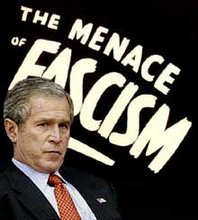


This article, written before Goodlings testimony, yesterday, describes an authoritarian follower-type person, who is easily led by the authority she worships, namely George W. Bush, and who will not hestitate to break laws for the authority.
They are crusading-crackpots and they pose a far greater danger to our nation and our constitution than al Qaeda could ever dream of posing.
We have seen this before in American government, but never to this degree.
The terrifying part is, there have been hundreds of people of Goodlings background (like Messiah College) hired into career positions in various government agencies.
Officials Describe Interference by Former Gonzales Aide
By Dan Eggen and Carol D. Leonnig
Washington Post Staff Writers
Wednesday, May 23, 2007; A04
When Jeffrey A. Taylor, interim U.S. attorney for the District of Columbia, wanted to hire a new career prosecutor last fall, he had to run the idea past Monica M. Goodling, then a 33-year-old aide to Attorney General Alberto R. Gonzales.
The candidate was Seth Adam Meinero, a Howard University law school graduate who had worked on civil rights cases at the Environmental Protection Agency and had served as a special assistant prosecutor in Taylor's office.
Goodling stalled the hiring, saying that Meinero was too "liberal" for the nonpolitical position, said according to two sources familiar with the dispute.
The tussle over Meinero, who was eventually hired at Taylor's insistence, led to a Justice Department investigation of whether Goodling improperly weighed political affiliation when reviewing applicants for rank-and-file prosecutor jobs, the sources said.
A 1999 graduate of Regent University law school in Virginia Beach with six months of prosecutorial experience, Goodling was among a small coterie of young aides to Gonzales who were remarkable for their inexperience and autonomy in deciding the fates of seasoned Justice Department lawyers, according to current and former officials who worked with the group.
She worked closely last year with D. Kyle Sampson, then the attorney general's chief of staff, sifting through lists of U.S. attorneys considered for removal, according to congressional interviews and Justice Department documents released to the public. Goodling also was central to the department's stumbling efforts to defend its handling of the firings of nine prosecutors, at times by attacking their reputations. She resigned in April.
Goodling is scheduled to testify today before the House Judiciary Committee about the firings, under an offer of immunity.
"All I ever wanted to do was serve this president, this administration, this department," Goodling tearfully told a senior Justice official shortly before she quit, according to a transcript of his interview released by the House committee last night.
Goodling's attorney, who has accused Democratic lawmakers of having already made up their minds about his client's role, did not return e-mail and telephone messages left at his office yesterday.
Goodling had been a divisive figure at the Justice Department since she arrived in early 2002, gaining a reputation for having a mercurial temperament and being prickly toward career employees, said numerous current and former officials who worked with her.
Goodling and Sampson "knew politics, not law," said Bruce Fein, a senior Justice official during the Reagan administration. "This extent [of] neophytes running the department is highly irregular."
Goodling started at Justice in a newly created position as senior counsel to the head of the public affairs office.
Nearly everyone who worked with her agreed that she was a tireless employee who often worked late into the night, and said she had deep loyalty to President Bush and his administration.
"She was very hardworking, she was dedicated, she was professional," said one former Justice official who worked closely with Goodling. "She is the type of person who is good at carrying out tasks. She was dependable."
In 2004, Goodling spent six months in the U.S. attorney's office for the Eastern District of Virginia, in a special program designed to give Justice employees and other government lawyers a chance to gain courtroom experience.
Reviews of her tenure there are mixed. Three current or former Justice officials said she quickly developed a reputation for having an antagonistic and sharply ideological style. Others said she carried out her responsibilities professionally.
Goodling's next stop was as deputy director of the Executive Office for U.S. Attorneys, which oversees the department's 93 chief prosecutors. In April 2006, she began working for Gonzales, who granted her and Sampson broad powers to make personnel choices and other major decisions, according to officials and documents.
E-mails and other documents show that Goodling, who was also Justice's liaison to the White House, played a central role in arranging for the appointment of Tim Griffin, a former Republican National Committee official and aide to presidential adviser Karl Rove, as the U.S. attorney in Little Rock.
Goodling also met last summer with two New Mexico Republicans who complained about then-U.S. Attorney David C. Iglesias, who was later fired. In another case, she single-handedly blocked the dismissal of a North Carolina prosecutor who for more than a year had been on the list of candidates to be fired.
The dispute with Taylor came last fall, when Taylor heard that Goodling was thwarting his effort to hire Meinero, sources said.
Taylor complained to Goodling directly, according to two sources who were told about the conversation, saying that a U.S. attorney's office hires all kinds of people. Taylor also complained to Sampson, who was a friend and eventually gave Taylor the authority to bypass Goodling.
Taylor mentioned the experience to U.S. Attorney Chuck Rosenberg of Alexandria, the sources said. After Rosenberg became Gonzales's temporary chief of staff following Sampson's resignation, he asked the department's inspector general to look into Taylor's allegations, they added.
Before she and Sampson resigned, Goodling wrote a series of memos summing up the longtime U.S. attorneys she helped to fire. She said that Iglesias was "in over his head," that Carol C. Lam of San Diego showed "a failure to perform" and that Arizona's Paul K. Charlton was guilty of "repeated instances of insubordination."
Yet Goodling's final list, assembled as "talking points" for Congress and the media, also noted that nearly every fired prosecutor had received stellar reviews from Justice Department evaluators.
Goodling's public troubles began in mid-March, when Sampson disclosed to Deputy Attorney General Paul J. McNulty and others that the plan to fire the U.S. attorneys had begun more than two years earlier in the White House, contrary to what McNulty and another official had testified to Congress.
He and Principal Associate Deputy Attorney General William E. Moschella were livid, believing that Goodling and Sampson had misled them during preparations for the testimony, according to new transcripts released yesterday by the House Judiciary Committee.
"They were dead to him," Justice official David Margolis said, referring to Moschella. "They had burned their bridges with him."
Margolis said that Goodling was "shaken to her core" by the controversy and that she sobbed for "30 to 45 minutes" during a meeting in his office shortly before she resigned.
"I knew she must think that everything was unraveling," he said. "And, you know, she was right about that."
Staff writers Amy Goldstein and Jerry Markon contributed to this report.
(In accordance with Title 17 U.S.C. Section 107, this material is distributed without profit to those who have expressed a prior interest in receiving the included information for research and educational purposes. I.U. has no affiliation whatsoever with the originator of this article nor is I.U endorsed or sponsored by the originator.)
The Nazis, Fascists and Communists were political parties before they became enemies of liberty and mass murderers.
Showing posts with label Authoratarianism. Show all posts
Showing posts with label Authoratarianism. Show all posts
Thursday, May 24, 2007


Tuesday, February 20, 2007
Can It Happen Here?
Well of course it can!
It is happening!
Serious, thoughtful people have been predicting that it would, for years.
"It's only a matter of time, " my own mother once said, some 40 years ago.
In an excerpt from his new book, Salon's columnist explains why, for the first time since the resignation of Richard M. Nixon, Americans have reason to doubt the future of their democracy.
By Joe Conason
Feb. 19, 2007 Can it happen here? Is it happening here already? That depends, as a recent president might have said, on what the meaning of "it" is.
To Sinclair Lewis, who sardonically titled his 1935 dystopian novel "It Can't Happen Here," "it" plainly meant an American version of the totalitarian dictatorships that had seized power in Germany and Italy. Married at the time to the pioneering reporter Dorothy Thompson, who had been expelled from Berlin by the Nazis a year earlier and quickly became one of America's most outspoken critics of fascism, Lewis was acutely aware of the domestic and foreign threats to American freedom. So often did he and Thompson discuss the crisis in Europe and the implications of Europe's fate for the Depression-wracked United States that, according to his biographer, Mark Schorer, Lewis referred to the entire topic somewhat contemptuously as "it."
If "it" denotes the police state American-style as imagined and satirized by Lewis, complete with concentration camps, martial law, and mass executions of strikers and other dissidents, then "it" hasn't happened here and isn't likely to happen anytime soon.
For contemporary Americans, however, "it" could signify our own more gradual and insidious turn toward authoritarian rule. That is why Lewis's darkly funny but grim fable of an authoritarian coup achieved through a democratic election still resonates today -- along with all the eerie parallels between what he imagined then and what we live with now.
For the first time since the resignation of Richard M. Nixon more than three decades ago, Americans have had reason to doubt the future of democracy and the rule of law in our own country. Today we live in a state of tension between the enjoyment of traditional freedoms, including the protections afforded to speech and person by the Bill of Rights, and the disturbing realization that those freedoms have been undermined and may be abrogated at any moment.
Such foreboding, which would have been dismissed as paranoia not so long ago, has been intensified by the unfolding crisis of political legitimacy in the capital. George W. Bush has repeatedly asserted and exercised authority that he does not possess under the Constitution he swore to uphold. He has announced that he intends to continue exercising power according to his claim of a mandate that erases the separation and balancing of power among the branches of government, frees him from any real obligation to obey laws passed by Congress, and permits him to ignore any provisions of the Bill of Rights that may prove inconvenient.
Whether his fellow Americans understand exactly what Bush is doing or not, his six years in office have created intense public anxiety. Much of that anxiety can be attributed to fear of terrorism, which Bush has exacerbated to suit his own purposes -- as well as to increasing concern that the world is threatened by global warming, pandemic diseases, economic insecurity, nuclear proliferation, and other perils with which this presidency cannot begin to cope.
As the midterm election showed, more and more Americans realize that something has gone far wrong at the highest levels of government and politics -- that Washington's one-party regime had created a daily spectacle of stunning incompetence and dishonesty. Pollsters have found large majorities of voters worrying that the country is on the wrong track. At this writing, two of every three voters give that answer, and they are not just anxious but furious. Almost half are willing to endorse the censure of the president.
Suspicion and alienation extend beyond the usual disgruntled Democrats to independents and even a significant minority of Republicans. A surprisingly large segment of the electorate is willing to contemplate the possibility of impeaching the president, unappetizing though that prospect should be to anyone who can recall the destructive impeachment of Bush's predecessor.
The reasons for popular disenchantment with the Republican regime are well known -- from the misbegotten, horrifically mismanaged war in Iraq to the heartless mishandling of the Hurricane Katrina disaster. In both instances, growing anger over the damage done to the national interest and the loss of life and treasure has been exacerbated by evidence of bad faith -- by lies, cronyism, and corruption.
Everyone knows -- although not everyone necessarily wishes to acknowledge -- that the Bush administration misled the American people about the true purposes and likely costs of invading Iraq. It invented a mortal threat to the nation in order to justify illegal aggression. It has repeatedly sought, from the beginning, to exploit the state of war for partisan advantage and presidential image management. It has wasted billions of dollars, and probably tens of billions, on Pentagon contractors with patronage connections to the Republican Party.
Everyone knows, too, that the administration dissembled about the events leading up to the destruction of New Orleans. Its negligence and obliviousness in the wake of the storm were shocking, as was its attempt to conceal its errors. It has yet to explain why a person with few discernible qualifications, other than his status as a crony and business associate of his predecessor, was directing the Federal Emergency Management Agency. By elevating ethically dubious, inexperienced, and ineffectual management the administration compromised a critical agency that had functioned brilliantly during the Clinton administration.
To date, however, we do not know the full dimensions of the scandals behind Iraq and Katrina, because the Republican leaders of the Senate and the House of Representatives abdicated the traditional congressional duties of oversight and investigation. It is due to their dereliction that neither the president nor any of his associates have seemed even mildly chastened in the wake of catastrophe. With a single party monopolizing power yet evading responsibility, there was nobody with the constitutional power to hold the White House accountable.
Bolstered by political impunity, especially in a time of war, perhaps any group of politicians would be tempted to abuse power. But this party and these politicians, unchecked by normal democratic constraints, proved to be particularly dangerous. The name for what is wrong with them -- the threat embedded within the Bush administration, the Republican congressional leadership, and the current leaders of the Republican Party -- is authoritarianism.
The most obvious symptoms can be observed in the regime's style, which features an almost casual contempt for democratic and lawful norms; an expanding appetite for executive control at the expense of constitutional balances; a reckless impulse to corrupt national institutions with partisan ideology; and an ugly tendency to smear dissent as disloyalty. The most troubling effects are matters of substance, including the suspension of traditional legal rights for certain citizens; the imposition of secrecy and the inhibition of the free flow of information; the extension of domestic spying without legal sanction or warrant; the promotion of torture and other barbaric practices, in defiance of American and international law; and the collusion of government and party with corporate interests and religious fundamentalists.
What worries many Americans even more is that the authoritarians can excuse their excesses as the necessary response to an enemy that every American knows to be real. For the past five years, the Republican leadership has argued that the attacks of September 11, 2001 -- and the continuing threat from jihadist groups such as al Qaeda -- demand permanent changes in American government, society, and foreign policy. Are those changes essential to preserve our survival -- or merely useful for unscrupulous politicians who still hope to achieve permanent domination by their own narrowly ideological party? Not only liberals and leftists, but centrists, libertarians, and conservatives, of every party and no party, have come to distrust the answers given by those in power.
The most salient dissent to be heard in recent years, and especially since Bush's reelection in 2004, has been voiced not by the liberals and moderates who never trusted the Republican leadership, but by conservatives who once did.
Former Republican congressman Bob Barr of Georgia, who served as one of the managers of the impeachment of Bill Clinton in the House of Representatives, has joined the American Civil Liberties Union he once detested. In the measures taken by the Bush administration and approved by his former colleagues, Barr sees the potential for "a totalitarian type regime." Paul Craig Roberts, a longtime contributor to the Wall Street Journal and a former Treasury official under Reagan, perceives the "main components of a police state" in the Bush administration's declaration of plenary powers to deny fundamental rights to suspected terrorists. Bruce Fein, who served as associate attorney general in the Reagan Justice Department, believes that the Bush White House is "a clear and present danger to the rule of law," and that the president "cannot be trusted to conduct the war against global terrorism with a decent respect for civil liberties and checks against executive abuses." Syndicated columnist George Will accuses the administration of pursuing a "monarchical doctrine" in its assertion of extraordinary war powers.
In the 2006 midterm election, disenchanted conservatives joined with liberals and centrists to deliver a stinging rebuke to the regime by overturning Republican domination in both houses of Congress. For the first time since 1994, Democrats control the Senate and the House of Representatives. But the Democratic majority in the upper chamber is as narrow as possible, depending on the whims of Joseph Lieberman of Connecticut, a Republican-leaning Democrat elected on an independent ballot line, who has supported the White House on the occupation of Iraq, abuse of prisoners of war, domestic spying, the suspension of habeas corpus, military tribunals, far-right judicial nominations, and other critical constitutional issues. Nor is Lieberman alone among the Senate Democrats in his supine acquiescence to the abuses of the White House.
Even if the Democrats had won a stronger majority in the Senate, it would be naive to expect that a single election victory could mend the damage inflicted on America's constitutional fabric during the past six years. While the Bush administration has enjoyed an extraordinary immunity from Congressional oversight until now, the deepest implication of its actions and statements, as explored in the pages that follow, is that neither legislators nor courts can thwart the will of the unitary executive. When Congress challenges that presidential claim, as inevitably it will, then what seems almost certain to follow is not "bipartisanship" but confrontation. The election of 2006 was not an end but another beginning.
The question that we face in the era of terror alerts, religious fundamentalism, and endless warfare is whether we are still the brave nation preserved and rebuilt by the generation of Sinclair Lewis -- or whether our courage, and our luck, have finally run out. America is not yet on the verge of fascism, but democracy is again in danger. The striking resemblance between Buzz Windrip [the demagogic villain of Lewis's novel] and George W. Bush and the similarity of the political forces behind them is more than a literary curiosity. It is a warning on yellowed pages from those to whom we owe everything.
From "It Can Happen Here" by Joe Conason. Copyright (c) 2007 by the author and reprinted by permission of Thomas Dunne Books, an imprint of St. Martin's Press.
-- By Joe Conason
(In accordance with Title 17 U.S.C. Section 107, this material is distributed without profit to those who have expressed a prior interest in receiving the included information for research and educational purposes. I.U. has no affiliation whatsoever with the originator of this article nor is I.U endorsed or sponsored by the originator.)
The Nazis, Fascists and Communists were political parties before they became enemies of liberty and mass murderers.
It is happening!
Serious, thoughtful people have been predicting that it would, for years.
"It's only a matter of time, " my own mother once said, some 40 years ago.
In an excerpt from his new book, Salon's columnist explains why, for the first time since the resignation of Richard M. Nixon, Americans have reason to doubt the future of their democracy.
By Joe Conason
Feb. 19, 2007 Can it happen here? Is it happening here already? That depends, as a recent president might have said, on what the meaning of "it" is.
To Sinclair Lewis, who sardonically titled his 1935 dystopian novel "It Can't Happen Here," "it" plainly meant an American version of the totalitarian dictatorships that had seized power in Germany and Italy. Married at the time to the pioneering reporter Dorothy Thompson, who had been expelled from Berlin by the Nazis a year earlier and quickly became one of America's most outspoken critics of fascism, Lewis was acutely aware of the domestic and foreign threats to American freedom. So often did he and Thompson discuss the crisis in Europe and the implications of Europe's fate for the Depression-wracked United States that, according to his biographer, Mark Schorer, Lewis referred to the entire topic somewhat contemptuously as "it."
If "it" denotes the police state American-style as imagined and satirized by Lewis, complete with concentration camps, martial law, and mass executions of strikers and other dissidents, then "it" hasn't happened here and isn't likely to happen anytime soon.
For contemporary Americans, however, "it" could signify our own more gradual and insidious turn toward authoritarian rule. That is why Lewis's darkly funny but grim fable of an authoritarian coup achieved through a democratic election still resonates today -- along with all the eerie parallels between what he imagined then and what we live with now.
For the first time since the resignation of Richard M. Nixon more than three decades ago, Americans have had reason to doubt the future of democracy and the rule of law in our own country. Today we live in a state of tension between the enjoyment of traditional freedoms, including the protections afforded to speech and person by the Bill of Rights, and the disturbing realization that those freedoms have been undermined and may be abrogated at any moment.
Such foreboding, which would have been dismissed as paranoia not so long ago, has been intensified by the unfolding crisis of political legitimacy in the capital. George W. Bush has repeatedly asserted and exercised authority that he does not possess under the Constitution he swore to uphold. He has announced that he intends to continue exercising power according to his claim of a mandate that erases the separation and balancing of power among the branches of government, frees him from any real obligation to obey laws passed by Congress, and permits him to ignore any provisions of the Bill of Rights that may prove inconvenient.
Whether his fellow Americans understand exactly what Bush is doing or not, his six years in office have created intense public anxiety. Much of that anxiety can be attributed to fear of terrorism, which Bush has exacerbated to suit his own purposes -- as well as to increasing concern that the world is threatened by global warming, pandemic diseases, economic insecurity, nuclear proliferation, and other perils with which this presidency cannot begin to cope.
As the midterm election showed, more and more Americans realize that something has gone far wrong at the highest levels of government and politics -- that Washington's one-party regime had created a daily spectacle of stunning incompetence and dishonesty. Pollsters have found large majorities of voters worrying that the country is on the wrong track. At this writing, two of every three voters give that answer, and they are not just anxious but furious. Almost half are willing to endorse the censure of the president.
Suspicion and alienation extend beyond the usual disgruntled Democrats to independents and even a significant minority of Republicans. A surprisingly large segment of the electorate is willing to contemplate the possibility of impeaching the president, unappetizing though that prospect should be to anyone who can recall the destructive impeachment of Bush's predecessor.
The reasons for popular disenchantment with the Republican regime are well known -- from the misbegotten, horrifically mismanaged war in Iraq to the heartless mishandling of the Hurricane Katrina disaster. In both instances, growing anger over the damage done to the national interest and the loss of life and treasure has been exacerbated by evidence of bad faith -- by lies, cronyism, and corruption.
Everyone knows -- although not everyone necessarily wishes to acknowledge -- that the Bush administration misled the American people about the true purposes and likely costs of invading Iraq. It invented a mortal threat to the nation in order to justify illegal aggression. It has repeatedly sought, from the beginning, to exploit the state of war for partisan advantage and presidential image management. It has wasted billions of dollars, and probably tens of billions, on Pentagon contractors with patronage connections to the Republican Party.
Everyone knows, too, that the administration dissembled about the events leading up to the destruction of New Orleans. Its negligence and obliviousness in the wake of the storm were shocking, as was its attempt to conceal its errors. It has yet to explain why a person with few discernible qualifications, other than his status as a crony and business associate of his predecessor, was directing the Federal Emergency Management Agency. By elevating ethically dubious, inexperienced, and ineffectual management the administration compromised a critical agency that had functioned brilliantly during the Clinton administration.
To date, however, we do not know the full dimensions of the scandals behind Iraq and Katrina, because the Republican leaders of the Senate and the House of Representatives abdicated the traditional congressional duties of oversight and investigation. It is due to their dereliction that neither the president nor any of his associates have seemed even mildly chastened in the wake of catastrophe. With a single party monopolizing power yet evading responsibility, there was nobody with the constitutional power to hold the White House accountable.
Bolstered by political impunity, especially in a time of war, perhaps any group of politicians would be tempted to abuse power. But this party and these politicians, unchecked by normal democratic constraints, proved to be particularly dangerous. The name for what is wrong with them -- the threat embedded within the Bush administration, the Republican congressional leadership, and the current leaders of the Republican Party -- is authoritarianism.
The most obvious symptoms can be observed in the regime's style, which features an almost casual contempt for democratic and lawful norms; an expanding appetite for executive control at the expense of constitutional balances; a reckless impulse to corrupt national institutions with partisan ideology; and an ugly tendency to smear dissent as disloyalty. The most troubling effects are matters of substance, including the suspension of traditional legal rights for certain citizens; the imposition of secrecy and the inhibition of the free flow of information; the extension of domestic spying without legal sanction or warrant; the promotion of torture and other barbaric practices, in defiance of American and international law; and the collusion of government and party with corporate interests and religious fundamentalists.
What worries many Americans even more is that the authoritarians can excuse their excesses as the necessary response to an enemy that every American knows to be real. For the past five years, the Republican leadership has argued that the attacks of September 11, 2001 -- and the continuing threat from jihadist groups such as al Qaeda -- demand permanent changes in American government, society, and foreign policy. Are those changes essential to preserve our survival -- or merely useful for unscrupulous politicians who still hope to achieve permanent domination by their own narrowly ideological party? Not only liberals and leftists, but centrists, libertarians, and conservatives, of every party and no party, have come to distrust the answers given by those in power.
The most salient dissent to be heard in recent years, and especially since Bush's reelection in 2004, has been voiced not by the liberals and moderates who never trusted the Republican leadership, but by conservatives who once did.
Former Republican congressman Bob Barr of Georgia, who served as one of the managers of the impeachment of Bill Clinton in the House of Representatives, has joined the American Civil Liberties Union he once detested. In the measures taken by the Bush administration and approved by his former colleagues, Barr sees the potential for "a totalitarian type regime." Paul Craig Roberts, a longtime contributor to the Wall Street Journal and a former Treasury official under Reagan, perceives the "main components of a police state" in the Bush administration's declaration of plenary powers to deny fundamental rights to suspected terrorists. Bruce Fein, who served as associate attorney general in the Reagan Justice Department, believes that the Bush White House is "a clear and present danger to the rule of law," and that the president "cannot be trusted to conduct the war against global terrorism with a decent respect for civil liberties and checks against executive abuses." Syndicated columnist George Will accuses the administration of pursuing a "monarchical doctrine" in its assertion of extraordinary war powers.
In the 2006 midterm election, disenchanted conservatives joined with liberals and centrists to deliver a stinging rebuke to the regime by overturning Republican domination in both houses of Congress. For the first time since 1994, Democrats control the Senate and the House of Representatives. But the Democratic majority in the upper chamber is as narrow as possible, depending on the whims of Joseph Lieberman of Connecticut, a Republican-leaning Democrat elected on an independent ballot line, who has supported the White House on the occupation of Iraq, abuse of prisoners of war, domestic spying, the suspension of habeas corpus, military tribunals, far-right judicial nominations, and other critical constitutional issues. Nor is Lieberman alone among the Senate Democrats in his supine acquiescence to the abuses of the White House.
Even if the Democrats had won a stronger majority in the Senate, it would be naive to expect that a single election victory could mend the damage inflicted on America's constitutional fabric during the past six years. While the Bush administration has enjoyed an extraordinary immunity from Congressional oversight until now, the deepest implication of its actions and statements, as explored in the pages that follow, is that neither legislators nor courts can thwart the will of the unitary executive. When Congress challenges that presidential claim, as inevitably it will, then what seems almost certain to follow is not "bipartisanship" but confrontation. The election of 2006 was not an end but another beginning.
The question that we face in the era of terror alerts, religious fundamentalism, and endless warfare is whether we are still the brave nation preserved and rebuilt by the generation of Sinclair Lewis -- or whether our courage, and our luck, have finally run out. America is not yet on the verge of fascism, but democracy is again in danger. The striking resemblance between Buzz Windrip [the demagogic villain of Lewis's novel] and George W. Bush and the similarity of the political forces behind them is more than a literary curiosity. It is a warning on yellowed pages from those to whom we owe everything.
From "It Can Happen Here" by Joe Conason. Copyright (c) 2007 by the author and reprinted by permission of Thomas Dunne Books, an imprint of St. Martin's Press.
-- By Joe Conason
(In accordance with Title 17 U.S.C. Section 107, this material is distributed without profit to those who have expressed a prior interest in receiving the included information for research and educational purposes. I.U. has no affiliation whatsoever with the originator of this article nor is I.U endorsed or sponsored by the originator.)
The Nazis, Fascists and Communists were political parties before they became enemies of liberty and mass murderers.
Subscribe to:
Posts (Atom)