Showing posts with label American Liberalism. Show all posts

Sunday, August 24, 2008

Liberal Thinking Increases In Popularity

One issue not mentioned here, in this article, is the religious right, as a factor in why America may well be moving left. What we've seen, in the last 7 years, at least, is that people have finally seen behind that curtain, and they don't like what they see. There is a movement out there to return to separation of Church and state.


DENVER — As they meet for their national convention Monday through Thursday, Democrats are poised to shift their party's course — and the country's.


They're turning to the left — deeply against the war in Iraq, ready to use tax policy to take from the rich and give to the poor and middle class, and growing hungry, after years of centrist politics, for big-government solutions, such as a health-care overhaul, to steer the nation through a time of sweeping economic change.


They are, in short, more liberal than at any time in a generation and eager to end the Reagan era, which dominated not just the other party, but also their own, for nearly three decades.


"Every generation . . . there are changes in people's relationship with government," said Sen. Charles Schumer, D-N.Y. This, he said, is such a time.


The shift of the party also reflects a change in much of the population — evidenced in the policy positions advocated by rank-and-file voters as well as the party's presumptive presidential nominee, Sen. Barack Obama of Illinois.


"Government SHOULD do more, especially when you're spending tens of billions of dollars in Iraq protecting the interests of millionaires," said Rebecca Washington, a Democrat and an accountant from Cleveland Heights, Ohio.


"We've got to revoke the tax cuts for the wealthy," said Vicki Balzer, a Democrat and retired teacher from the Cleveland suburb of Berea. "We definitely need to do something more for the economically disadvantaged. . . . We've allowed big corporations to take millions for corporate leaders while workers get nothing."


Nationally, 40 percent of Democrats in the 2006 midterm elections called themselves liberal, the highest since the American National Election Studies program started asking in 1972.


At the same time, the number of Democrats who support a government safety net for the poor — such as guaranteeing food and shelter for the needy and spending to help them even if it means more debt — jumped by 14 percentage points from 1994 to 2007, according to the Pew Research Center.


Support for that safety net also rose by 15 points among independents and 9 points among Republicans.


That's a remarkable change since the mid-'90s, the decade when centrist Bill Clinton dominated the Democratic Party, signed a welfare overhaul into law that forced recipients to work, expanded free trade against the wishes of organized labor and famously declared the era of big government to be over.


"During the era when Bill Clinton was president, there was a clear re-centering of the party," said Democratic Gov. Kathleen Sebelius of Kansas.


Today, she added, "there is a growing understanding that government can play a positive role in investing in our country."


What changed? Several things.


The Iraq war lasted longer, cost more lives and money, and proved deeply unpopular. A few years ago, Obama was a rare voice in the party opposing the war; today he's one of a chorus.


Anxiety about a slowing economy resurrected fears about American jobs and paychecks in the global economy. Promises to change trade deals such as the North American Free Trade Agreement punctuated the Democratic primaries.


Also, Obama promises a dramatically different tax policy, one that would raise taxes on the wealthy, cut taxes for the middle class and offer new "refundable" tax credits to the working poor that would wipe out tax liabilities and deliver anything left over in the form of checks.


He also wants to tax oil companies and use the money to give checks to the poor to pay for high fuel costs, or anything else.


Many Americans recoiled at the weak federal government response to Hurricane Katrina in 2005.


Republican George W. Bush turned into one of the most unpopular presidents in modern history. Just as American revulsion at Democrat Jimmy Carter in 1980 helped usher in the Reagan era, rejection of the Bush era could help swing the pendulum the other way.


At the same time, the party has new power centers in liberal groups such as Moveon.org and blogs such as dailykos.com, where antiwar fever and anti-Bush anger are magnified.


They helped propel Howard Dean to an early lead for the 2004 Democratic nomination, lost, then regrouped to help defeat pro-war Democratic Sen. Joseph Lieberman of Connecticut in a 2006 primary, though he went on to win re-election as an independent.


"Enormous dissatisfaction with the Republican Party has brought out the base more," said Democratic Gov. Bill Richardson of New Mexico.


Ever more vocal and influential heading into this year's election, that base fed the sense that the party should "return to its core values," Richardson said. "The rise of the Internet and bloggers have made the party more progressive."


Schumer also thinks that it's all part of a historic cycle in American politics — or at least he hopes it is.


He said Americans encouraged and grew accustomed to an activist federal government during the Great Depression of the 1930s, one that Democrat Franklin Roosevelt delivered and Democrat Lyndon Johnson accelerated in the 1960s.


They grew disenchanted with that big government by the 1970s, a government seen as corrupt in the Nixon days, unable to stop oil crises or runaway inflation, and unable to rescue Americans whom Iran had taken hostage.


"By 1980, the average person said, 'I don't need government anymore. I'm fine on my own,' " Schumer said.


That sentiment drove U.S. politics for years, helping Republicans win five out of seven presidential elections and giving the Democrats two victories only when they nominated a Southern centrist in Clinton.


This year, however, Democrats rejected Hillary Clinton, who, while arguably more liberal than her husband, was to the right of Obama on big issues such as tax policy and had a history of being more hawkish on national security.


Perhaps it's because Obama was simply a more appealing candidate. But it also might be because times are changing.


Now, Schumer said, Americans feel shaken by big forces such as globalization, terrorism and a sputtering economy. "The whole world changes, and people feel a little bit at sea, and they need help," Schumer said.


Whether the country will turn to a resurgent-liberal Democratic Party to navigate that less-certain world won't be known until November. But for Democrats watching their national convention, it's clear they want something very different.


(In accordance with Title 17 U.S.C. Section 107, this material is distributed without profit to those who have expressed a prior interest in receiving the included information for research and educational purposes. I.U. has no affiliation whatsoever with the originator of this article nor is I.U endorsed or sponsored by the originator.)


The Nazis, Fascists and Communists were political parties before they became enemies of liberty and mass murderers.


Wednesday, March 19, 2008

American Liberalism

From the Publisher of "Why We're Liberals":

The bestselling author demolishes myths about liberalism in a spirited polemic

Thanks to the machinations of the right, there is no dirtier word in American politics today than “liberal”—yet public opinion polls consistently show that the majority of Americans hold liberal views on everything from health care to foreign policy. In this feisty, accessible primer, bestselling author Eric Alterman sets out to restore liberalism to its rightful honored place in our political life as the politics of America’s everyday citizens.

In Why We’re Liberals Alterman examines liberalism’s development and demonstrates how its partisans have come to represent not just the mainstream, but also the majority of Americans today. In a crisply argued though extensively documented counterattack on right-wing spin and misinformation, Alterman briskly disposes of such canards as “Liberals Hate God” and “Liberals Are Soft on Terrorism,” reclaiming liberalism from the false definitions foisted upon it by the right and repeated everywhere else. Why We’re Liberals brings clarity and perspective to what has often been a one-sided debate for nothing less than the heart and soul of America. Why We’re Liberals is the perfect election-year book for all of those ready to fight back against the conservative mud-slinging machine and claim their voice in the political debate.

If truth be told, by the time this administration is over, the most despised word in American politics will be neoconservative. We certainly intend to help make it so.

About Eric Alterman:

Eric Alterman, media columnist for the Nation, is professor of English at Brooklyn College of the City University of New York, senior fellow of the Center for American Progress, and “Altercation” weblogger for MSNBC.com. He is the author of five previous books, including The Book on Bush (with Mark Green), What Liberal Media? and Sound and Fury.

Eric blogs at Altercation.


If anyone is interested in buying a copy of Alerman's book, please help BuzzFlash by adding "Why We're Liberals: A Political Handbook for Post-Bush America (Hardcover)" to your shopping cart (buzzflash.com). These folks do a good job of news hunting and gathering.


(In accordance with Title 17 U.S.C. Section 107, this material is distributed without profit to those who have expressed a prior interest in receiving the included information for research and educational purposes. I.U. has no affiliation whatsoever with the originator of this article nor is I.U endorsed or sponsored by the originator.)


The Nazis, Fascists and Communists were political parties before they became enemies of liberty and mass murderers.
Monday, December 3, 2007

"Conservative" and "Liberal" Have No Meaning Anymore


Why the GOP lies about the economy

By The Existentialist Cowboy

The United States has never been so polarized and never has the polarization made less sense. Never has it been more virulent. But --what if I were to tell you that Ronald Reagan was the biggest spending liberal of them all and John Maynard Keynes --reviled by Reagan-heads --was a conservative? What if I told you that Ronald Reagan failed when he actually did what he said he would do and succeeded when he did what he said he wouldn't?

"Whore House" politics debases the language to facilitate their lies. They lie in order to cover up the the cloaked pay off. What passes for debate is irrational and needlessly vehement. It's all a smokescreen. The terms "liberal" and "conservative", for example, are all but meaningless in the world apres-Bush. The meaning of both terms are entirely different now than in the 19th Century, in fact, both terms are used differently in Europe than in the US.

For example, British economist John Maynard Keynes is habitually scorned by right-wingers. Not surprisingly, his brand of economics is called "liberal" if his name comes up at all. I daresay --most conservatives have probably never heard of him. Of those who ave heard his name, few understand him. Yet, Keynes took issue with Karl Marx on a key point: "I don't want a social revolution". Keynes, however, called poverty a "...dysfunctional threat" to a capitalist system which he favored.

I call favoring capitalism, "conservative". Nevertheless, that Keynes denounced "poverty" is enough to earn the enmity of modern conservatives who obviously like the feelings of superiority they experience when millions of others are without jobs and scrambling to feed themselves or, as Bush put it, to "...put food on your families".

It is Keynes' use of the phrase "...extending the traditional functions of government" that inspires conservatives to cross themselves and wear garlic. It was by "extending" those traditional functions that Keynes believed unemployment could be eliminated. This is, of course, anathema to laissez-faire throwbacks like Ron Paul whose economic thinking is stuck in the 19th Century.

The same conservatives are not bothered by "extensions of government" effected by Reagan, Bush Sr., and now the Shrub. Ronald Reagan's program would have been thought "liberal" had the same program been advocated by a Democrat. Just as it is believed "Only Nixon could go to China", it is apparently believed that only a conservative can espouse a "liberal" agenda and get away with it.

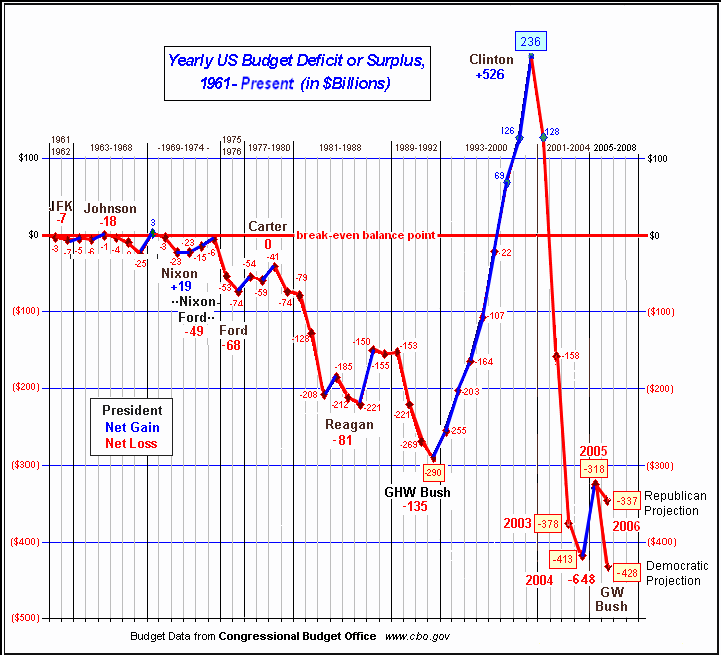
Hypocrisy is expedient. Until Bush Jr, Ronald Reagan was our biggest spending liberal. He tripled the national debt, ran up historically high deficits, and doubled the size of the Federal Bureaucracy. None of it worked as planned because none of it benefited working Americans. Reagan had in mind "extending the traditional functions of government" but only in order to benefit the wealthy and the corporate. It is only when "extending the traditional functions of government" benefits the middle or poorer classes that "conservatives" object to "liberal" policies. "Conservatives" love welfare when it benefits elites who don't need it.

Some history may illustrate the point: the Wall Street crash of 1929 was followed by a severe world wide depression acutely felt in the U.S., Germany, France, and to a lesser degree --Great Britain and Sweden. Nevertheless, unemployment was high in Sweden when that nation returned a Labor government committed to a program of public investment to address the high unemployment problem. It worked. By 1935 real output in Sweden was 7 percent above its 1929 level. Unemployment was reduced and the finance minister was said to have been happy to suffer another budget deficit to stimulate the economy.

To be fair, the US also spent itself out of the Great Depression. The differences are that it occurred much later, and then it was due to the massive military spending necessary to wage World War II. The US has been addicted to war ever since. Spending in Sweden tended to benefit not merely the rich elites but, rather, the population as a whole. The US "experiment" benefited but a few monied defense contractors and birthed the egg from which a Military/Industrial complex would hatch.

Ronald Reagan's budget deficit did not have as happy a result as those achieved peacebly in Sweden. Reagan's spending should have resulted in comparable widespread, near universal prosperity. But because it was a payoff instead of a program, his tax cut of 1982 was quickly followed by the nation's worst recession since the Great Depression, a recession of some 18 months characterized by record levels of unemployment, home losses, the newly poor sleeping under bridges and overpasses. For having been screwed by "Unca" Ronnie, the recent poor were called "crazy" by Reagan and his GOP disciples.

The explanation is simple and may be found in the writings of Reagan's budget director, David Stockman who blamed a "noisy faction of Republicans" for Reagan's infamous tax cut. Reagan might have achieved the prosperity that Keynes had predicted had his policies not been designed to reward only the filthy rich elite, in other words, his base. It was said that his tax cut would stimulate new investment and create new jobs --the vehicle by which the increased wealth would trickle down! It all sounds good in theory. The mountain of stats at the Bureau of Labor Statistics, BEA, and elsewhere clearly prove that the wealth never trickled down: the rich did not re-invest the tax cuts. There were no new jobs.

One wonders why Reagan didn't just cut out the middle man. A more equitable tax might have put more spendable income directly into the hands of consumers. Spent money circulates and drives an economy. That consumers spend money seems to be a fact lost on the likes of Reagan, Bush, and the nation's rich and callous elites.

Surely, there were knowledgeable advisers in Reagan's regime who knew better. The tax cut, therefore, was entirely political, a pay off to the rich for their support. Nothing has changed in the GOP. The Bush administration has made several such "payoffs" during his catastrophic and criminal regime.

(In accordance with Title 17 U.S.C. Section 107, this material is distributed without profit to those who have expressed a prior interest in receiving the included information for research and educational purposes. I.U. has no affiliation whatsoever with the originator of this article nor is I.U endorsed or sponsored by the originator.)


The Nazis, Fascists and Communists were political parties before they became enemies of liberty and mass murderers.

Monday, February 19, 2007

A Liberal Resurgence in America?

WASHINGTON: These are balmy days on the American left — genuine, uncharacteristic sunniness unpolluted by some fluky political climate change. There is even talk of a — stutter, clear-throat, perish- thought — liberal resurgence.

Or, treading gingerly, a "liberal moment."

"Hell, ya, this is a liberal moment," exults Thomas Frank, author of "What's the Matter With Kansas?" — and yes, he even calls himself a "liberal" writer, eschewing the sleeker "progressive" stage name that many lefties are preferring these days. He declares this "liberal moment" loud and proud. Until the inevitable qualifier comes.

"A potentially liberal moment," Mr. Frank says, "assuming that liberal politicians can seize the moment and get beyond their usual plague of incompetence."

Oh, snap. Liberal optimism, thy name is caution and caveat.

But it is optimism nonetheless, and well-founded, too, say Mr. Frank and a broad spectrum of political thinkers and leaders. And, they say, the evidence goes beyond the obvious indicators — the ascendance of Democrats in the House and Senate, President Bush's second-term belly-flop and poll numbers showing the Democratic Party trending left and the nation's political center trending Democratic.

The chicken-egg riddle is how much this alleged "liberal moment" bespeaks genuine momentum for the left and how much stems from anti-Bush, antiwar, anti-Republican fervor.

In other words, liberal moment or conservative slump?

The Bush administration has shown the world the ugly face of American Conservatism (neo-conservatism, in particular), with its hellish imperial visions and corporte greed. Goldwater conservatism is all but a memory; like conservatives with a conscious. The conservative movement in America is a movement of authoritarian, fasism, and more and more people are seeing it.

Both, presumably, for reasons that could be explained in part by the "mommy party/daddy party" cliché — that is, that voters typically favor Democrats ("mommy party") on social issues and Republicans ("daddy party") on national security.

"At the moment, daddy seems to have messed up the war in Iraq," says Rich Lowry, editor of the conservative National Review magazine, "so people are much more willing to listen to mommy, which helps Democrats."

Or, could it be, as we independents hope, that Americans have grown up and no longer need an over-protective, smothering mommy or a bully-on-the-block, sociopathic daddy?

But beyond the time-worn parental paradigm, it's clear that issues once largely walled off to the liberal hinterlands have suddenly gained mainstream acceptance and urgency. "There does seem to be momentum around a set of issues that have traditionally been the property of the left," says David M. Kennedy, the Stanford University historian.

Presidential candidates, for instance, can now safely utter "universal health care" without being tarred as supporters of "socialized medicine." Polls show increasing support for raising the minimum wage, stem-cell research, gay and lesbian civil unions, alternative-energy initiatives and increased financial aid to offset the escalating cost of college.

Could be that the usual Rethug scare tactics just aren't working anymore. A gang of thugs can only use fear for so long, then the people will turn on them with a vengeance.

Republicans can no longer blockade the cause of global warming to the wild- haired left. Once derided as "Ozone Man" by the former President Bush, Al Gore is now up for a Nobel Peace Prize and an Oscar (while California's non- Oscar-nominated Republican governor, Arnold Schwarzenegger, has been hailed as an environmental action hero for introducing stringent emissions standards).

Representative Barney Frank, Democrat of Massachusetts, posits that President Bush's abortive attempt in 2005 to privatize the New Deal totem of Social Security helped usher in what he agrees is "a liberal moment."

After the 2004 election, "there was reason to think we were in the midst of a conservative moment," said Mr. Frank (no relation to Thomas Frank). He recalls that there was concern, at first, that Mr. Bush — stout from his re-election — would win the support of young voters and prevail easily on Social Security.

But the foray "flopped totally," Mr. Frank said, and it became a "powerful affirmation of the public sector."

A few months later, Mr. Frank says, the Terri Schiavo case repudiated what he calls "the Republican moral agenda" and became a seminal event in the dawning of a "liberal moment."

"Republicans thought this was a great issue for them," Mr. Frank remembers. But then, all of a sudden, he said, "people realized that 'Hey, those guys are trying to come into my life.' "

Just goes to show how deluded they became!

A Gallup survey last month found that Democrats led Republicans by 34 percent to 31 percent in party affiliation — the largest Democratic advantage since the Clinton administration (34 percent of respondents identified themselves as independents).

By the same token, voters aged 18 to 25 are far more Democratic than previous generations, according to a 2006 survey by Pew Research. And the ratio of Democratic voters who describe themselves as "liberal Democrats" (32 percent) has risen steadily while the share of "conservative Democrats" has dropped (23 percent). Four years earlier, 27 percent of Democrats identified as conservatives, 26 percent as liberals.

The right is seen as divided, demoralized and possibly saddled with a top duo of Republican presidential candidates — John McCain and Rudy Giuliani — who could be unnervingly palatable to moderates and even liberals on certain issues (climate change and campaign finance for Mr. McCain; abortion and gay rights for Mr. Giuliani). A third, Mitt Romney, was just four years ago elected governor of a state — Massachusetts — that many Republicans regard as the political equivalent of a Superfund site.

1 2 Next Page


(In accordance with Title 17 U.S.C. Section 107, this material is distributed without profit to those who have expressed a prior interest in receiving the included information for research and educational purposes. I.U. has no affiliation whatsoever with the originator of this article nor is I.U endorsed or sponsored by the originator.)

The Nazis, Fascists and Communists were political parties before they became enemies of liberty and mass murderers.